
The Last Saint – An interview with author J.R. Cooper

BooksGoSocial

Today we are chatting with J.R. Cooper the author of The Last Saint.


Tell us something unexpected about yourself?

My artistic endeavors began with music. I was a front man for a rock band for 10 years. We tried to get signed, make a career of it, and were very good, but never quite made it far enough to reach a critical mass. As things do, that part of my life faded away, and took my artistic outlet with it. That loss of creativity left a vacuum, a need to create something. Instead of songs, I began writing stories, which of course led to my writing of The Last Saint.


What novels affected you the most growing up?

I was always a great fan of big adventure stories. 20,000 Leagues Under the Sea, The Hatchet, Treasure Island, The Count of Monte Cristo. These were epic tales to me, that spanned far off worlds and the gravest circumstances. There was courage, and tenacity, and within them I found the romance of living outside of safety, was taught the danger of freedom, but also what awaits those who face there fear. I dreamed of one day being as bold as the characters in those books.


Where did the idea for your current book come from?

After years of studying and teaching apologetics, and Creation vs Evolution, and after the aforementioned band break up, there was a perfect storm of knowledge and the need to create. In Christian Fiction, post-rapture stories were popular, but there wasn’t much about the events leading up to the end, and I had my own ideas about how that would look. Early on I wanted a strong female character, someone who was empowered, and yet challenged by the danger and chaos she was perceiving all around her. The events had to take me on a journey like those novels of old, but they had to also be true to Christian doctrines. Often we have seen Christians portrayed as horrible people in literature and in film. I wanted to paint a truer vision of what reasonable, loving Christianity was, rather than this skewed Hollywood version of faith.


Do you think there’s any way you could ever run out of ideas for books?

Sure, I suppose the well of ideas can dry up from time to time. It isn’t something to be scared of though. I think ideas come from experience, and love, and emotion. In the band, it was always harder writing songs when life was content. The three basic conflicts, right? Man vs Man, Man Vs Nature, and Man vs Self. If there isn’t a premise for conflict, something you can latch on to that is salty enough, intense enough, if a writer struggles with contentment, then it is possible he/she would have to wait for that conflict to arise organically so that there is passion behind the idea. Sure, and idea can be forced, but that isn’t art. That’s fulfilling a contract.


What is your routine for writing and has this method changed over the span of your career?

I wrote my novel the same way I wrote lyrics to my songs. I would concentrate on an emotion or a setting, and then crank up the intensity. I would approach it manic, reveling in the emotions of a character in order to decide dialect and direction. After that, and the basic conflict was decided, I simply experiment forward, feel out how to get from one circumstance to the next. Most important thing for me is to take copious notes. I always have an alternate outline/notes page up, and if I get an idea, I bullet point it, so I can make sure it makes it into the story. A good plot is wonderful, but if you add in the details that render nice full characters, and have tied up loose ends that even your reader has forgotten about, it makes, in my opinion, for a much more satisfying journey.

How important is marketing and social media for you?

I have to say, I am embracing it. I understand why, in this day and age, it is so important. I have a lot to learn, and I, like most writers I’m sure, would rather gain kudos from the trade craft itself. But the truth is, it is simply another part of the writer’s journey, and not without its own reward. Relationships and dialogue with fans can be developed, and other opportunities to network with guilds, promoters, business people, and the like can be discovered, where as without social media, opportunities would have stayed unrealized. Plus, for me personally, I have a publishing company who has put there faith in me, and I owe it to them to market my book as well. It’s about doing honor to the blessings you’ve been given.


What advice would you have for other writers?

I don’t think at this point I am qualified to give advice to other writers. There is much I still have to refine. But I will say that there is a world full of joylessness out there. A world full of the anonymous negative, who hate that they have not risked, or that they have never tried, because they think if it doesn’t work out, if the world doesn’t make them ‘go viral’, it is tantamount to being nothing. Those people will attack, they will use the anonymity of the web, or the distance between your effort and theirs to berate and slander and cut down who you are. And I understand that not everyone has the self-confidence to face such a world. That doesn’t mean there is something wrong with you. But, as a man who has written songs I feared people would hate, and stepped on stage to sing when I knew that I wasn’t one of the vocally blessed, and written a novel half convinced I wasn’t qualified to write, I will say that following through is an awakening of self-discovery. Each show, or story, both the good and bad, has forced me to reflect upon my path, and honestly assess who I am and where my power lies to affect others for the better.

I would encourage you all to try and push the boundaries of those passions you love, those things you spend hours doing, perfecting, and to then put that love into the world. The world will never get better by taking from it, only by giving to it, and you all have something unique to give. Let it fly, and do your best to not just hear the negative joyless, but look beyond to the courage you have to love the world in a way only you could.


What are you reading now?

Right now my studies continue, and I am reading along with my Bible, Frank Turek’s “Stealing From God: Why Atheists Need God to Make Their Case.” And Gary Bates. “Alien Intrusion.” And for pleasure, I am re-reading my childhood favorite, The Count of Monte Cristo by Alexandre Dumas, but the unabridged version this time, which is adding an element to it that I must say has me positively excited.


What’s your next step?

We have pulled the trigger on releasing my novel, The Last Saint, and I will divide my time between marketing it, and finishing the first draft of my second novel, which I hope to have out in 2017. I find the premise to be extremely exciting, but it is a much different tone than The Last Saint. So I am studying a great amount, to not only get the science and theology correct in it, but also to develop my craft enough to keep the reader engaged using more subtle elements than action, such as tension, inner turmoil, and suspense. I love the challenge my new idea has brought me, and I hope that it is as rich and fun to read as my first. I hope those who have read this interview will follow me in that journey, and I look forward to finding out what God has in store for me.


The Last Saint by J R Cooper is available here 


The Power of Simplicity (abstract)

I was shaving, using an old-fashioned boars hair brush, and homemade farmer’s market shaving soap that smells like sandalwood and lavender, listening to Sinatra, and slowing the haste of the world with my breathing.

This idea of transcendent purpose has affected me as of late, a clinging to a purpose I can serve, one that is larger than the vanities of our day. King Solomon told us that “All is vanity” (Ecc. 1:2). If not but for God, it would seem that Solomon ended up a nihilist. He felt what we all feel eventually, that the toil of life mixed with the purposelessness found in the perfunctory grind of our daily action is the legacy of dead men walking.

We work diligently in thought and deed for great swaths of time towards goals we find give us a sense of relevance. These are different for all. Maybe you are saving the manatees. Perhaps you follow the political battles of Washington D.C., working hard each day to know and understand your platform, so you can defend it, prepared to forgive the trespasses on your side, and militantly oppose the other. You may march with signs. You may work towards a financial goal, or strive to build a business. Perhaps you pursue love, and escape in the delirium of intense desire. You build a world around a hope, an earthly hope that has no choice but to crumble under the weight of your expectations. No matter your interest, as it pulls you from ecstasy to the depths, and back again, any achievement or reciprocation received is short lived, and leads only to bitter unrest at the knowledge that any joy it brings will not endure.

Does this foreknowledge of failure make you negative? A pessimist? Being able to see the collapse of hope in the distance, and unable to stop it often makes us even more dedicated to our dream. It could even be stated that doubt and uncertainty are part of a recipe necessary for coveting that which we cannot live without. It is shocking the violence that takes place in the mind when our desires and fears mix. Compulsive daydreams infect how we perceive reality, and despite the real understanding that all will burn, along with the knowledge that we are helpless to stop it, we choose to run headlong towards an ecstatic finale we know is not there.

So then, what purpose transcends this inevitable disappointment? Further, what transcends our lives? Fame? Sex? Power? Glory? We would need a purpose that exists beyond our time here. One that makes us part of something much grander than our accomplishments. Robert Lewis wrote: “A transcendent cause must be truly heroic, timeless, and supremely meaningful.”

Upon reflection, there is only one thing in the universe that qualifies. That is Jesus Christ. And lo and behold, He has offered to make us a part of His transcendent story.

So these items we cherish, wine, love, money, they as blessings cause enjoyment in one who’s focus is on Christ. They are merely things He has placed in your path as you live and grow in sanctification. But, as idols, they take, and they keep taking, and no permanent  satisfaction will ever be attained from them. The idols like those I have sought to validate me, instead have devoured me, and refusing to admit they were there, it was to the depths I went. “For when I kept silent, my bones wasted away through my groaning all day long.” (Psalm 32:3)

But to acknowledge this? How good I perceived myself as being versus how broken my actions had become? So twisted that God had to actually save loved ones from me? Deliver them from me, as I had become a catalyst for pain and lack of peace?  Who was this man I never meant to be? My heart desired what I dare not speak aloud, much less pray for. I coveted. I had false idols. I wished to steal (not just material things, but love, dignity, respect of others, time, freedom, for the most dire things stolen are not things at all). I am angry. I lust. This all means I bear false witness. A liar, especially to myself. One then who is blind to sins known since childhood, sins known to have been written by the very finger of God. What a pretty picture of a Christian.

And the result? Distance from God. Silence in prayer life. Anxiety. Inability to properly love others. Self-loathing. To be the clanging cymbal that has no love in his heart. Despair. And how much more, in these depths, did I rail against the world for my causes, or grasp harder for my purpose, my secular validation? Or, how much more did I escape, self-medicate, choose negligence, indifference. Has the man who militantly blames society for his pain examined his character?  Do the high ideals in the public square extend to his wife and kids? Does he bring the whole of himself home each night, as priest of it? Does he grab his wife’s hand and pray with her, or teach his son or daughter why the bible is true, or how to love? Does the daughter witness from him what she should expect out of a husband someday, or is this not a consideration the father should concern himself with? Can he put himself last and still hope for fulfillment when all the magic he desires is rationed to the fortunate unworthy standing in the wake of his life’s disintegration? Look in his eyes; he is simply not there.

Unfortunately, recognition of who we truly are must proceed change. When we all started this journey, we thought to ourselves, I will be this type of Christian, or this type of spouse, or this type of parent. My intentions are to be purposeful and knightly, and full of honor. But all is vanity; and distractions erode us; and idols fill us; and it isn’t long before we have forgotten how to love, because we have forgotten who loved us first.

The simplicity of life: “But I am afraid that, as the serpent deceived Eve by his craftiness, your minds will be led astray from the simplicity and purity of devotion to Christ.” (2 Corinthians 11:3) The Alpha, the Omega, and your transcendent purpose. It need not be more complicated then this. All else, blessings to be enjoyed, or not.  In a world of distractions, and the great whirlwind of lives to compare and contrast yourself with, and the pressure of forcing idols to answer wishes for love and money, what if we take Christ at His word. What if it is enough? And in this power, as it allows you to love properly again, you live out the life you were meant to?

I was shaving, using an old-fashioned boars hair brush, and homemade farmer’s market shaving soap that smells like sandalwood and lavender, listening to Sinatra, and slowing the haste of the world with my breathing. Starting at the center of myself, and working out. The parts I could control. I could be thankful for the music, and the steam, and be blessed to feel the satisfaction of a proper shave, and the calm in which this romantic chore took place. Like an artist who paints a leaf, there was beauty in the smallness of the moment, and I was “allowed” to be part of it. From here, what man would I chose to be? I could step out and complain about money, or Washington D.C., or be anxious for investment returns, or escape into a fantasy of love never actualized. Would these actions help me love others the way they needed to be loved? The way they deserve to be loved by me?

Or can I step outside the walls of my bathroom and be a different man; a simpler man, and not concentrate on the periphery of the world, but on my walk down the hallway, the embrace of my child, the prayer that my loved ones deserve, the health and wellness my body deserves, the study of scripture that my God deserves. I could ask God to teach me to love others better, and then make efforts to do that. Imagine it! Edifying others without seeking gain!

But I wanted them all to think I was smart, and special, and attractive. I wanted to be worth something to everyone.

But would my worth, according to them, change at all how I could love them, if I was loving them properly? Can I change that? No. I can change only me.

This will change my home. Which will change my church. Which may change my town. Which may change the state. Which may change the country. Which may change the world. But I leave this to God. I won’t yell at you about who you are supposed to be. I will do better at what I should have been doing. Overtime, perhaps I can be forgiven for having loved so badly, and so selfishly. But, it was coming from my flesh, not Christ, so it was bound to an inherently faulty foundation. If I can truly make Christ first, then how I see the world, how I love the world, everything changes. And everything is simplified into one transcendent purpose. Suddenly, I feel blessed just to be allowed to enjoy any of this silly old world at all.

Micah 6:8 – He has told you, O man, what is good; and what does the Lord require of you but to do justice, and to love kindness, and to walk humbly with your God?

Colossians 3:23 – Whatever you do, work heartily, as for the Lord and not for men,

Hebrews 12:1 – Therefore, since we are surrounded by so great a cloud of witnesses, let us also lay aside every weight, and sin which clings so closely, and let us run with endurance the race that is set before us

Isaiah 49:4 – But I said, “I have labored in vain; I have spent my strength for nothing and vanity; yet surely my right is with the Lord, and my recompense with my God.”

And so, I was just shaving, using an old-fashioned boars hair brush, and homemade farmer’s market shaving soap that smells like sandalwood and lavender, listening to Sinatra, and slowing the haste of the world with my breathing. And I thanked God.

Dark Streak

Romans 7: 14 We know that the law is spiritual; but I am unspiritual, sold as a slave to sin. 15 I do not understand what I do. For what I want to do I do not do, but what I hate I do. 16 And if I do what I do not want to do, I agree that the law is good. 17 As it is, it is no longer I myself who do it, but it is sin living in me. 18 For I know that good itself does not dwell in me, that is, in my sinful nature. For I have the desire to do what is good, but I cannot carry it out. 19 For I do not do the good I want to do, but the evil I do not want to do—this I keep on doing.

How many times have these verses been used to rationalize sin in a Christian’s life. For myself, the verse occurs to me all too often. I, panic-stricken, will scan the horizon of my journey for fruit of the spirit, and will quickly tally righteous action or heartfelt attempts at ministry to weigh against a hidden darkness. But when God shines the bright lights of holiness like a spotlight  upon the part of yourself you were unwilling to face, the part you refused to humble, the dark streak to which you held fast, it is shocking how paltry the offering of good works seems. As we have learned from Isaiah, these works are filthy rags, each one a complexity of self-serving, accolade seeking, pride boosting liabilities, that crumbles like dust in the searing light of holiness. What’s left is the desperate cry for grace.

A cry for grace, because you know you need it, and because you realize you’re not worthy of it, and you fear a God who may not give it.

A mentor has said, “If you don’t choose to humble yourself, God will choose to humble you.” So to scripture then, when God asked Pharaoh through Moses, “How long will you refuse to humble yourself before me?” Or how about 1 Peter, “Humble yourselves, therefore, under God’s mighty hand, that he may lift you up in due time.” But as Paul said in Romans, “But this evil I keep on doing…”

Every person struggles with sin, many struggle specifically with that one thing, that one thing they keep for themselves, that they won’t die to, that they fight to retain, that darkness that no one is allowed to see. But it will get comfortable to feed it, and it will be easier to ignore the expanding edges of that dark place, and it will seem sane to rationalize an unhealthy paradigm you’ve created for yourself. It will start to not matter that you have to lie to yourself every moment, and eventually you will grow to feel empowered by this thing. You think I jest? Tell me it doesn’t sound powerful to be in control of darkness, to navigate the perils of secrecy for just one more day, so that each titillating result was a pleasure earned, and a temple to your own desires you were able to  guard. You took back control, didn’t you? It felt good to immerse yourself in it, didn’t it? To push the boundaries of reality, and euphorically realize reality hasn’t stopped you? How could you not keep pushing?!

Your sin will hurt you, but what’s worse, it will diminish your relationship with God, and it will harm your testimony, sometimes beyond repair. In the midst of darkness, we can rationalize hurting ourselves, but soon the darkness will begin to hurt others, and that will be hard to watch. The fall out is typically preceded by warnings, but in the end, for a holy God, it is better to ruin your life and save your soul, then to gain your darkness and lose it. We see the verse in Matthew, “What good will it be for someone to gain the whole world, yet forfeit their soul? Or what can anyone give in exchange for their soul?” Hence the great light of Christ, the devastating blessing, the humbling exposure to holiness, the loss of all your power…

But you are not alone, and I am not alone, and so we turn back to God, damaged and free, humbled and grateful, with a fuller understanding of what grace means, and an appreciation for how it saves a wretch like me. We look back through biblical history and take comfort in how God used the broken to carry out His will. We pray thanks for a justification we don’t deserve, and hope that understanding makes us that much better at telling others about the good news.

As for me, I have a dark streak, it has always been there, and I don’t think it will ever go away, but I know that I am not alone. The solution is simple; just keep shining light on it. “In him was life, and that life was the light of all mankind.  The light shines in the darkness, and the darkness has not overcome it.” – John 1:4-5

How Geisler Defeated Skepticism

The great apologist, Norman Geisler, was battling the growing philosophy of skepticism back in the mid-sixties, made popular by David Hume over 200 years earlier. Hume’s skepticism regarding truth led other philosophers to follow suit, to expound on his ideals, leading to the pervasive skeptic movement that still exists today in academia. Hume’s assertion was that things were only actually meaningful if, and only if:

  1. The truth claim is of abstract reasoning, such as 2+2=4, or all triangles have three sides;
  2.  the truth claim can be verified by the 5 senses.

According to his book, if it does not have reasoning concerning quantity or number, and it does not contain experimental reasoning, it should be “committed to the flames” as an illusion.

This of course does away with almost everything forensic in nature, not to mention relegating every religious book to usefulness only as fuel for a book burning.

God within philosophy was hard hit, and it opened up avenues for skeptics that are alive and well even now.

We have discussed The Law of Non-Contradiction, a self-evident first principle of philosophy in the previous article linked here. As a review, the law of non-contradiction states that contradictory statements cannot both be true in the same sense at the same time, e.g. the two propositions “A is B” and “A is not B” are mutually exclusive.

This Law gives logical ammunition to those who know how to use it as Geisler did, and in a college professor’s class at the University of Detroit in the ’60’s, he did just that. Hume’s philosophy was called ’empirical verifiability’, and was the second chapter of the subject matter being taught during this 14 week course. The professor, a professed atheist, allowed Norman to give his presentation on a chapter. He chose the empirical verifiability chapter.

That morning, the professor said to keep the speech at 20 minutes, so there was room for discussion after. Norm didn’t need that long. He stood up in front of the class, and stated this:

“The principle of empirical verifiability states that there are only two kinds of meaningful propositions: 1. those that are true by definition, and 2. those that are empirically verifiable. Since the principle of empirical verifiability is neither true by definition, nor empirically verifiable, it cannot be meaningful.”

He then sat down, and the class and professor both were silent.

Just like that, Norm had shown concisely, that the principle contradicted itself, and was not internally logical. It was self-defeating. The professor later blamed the train wreck of a semester, and all of its volatility on that one statement.

When we are faced with these world views, notice often that the writer or espouser always wishes to be excluded from his or her own statement. This occurs again with Kant, when he claims that no one can know the real world. In this premise he himself claims to know something about the real world.

We do very much believe in a God of logic, and who is reasonable. There is objective morality, objective truth beyond ourselves, and this should comfort us. Without it, we could not know anything at all. This is not to say we understand everything, for what kind of God would that be if we could comprehend all His glory. But, I dare say, it is more comforting believing in Him, then filling your worldview with doubt. What hope is there in doubt?


Fundamentals, Heroes, and Rabbit Trails

As an author, sometimes, I get caught up in apologetics, and science. It can be a mentally stimulating distraction. But the truth is, though my writing and research may help fortify the faith of others, or raise good questions, or even give people confidence that there is someone out there who “actually” believes that the bible is still real, and relevant, in a world where the power of mankind is idolized, I don’t expect to change many hearts, if any. I dare say, that is not my job, and furthermore, I continue to work on my own as well, learning through study and regurgitating facts, bolstering my faith, wading through the perceived relative truth of the day. But as much as I enjoy learning and teaching, my heart remains… we will say… a work in progress.

One thing I noticed upon meeting some of the apologetic greats of our time, and that is, they had the fundamentals down. They seemed stoic and stable. These were not houses of cards ready to tumble at the first sign of strife. They were prayed up, and forged, soldiers bought by the blood of Christ. It wasn’t just knowledge, and facts, and answers. They loved what they did, and they love the Lord.

Each of us must prepare our hearts, in our own way for what’s to come, what is here, what we walk through. And I would go out on a limb and guess that each of us, despite the constant motion of our trudging actions towards goals, we internally and continually fight off doubt, search for meaning and purpose, and attempt to validate our existences in some form or another. For some it is sexual conquest. For others it is money, others power. But John Eldridge illustrates in his book, Wild at Heart, this common theme of validating ourselves through God, a theme I relate to in my mind, but struggle with in my heart. The bible supports this theme, through Solomon’s Ecclesiastical outlook on the vanity of all things not God, among other places.

But with so many barometers for success held in high esteem all around us, and so many desires in the human heart to chase what makes us happy, despite all morality or consequence, how hard is it to simply be satisfied with who you are in Christ. To present yourself to the world, damaged, and unafraid. Vulnerable. At home in Him. The truth is, the world would eat you up, and spit you out if you did this. Furthermore, I don’t have the strength to do it.

I’ve been in constant prayer as of late, not under the illusion that I will change God’s mind to conform to mine, but instead to search for His will in my life, and to ask for His will to be done in the lives of those I love. I realize I am not the solution, but He is. That I can’t heal myself or others, but He can. I can’t forgive myself, but He did forgive me.

I wanted so badly to be the hero of the love story. To be the one who changed hearts, and gave loved ones sanctuary, and to quell their fears. I wanted my book, my advice, my words, my caring, to be powerful forces in their journeys. I wanted credit in the form of affection for my effectiveness. I wanted the love that was “owed” to me because of all I had accomplished. I wanted to be enough. I am not.

After much prayer, the Lord has seen fit to grant me some perspective, some empathy, and to look at things from outside of the narrow, self-serving lens through which I view them. It is with this perspective that I sense the deep well of pain within others that I do not remove, and cannot touch, and upon which I have no affect. Who did I think I was? Simply the offering of a broken vessel when someone asks you to hold their water.

Furthermore, all the wise words I have collected, and studied, and regurgitated has not healed my own heart. Because my love is insufficient. You know the verse, made popular as a wedding day staple:

“Love is patient and kind; love does not envy or boast; it is not arrogant or rude. It does not insist on its own way; it is not irritable or resentful; it does not rejoice at wrongdoing, but rejoices with the truth. Love bears all things, believes all things, hopes all things, endures all things.  Love never ends.”

It rolls out of us automatic, and we hear it and feel comforted as if those qualities are imbued to us because of our worth. But it is a command, and we fall short. It is a warning, and we fail. What’s more, the warning before it states plainly that my endeavors are simply a clanging instrument, fit for nothing but to annoy, if I do not first have this type of love. I do not.

I have not been patient. I am not kind. I am rude. I am envious and resentful. I struggle to endure, and I struggle to keep hope. How then, can I be anyone’s hero. I cannot save anybody.

I wanted so desperately to be the paladin. The knight that edified those I love. In trying, I engage, and re-engage, jealously coveting accolades and kudos meant for my thoughtfulness, and resenting achieved value obtained by vehicles other than myself. I beg for compliments to sustain my self-worth, and when they fade, I crave reassurance, like an addict. I force answers and demand change, because in my heart I think that I really ought to be enough. I am not.

Let us then let the truth shine.

I am the clanging cymbal. So, to all those to whom I have spoken with insufficient, imperfect love, I am sorry.

I am not light. Christ is.

I am not a sanctuary for anyone in my brokenness. Christ is.

My love is not sufficient to save anyone. Christ’s is.

I am no lion. Christ is. 

I am no one’s king. Christ is.


SES National Conference on Christian Apologetics

I just got back from the 2017 SES National Conference on Christian Apologetics which took place in Charlotte, at the Calvary Campus, and was for two days, home to some of the greatest apologetic minds of our day. It was a bit like going to Disney World for me. This was my Super Bowl.

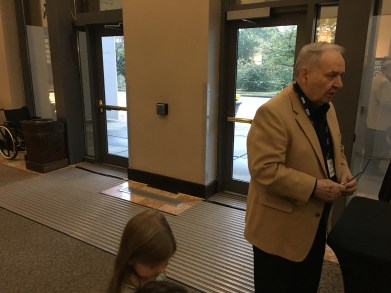
I met the great Norman Geisler,

IMG_1496
Norman Geisler

and his son, and spoke with many great minds from different fields. There was not always agreement about theological interpretation, but all these men and women love the Lord, and it was wonderful to see the camaraderie and the shared mission of the speakers, to make disciples for Jesus Christ and the truth of the resurrection.

There was much to hear, I bought many new books, and of a most interesting conflict among the scholars was of course young verses old earth opinions. I may do a follow up article on that, as it was quite unique the way scholars who believe in the big bang theory have to explain themselves under the paradigm of a creator. They certainly have rebuttals and evidences all neatly decided upon, however, to me (though I am no astrophysicist), these explanations fall very short, and completely contradict what we find in God’s word. You can play interpretation games all day long, but as Ken Ham said quite correctly at the conference, you do not get the idea of millions of years from a simple reading of bible. It is a man-made worldview, which must then be shoehorned into the text to make it seem to fit.

There was a particularly potent and personal talk I attended, given by a neuroscience Doctor, a Dr. Camp. She (pictured above) was discussing specifically the tendency of Christians, within the social and secular construct of this world as a perfect storm, to be anxious and depressed, and why that is, rather than full of joy for Christ. Personally, this is something I struggle with, and so I attended her class away from my group, and learned a bit more about how our brains were wired. What I learned both comforted me, because there were solutions, one of which was knowledge, and also scared me, because of how are brains become hardwired to believe the lies we tell it.

There was an atheist vs God debate, based on things like philosophy, and the perceived tyrannical nature of God in the Old Testament. Dan Barker from the Freedom From Religion Foundation debated Dr Howe, and did very well. I commend him for braving the venue, and standing before all the Christians making a very direct and succinct case. It created a great many good topic questions for us later in groups, and his overall communication skill was terrific. Clearly he is passionate, though I disagree with his goals and conclusions. We discussed in groups questions like, can God commit murder? And, the importance of context when discussing bible stories/verses.

Frank Turek and J. Warner Wallace were amazing, and I loved meeting Dr. Sanford who wrote Genetic Entropy, an excellent case against evolution from the observable degradation of the human genome.

All in all, it was a fantastic and mentally stimulating trip, and I’d love to make it a tradition. Honestly, I’d love to lock myself in there and just study and drink coffee for a year, however, that seems slightly impractical.


Case Study: A Wasted Life, Martians vs Percival

470172a-i1.0What led to Percival Lowell’s obsession with life on Mars? Led him to be convinced all the way to his deathbed it held signs of ancient civilizations? Led him to waste 22 golden years convincing his eyes of what his heart wanted to see? Life on mars, and martians,  is a theory that captivates the imaginations of people even today. (See: UFO’s and God)

As the egregious failure to provide evidence of abiogenesis, or the natural process of life arising from non-living matter,  marred evolutionary progress in the late 1800’s, some form of organic evolution had to be found. Abiogenesis was essential for propping up Darwinian theory, and amidst the embarrassment of Darwin’s disciples classifying gypsum (sulphate of lime) as a spontaneous sea life form, science needed a new, non-divine source for life. Incidentally, the newly found ‘life form’ was never denounced publicly, and Haeckel, the evolutionist who presented it, was convinced the real life form of his imaginings was laying in the ocean floor waiting to be discovered until his dying day. He was lecturing in Berlin on evolution in 1905, standing before a back drop of artist renderings relating man with apes, and his own notorious embryo drawings, found later to be completely falsified. (Haeckel was known to be a German hero of Hitler, and gave credence to his opinions on the master race.)

At the height of his influence in 1876, Haeckel said, “[The spontaneous generation] hypothesis is indispensable for the consistent completion of the non-miraculous history of creation.” One year later was the’discovery’ from Italian astronomer Schiapatelli that would ignite a series of far reaching events to answer this evolutionary vacuum. With the limited telescopic technology available, this searcher of the stars found a straight line on the planet mars. He called them “canali” for channel in Italian, which of course became “canals” in English. A few months after this announcement was the failure of Haeckel’s spontaneous life form. Despite the modesty of Schiapatelli’s report, the imaginations of the scientific community where abuzz with visions of extraterrestrial life. And why? Ian T. Taylor says it this way: “Relegating that origin to some cosmic outpost gave a measure of intellectual satisfaction since no amount of negative evidence could lessen the possibility of it being true; in other words, it was for the foreseeable future beyond the reach of man’s inquiry and could neither be proved or refuted.” (In the minds of Men, 2008)

Which brings us, stage now set, to Percival Lowell. While traveling abroad, Percival discovered that Schiapatelli was no longer able to continue his work, and enthusiastically adopted the search for proof of Martians. He was surrounded by the progressive thinking of evolution, and with science clamoring for a life source from space, Mr. Lowell was all too eager to help. From 1894 to 1916, Lowell observed Mars, wrote about Martians, and encouraged the public with lectures and maps. Using the excellent viewing conditions of Arizona’s nighttime sky, the number of canals he observed swelled to over 700.

Other scientists seemed to struggle with eyeing the same canals Percival did, to which he replied – ‘such observations relied heavily upon viewing conditions.’ There was even a water vapor discovery that also somehow eluded other scientists. This did not stop the passionate, if not obsessed, astronomer from producing “Mars” (1895), “Mars and Its Canals” (1906), and “Mars As the Abode of Life” (1908) along with a myriad of articles discussing our fourth planet.

I discuss the dangers of indoctrination in other articles, and continue to make application as we face an educational system today that is itself obsessed with the faith of evolution. Let us examine the fall out from Lowell’s observations, bearing in mind the unrelenting PR campaign for evolution that took place before Lowell, run by Huxley, the X-Club, and various societies that held sway over the whole scientific community (this is not an exaggeration, and parallels today’s methodology). Lowell influenced the imaginations of the western world with his continual promotion of a martian probability. One such imagination belonged to a writer named H.G. Wells. The very one who wrote War of the Worlds (1898) about a martian invasion of Earth.

You know what comes next. Another Wells, this time Orson Wells, and his Halloween hoax radio show of 1938, an age of tension, and war, and technological terror. Orson proved that with theatrics, some sound effects, and not a shred of evidence, a dedicated groups of individuals could create absolute panic. The radio broadcast convinced thousands the end of the world was happening, as he presented a War of the Worlds live radio show, causing at least one death, flooding the police switchboards, and pulling off the greatest media stunt of all time.

Sci-fi followed suit, from Isaac Asimov to  area 51 to Star Trek, and as evolution was blasted into the American school system in 1959 via Eisenhower’s National Defense Education Act, the need for abiogenesis was just as necessary as it was in 1876. With the space race against the Russians being the impetus for this, and the moon landing not far off, it is no wonder America never lost its fancy for Martians.

In 1976, 60 years after Lowell’s death, the Viking spacecraft landed on Mars, mapping the surface, and proving what the Mariner series spacecraft had already ascertained a couple years before. Lowell was wrong. There were no canals. None. Not one.

I cannot think of a more disappointing scientific legacy that that of Percival Lowell. I have written my first book, and know the passion and dedication that it takes to carry it out. This man not only wrote three, but built his own observatory, staffed it, and arduously studied the red planet for 22 years. I in no way feel that Lowell was a con-artist. On the contrary, I believe with every fiber of my being that he worked with dedication, ethics, and honor, and that he truly felt he was serving humanity with his efforts. He never learned of the worthlessness that was his legacy. So where did it all go wrong?

The presupposition, of course. The starting point, believed with an emotional faith that, I dare say, no one could have talked him out of. It is the same here as with biology, paleontology, anthropology, and all sciences, where how you interpret the world around you is directly affected by what you believe. Some would levy the same argument against Christianity, and would be right to do so, though it is the only starting point that offers satisfaction. To explain would take another article entirely, however I will say this. There is reason, logic, and answers within Christianity that cannot be found anywhere else. Rom 1:20 – “For from the creation of the world the invisible things of Him are clearly seen, being understood through the things that are made, even His eternal power and Godhead, so that they are without excuse.” God can be clearly seen, and a presupposition beginning with a holy, inerrant, and prophetic creator is a much more reasonable faith than a faith based on man’s failed attempt to prove we are all just cosmic accidents. If Percival Lowell hadn’t been influenced by man’s idea to supplant Christian truth with humanistic evolution, as history shows us, this story wouldn’t be so tragic. Would  those 22 years have been better spent studying God’s word, instead of Mars?

Christians are Hypocrites

“I don’t go to church, because Christians are nothing but hypocrites!”

This charge is often levied against churches, or the people who attend them.

“I know a guy/girl who goes to church, and acts Christian, but they did this, or that.” “I talked to this pastor, and he was a jerk.” “At least I’m real and true to who I am, Christians pretend like they are perfect or righteous.”

Let’s cut past all the subterfuge and subtlety. Are Christians hypocrites? Yes. Every single one. Hypocrisy is the practice of claiming to have moral standards or beliefs to which one’s own behavior does not conform. By definition, Christians have moral beliefs, set forth by God’s word, to which we desire to adhere. But every single Christian fails in this task. Every single one falls short, and I dare say this happens daily in the heart and minds of each, if not in actions.

Jesus says, “Be ye therefore perfect, even as your Father which is in heaven is perfect.” The moment this expectation, demanded by a holy God (for what else could infinite perfection demand), has failed to come to fruition, even in the smallest of ways, we have by definition become hypocrites and in fact, lawbreakers. We have failed to live up to a moral standard we accept as right.

But let us consider an atheist, who by definition, has a subjective moral code, derived from either ones own opinion, from popular opinion, or from the opinion of those who are in charge and can force a citizenry to exercise a particular behavior. In these instances, a moral code also exists, albeit one that is not handed down from a perfect creator, but is instead decided upon by mankind. If we reflect on the results of these subjective moral laws, depending on the flexible moral code of a given society, then two results  can generally be expected:

  1. If you live in a morally stringent society with heavily girded laws, as a citizen subject to these agreed upon codes, any violation of these codes renders you a hypocrite, and a law breaker, i.e. anyone who disagrees with Sharia.
  2. If you live in a morally relativistic society, defined by anarchy, nihilism, or lawlessness, or if you have determined within your own subjective mind that your behavior should fit no moral code (i.e. sociopath, or in religion – New Ageism), then you have absolved yourself from consequence to escape guilt. Anything goes.

Number 2 is extreme, and approaches mental disorder, however the reality in everyday life is a combination of the two. Often one who wishes for the freedom to be flexible in beliefs finds themselves to be militaristic towards anyone who holds to an opposite view, like during an abortion or transgenderism conversation, thereby pitting one set of subjective beliefs against another, if there is indeed no standard, and neither of which has more merit.

The reality is, therefore, to escape being a hypocrite against whichever moral code you reside under,

you must either operate perfectly within that framework – nigh impossible, or

you must adopt a framework with a moral bar set so low that you can’t help but live up to its standard, and then defend it militantly to escape any shame and guilt associated with those behaviors, or

you must constantly be ‘moving the goal posts’ within an ever changing set of standards, which is by definition, not a standard at all.

With careful, logical scrutiny, one could conclude that every acceptable moral set of beliefs would inherently have as its members nothing but hypocrites, all of whom are constantly trying, and re-trying, to live up to the expectations they believe in. As it is with every pursuit in life, from sports, to education, to religion, to parenting, human experiences are riddled with failures, and shortfalls. We strive for excellence in these pursuits, though we may never achieve perfection, and in so doing we work to better ourselves. It is the same with our walk in Christ, and for this walk we use the word sanctification, a lifelong and constant goal. The alternative, in Christianity, as well as sports/parenting/education, is to set the standard so low, that you feel validated by sub-par character and performance. This is no way to enrich a life, or the lives of those around you.

The result of this constant falling short is accepting the reality of hypocrisy. This is why Christians should gather in churches, as it is a place not only for worshiping the one person who set up the holiest standard possible, and then lived up to it, but also to surround yourselves with those who cannot, and are there to love and support each other. This is the essence of the body of Christ. Those who recognize that despite all human effort, they are in need of grace and mercy from a holy Creator.

Let me save you the trouble of pointing it out. You will not find perfect Christians in church. Christians struggle with anger, alcohol, sexual immorality, hate, depression, gossip – oh Lord the gossip, among a myriad of other sins. Yes we hide them, yes we don’t like to announce our struggles and shames from the mountain tops, and yes we pray for forgiveness constantly for not being as good as we can be. But there is peace and joy in Christ, in grace, and in knowing that we can let go of all of our missteps and focus the next day on how to love better. And despite these struggles, there is a concerted effort (or should be in a healthy church group) to do good works, to support others, and to be generous with the gifts that we do have.

If you are a non-believer that has had an unpleasant experience with a Christian, please realize that this person is struggling daily to do what is right, or may be going through his or her own temptations or trials, just like you. To dismiss thousands of years and mounds of evidence of revelation from God, to dismiss all His good works to bring about a savior, and our relationship with Him, and to dismiss the reality of eternal life with that Creator, because you interacted with someone who fell short in their walk is to dismiss the very reason we need Jesus Christ. In fact, as an unbeliever, are you not claiming to have a problem with a belief to which you do not conform? Is that not hypocrisy?

So if someone finally reaches the conclusion that he or she has fallen short of God’s perfect moral standard, that they are ready to admit that they are a hypocrite in their own right, based on the moral law written on their heart, then they can safely come to a church of believers. They are in good company, a place full of hypocrites, who all have fallen short, and all wish to experience freedom from their sins. If I see you there, I will do my best to lift you up, and do life with you. But I am a hypocrite too, so I may fail, and need forgiveness from time to time.


Supposed Final Words of Steve Jobs

Widely reported as the last words of Steve Jobs, though inspired and interesting, is most likely a false deathbed speech. We can easily imagine thoughts such as this passing through our minds at the end. Though most likely not genuine, it is interesting to consider them, and how they reflect our hopes for our lives:
“I have come to the pinnacle of success in business.
In the eyes of others, my life has been the symbol of success.
However, apart from work, I have little joy. Finally, my wealth is simply a fact to which I am accustomed.
At this time, lying on the hospital bed and remembering all my life, I realize that all the accolades and riches of which I was once so proud, have become insignificant with my imminent death.
In the dark, when I look at green lights, of the equipment for artificial respiration and feel the buzz of their mechanical sounds, I can feel the breath of my approaching death looming over me.
Only now do I understand that once you accumulate enough money for the rest of your life, you have to pursue objectives that are not related to wealth.
It should be something more important:
For example, stories of love, art, dreams of my childhood.
No, stop pursuing wealth, it can only make a person into a twisted being, just like me.
God has made us one way, we can feel the love in the heart of each of us, and not illusions built by fame or money, like I made in my life, I cannot take them with me.
I can only take with me the memories that were strengthened by love.
This is the true wealth that will follow you; will accompany you, he will give strength and light to go ahead.
Love can travel thousands of miles and so life has no limits. Move to where you want to go. Strive to reach the goals you want to achieve. Everything is in your heart and in your hands.
What is the world’s most expensive bed? The hospital bed.
You, if you have money, you can hire someone to drive your car, but you cannot hire someone to take your illness that is killing you.
Material things lost can be found. But one thing you can never find when you lose: life.
Whatever stage of life where we are right now, at the end we will have to face the day when the curtain falls.
Please treasure your family love, love for your spouse, love for your friends…
Treat everyone well and stay friendly with your neighbours.”

I have never personally faced a life threatening illness. But I have had my life threatened, as well as watched the life of a loved one deteriorate. I have watched helplessly at a bedside, when the only power I had was to pray to God. And the only hope that I had in my heart was that if that loved one passes from this world to the next, I will get to see them again, and stand with them before a God who saved us both through His mercy and grace.

These final words go far, and they are serious, and wise, but do they go far enough? The author mentions God, but if there is one and only one infinite God, He alone is to be sought. And if that God has declared the one door to Him is through His son, Jesus Christ, then I would lovingly declare this statement does not go far enough by any stretch of the imagination. An atheist who lived out Steve’s advice would die with memories, and still with no hope. And those who remembered them, would also perish, and so the love that had been attained in a lifetime of wholesome philosophy would be lost to history. This alone is not the answer. That is why I often repeat my favorite verse in these articles, “Wherefore, my beloved, as ye have always obeyed, not as in my presence only, but now much more in my absence, work out your own salvation with fear and trembling.”

In John 10:9, Jesus says, “I am the door: by me if any man enter in, he shall be saved, and shall go in and out, and find pasture.”

In John 14:6 Jesus answered, “I am the way and the truth and the life. No one comes to the Father except through me.”

This may seem narrow-minded to some, or dogmatic, and I assure you it is, unless it is the truth.43dc6e87710d1c4d4f780482f310a7df If it is the truth, if God entered His creation to die for our sins, and that sacrifice resulted in the legal and moral substitution for a judgement we deserve, then it would indeed be the only way, and the truest act of love. The author mentions God, and speaks of the importance of love in this life. True words, sir, and a very fine philosophy for living. Yet those with money, and those with loving memories both still stand to lose all if they do not address the truth of salvation.

The bible is not ambiguous on this point. There isn’t one way for Christians, one for Muslims, one for Buddhists, and another path for New Agers. There is one door, which is why Christ Himself includes that He is the truth, as well. It is a warning, given in love, and providing hope for all, for all are fallen, and all face death. To Mr. Steve Jobs, I say, boldly and beautifully said, a sad and grave wake up call against the things that drive us. But, I also say, your love and memories cannot save you. Living for a fallen version of love will still leave you wishing and hoping in a hospital bed. There is only one door. Though it is now, more unpopular than ever to state, and offends many, we cannot be so timid as Christians that we cannot claim the truth, and that is that Jesus Christ is our door to salvation. It is said that this speech, despite its lack of authenticity, has inspired many. But we must ask, does talk like this truly help? or does it give a false sense of meaning, and therefore provide a complacency more dangerous than the position of men who admit they are evil. Change is only possible when one realizes it is necessary.


The Feelings That Drive Us

In studying forgiveness this week, we delved in to Luke 17:

3 Take heed to yourselves. If your brother sins against you, rebuke him; and if he repents, forgive him. 4 And if he sins against you seven times in a day, and seven times in a day returns to you,[b] saying, ‘I repent,’ you shall forgive him.”
5 And the apostles said to the Lord, “Increase our faith.”

6 So the Lord said, “If you have faith as a mustard seed, you can say to this mulberry tree, ‘Be pulled up by the roots and be planted in the sea,’ and it would obey you. 7 And which of you, having a servant plowing or tending sheep, will say to him when he has come in from the field, ‘Come at once and sit down to eat’? 8 But will he not rather say to him, ‘Prepare something for my supper, and gird yourself and serve me till I have eaten and drunk, and afterward you will eat and drink’? 9 Does he thank that servant because he did the things that were commanded him? I think not. 10 So likewise you, when you have done all those things which you are commanded, say, ‘We are unprofitable servants. We have done what was our duty to do.’”

The interesting thing about forgiveness is that here Christ commands it, as a duty, which is especially noteworthy in a society that cultivates self-gratification, the fulfilling of emotional desire, and the alleviation of consequence from duty or action. The pleas for help against the strength of emotion are not merely a product of today, but of the weaknesses of all mankind, and is illustrated here by the apostles themselves, when they ask Jesus for increased faith. They wish for a greater faith to overcome the emotions set against forgiving others. It is as if they are saying, “no one can forgive someone over and over on their own!”

Jesus’ response? It is your duty. Don’t hem and haw and finally decide to forgive, so that you may then turn around and ask for praise and adulation for simply doing what is commanded. If you follow me, if you love me, then you will forgive, because that is what I have done for you. It is your duty.

Society will absolve guilt and duty with phrases and mantras such as:

“You shouldn’t have to apologize for your feelings,”

“We can’t control our emotions,”

or even

“We should allow for our feelings to guide us in our decisions.”

I admittedly am an emotional person, given to highs and lows, and do struggle with the discipline of not letting un-caged emotion drive my decisions. However, we must remember that we are Christians because it is true, and there is hope in truth. Yes it is emotional, but God has also provided a great many evidences, not the least of which is the reality of a resurrected messiah.

John MacArthur has said, “Pertaining to the bible, its prophecies are fulfilled. Its miracles are true and attested to. It is scientifically flawless and accurate. Its history and archaeology are verifiable to the smallest detail.”

He goes on to assert, “The basic task of the church is to teach sound doctrine. It is not to give one pastor’s opinion, to recite tear-jerking illustrations that play on emotions, to raise funds, to present programs and entertainment, or to give weekly devotionals.”

When it comes to forgiveness, it is described as a duty that should supersede emotional qualms. This also implies that forgiveness is not waiting on the emotion to join the intent, but instead is action taken despite emotion. But what action?

Forgiveness is simply releasing the right for revenge. The action of not disparaging a person who sins against you. To not gossip about them. To even speak well of them. To not seek or hope for their demise, or punishment, or just desserts. These are actions. These can rise above emotion.

Put another way, the act of forgiveness can be carried out as a duty until the emotions match the actions. If however, we wait on the emotion, the weakness of our flesh, to entice us to follow God’s command, would it ever happen?

Another instance of an emotionally driven construct of today is the transgenderism issue, a delicate one, and one that not only defies God’s will for us based on emotion, but also defies very real and understandable science and genetics. Scientifically stated, there is no such thing as transgenderism. It is  a construct of our society. We see similar psychological disorders with anorexia and the like, a person who perceives reality and the biology of their body differently than what is real. Consider this denial in who you are, this rebellion against how you were made, total denial in the identity of yourself. This is akin to suicide, the end of your life as what you were designed to be. Couple that with the mutilation of one’s body to fulfill the emotional desire to not be oneself, and you have not only physically harmed the body, but have harmed chances of a marriage, of having your children with a spouse, to connect with people of the same and opposite sexes on a meaningful level in many ways. This is why those in the transgender world are 19 times more likely to commit suicide than other people groups. A group forever forced to adopt the persona of what they are not.

Dr. Paul R. McHugh, is the former psychiatrist-in-chief for Johns Hopkins Hospital and its current Distinguished Service Professor of Psychiatry, and is the author of six books and at least 125 peer-reviewed medical articles. He states that transgenderism is a “mental disorder” that merits treatment, that sex change is “biologically impossible,” and that people who promote sexual reassignment surgery are collaborating with and promoting a mental disorder.

“This intensely felt sense of being transgendered constitutes a mental disorder in two respects. The first is that the idea of sex misalignment is simply mistaken – it does not correspond with physical reality. The second is that it can lead to grim psychological outcomes.” Regarding his willingness to reassign gender through surgery, he said this: “And so at Hopkins we stopped doing sex-reassignment surgery, since producing a ‘satisfied’ but still troubled patient seemed an inadequate reason for surgically amputating normal organs.”

We could go on and on with this subject, discussing an “everything is normal sex education”, child abuse, etc. But the point here and of this article is, we must be aware that truth and morality are objective things. They are verifiable things, and therefore, we must make a choice not to fall into the tempting pattern of blaming and cultivating emotions not anchored to truth, in order to absolve ourselves from reality.

Especially with the support of society, it can be easy to simply blame emotion for all of the situations we find ourselves in, but those not squarely rooted in God’s will tend to leave people in tumult, whether it be in anger, or anxiety, or depression. As we mature in Christ, it should become clearer that the discipline of our actions define who we are. Galatians lists fruits of the spirit in chapter 5, one of which is self-control. Ephesians 4:14 says, “Then we will no longer be infants, tossed back and forth by the waves, and blown here and there by every wind of teaching and by the cunning and craftiness of people in their deceitful scheming.” We must ask ourselves, when society plays on feelings and emotions to convince us that reality is false, do we consult the word for truth, or succumb to the continued and pervasive relativity of popular opinion and PC pressure. If we allow our emotions to be victorious over reason, what do we gain? What do we lose?