
Earth’s Magnetic Core; Limiting Factor

If you have never heard of the Dynamo Theory, another of secular science’s fudge factors, like dark matter, the inflaton, punctuated equilibrium, the Ort Cloud, and others…. then you may be interested in examining how it is that a measurably degrading magnetic core could have sustained life for hundreds of millions of years. Let me explain.

The earth’s magnetic core is getting weaker. This of course means that in the past it was stronger. By some measurements, it is determined that the magnetic core is 40% less strong than it was 1000 years ago. Measurements vary, and different areas degrade at different rates, but if today’s decay rate were projected backwards, the core would be implausibly strong in tens of thousands of years. Like catch the atmosphere on fire strong. All life on the planet gone strong. This means that for a Young Earth Creationist, we can once again make scientific observations that square with the truth of scripture quite easily. But of course the materialist, the evolutionist, those who demand deep time, and slow gradual random processes over billions of years, will have to appeal to some mechanism that forces the magnetic core to stay within a cosmically tight tolerance in order to not become deadly. Welcome to the Dynamo Theory.

As was ignored regarding Pluto, comets, and other celestial bodies, the obvious ignoring of thermodynamic laws must be applied here, as scientists propose the magnetic core conveniently goes through stages of magnetic powering up, not too powered up though, and at the specific times it is needed. The basic idea is:

Heat escapes from Earth’s core.
Molten iron circulates.
Because iron conducts electricity and the Earth rotates, electrical currents are produced, and those currents regenerate the magnetic field.

In their model, the field is not a battery slowly running down but a self-sustaining system that can strengthen, weaken, and even reverse. This same mechanism is applied out of necessity to Jupiter and Mercury as well. Computer simulations are adjusted to make the tolerances work for life, and the plausibility is accepted across academia since it must be so!

The greater difficulty, even if the recharging of a magnetic core is possible, is the heavier burden of this process allegedly operating for 3.8 billion years while remaining compatible with life the entire time without a single mistake! Through this constant supposed ebbing and flowing through time, the core by natural unguided means, must avoid prolonged states of weakness which would allow solar wind and radiation to destroy the atmosphere. And though we have never observed it getting stronger (other than normal flux), we must assume that it always obeyed upper limits of magnetic strength that would have set the world on fire, again, by luck, random chance, and randomly sitting in the perfect pocket for millions of years.

Remember, it has changed by 40% in 1000 years. How many years based on 40% being lost in 1000 years, could we safely go back in time before the magnetism got too strong for life? There is a record of pole reversals that align with the flood, and catastrophic results of that event, but under normal consistent observation, the core is behaving exactly as we would expect, and slowly losing power.

If we use the stated premise literally — 40% loss per 1,000 years — then running the field backward means multiplying its strength by: 0.61​=1.667

every 1,000 years.

So the backward-growth formula is: B(t)=B0​(1.667)t/1000

One key problem is that there is no universally agreed single magnetic-field strength at which “all life dies,” so I cannot give you one scientifically established cutoff year. But we can calculate how quickly the field becomes dramatically stronger than today’s:

Years backApprox. field strength vs. today
1,357
3,151
4,50810×
5,86520×
7,65850×
9,015100×
13,5231,000×
18,03010,000×
27,0461,000,000×

If you choose even a very generous hypothetical tolerance of 100 times today’s field, you’ve only gotten about 9,000 years into the past. At 1,000 times, you’re only at about 13,500 years.

So with even a conservative instinct of something like 15,000–25,000 years as the region where straight backward extrapolation becomes physically absurd, by then you’re dealing with fields thousands to hundreds of thousands of times stronger than today. So the clean conclusion is: At a 40%-per-millennium decay rate, a simple backward extrapolation becomes extraordinarily problematic within roughly ten to twenty thousand years—not millions or billions.

But I want to keep one guardrail firmly in place: this calculation only attacks a monotonic-decay model. The standard geodynamo response is precisely that the field does not follow this exponential trend backward indefinitely.

But where the broader argument becomes interesting is different: if the dynamo is invoked to prevent those absurd historical strengths, then the burden shifts to showing that its long-term fluctuations stayed within whatever the genuinely habitable limits are; i.e. a habitable zone defined by an ebb or flow period of only 10,000 years long.

So a scientific question might be:

Across 3.8 billion years of modeled fluctuations, what is the probability that the field never leaves that safe range long enough to sterilize the planet or permanently derail complex life?

And that, as we discussed, is the probability question for which we currently do not have a well-established numerical answer.

This “Chaotic Cycle” does not mean that every conceivable field strength is equally likely. A hurricane is chaotic, but it does not randomly become hotter than the Sun. The governing equations and available energy constrain its possible states. But it is not unreasonable to imagine that when dealing with small tolerances for life, and powerful cosmic forces, magnetic force with no intelligent control could easily surpass safe levels in either direction.

Using a hypothetical 10,000-year tolerance window: 10,000/3,800,000,000​=380,000​

So that’s 380,000 consecutive 10,000-year windows across 3.8 billion years of life leading to humans (from goo to the zoo to you; i.e. what they teach your kids in school).

Each 10,000 year interval becomes 0.000263% of proposed life history.

One important mathematical distinction: that does not itself mean “380,000 perfect dynamo cycles,” because we haven’t established that the dynamo cycles every 10,000 years. What we are calculating is 380,000 hypothetical tolerance intervals.

But the probability question becomes sharper: if a lethal magnetic excursion had some probability (p) during any 10,000-year interval, what is the probability Earth survives all 380,000 intervals without a single terminal excursion?

Under the simplified assumption that each interval were independent: P(survival)=(1−p)380,000

That gets brutal remarkably quickly. Even a lethal-event probability of only 1 in 100,000 per interval gives: (0.99999)380,000≈2.24%

So under that illustrative model, even a 99.999% safe 10,000-year interval yields only about a 2.2% chance of making it through all 3.8 billion years.

For Earth to retain even a 50/50 chance of surviving all 3.8 billion years under this simplified model, the probability of a sterilizing magnetic failure during any individual 10,000-year interval could be no greater than approximately 0.0001824%—about one chance in 548,000 per interval. And it would have to maintain that extraordinary reliability through all 380,000 hypothetical tolerance windows.

380,000 tolerance windows, with effectively no room for a single sterilizing failure.

The wider the modeled variation compared with the habitable window, the less plausible the model becomes. And if the system is genuinely chaotic, one cannot simply point to its present survivability and call the problem solved. That risks reasoning backward from the desired outcome: life exists, therefore every prior excursion must somehow have been survivable.

A proposed mechanism is not yet a demonstrated history. Saying “the dynamo regenerates the field” does not answer:

how strong or weak it can become,
how long dangerous excursions can last,
what the biological and atmospheric limits are,
or why those limits were allegedly never exceeded catastrophically over immense time.

I would still distinguish “this looks profoundly implausible” from “mathematically disproven,” because the latter requires numbers we do not possess. But common sense is not worthless simply because a complete probability distribution is unavailable. Common sense often identifies where a theory carries an enormous hidden burden.

Moreover, Earth’s habitability depends on a coupled systems: magnetic field, atmosphere, solar behavior, gravity, mantle evolution, plate tectonics and lunar influences, etc. This is one large habitation problem in a series of large habitation problems. But specific to our necessary and amazing magnetic core, we either must attribute perfectly self-sustaining mechanisms applied over billions of years without a single mistake to natural cosmic processes, or admit that our fragile window of existence is held firm by the author of life.

The stability and order of creation ultimately must rest upon God rather than autonomous natural processes:

Psalm 75:3 (ESV) “When the earth totters, and all its inhabitants, it is I who keep steady its pillars.”

1 Samuel 2:8 (ESV): “For the pillars of the earth are the LORD’s, and on them he has set the world.”

Psalm 104:5 (ESV): “He set the earth on its foundations, so that it should never be moved.”

And Colossians 1:16–17 takes the concept beyond the Earth to the entire created order: “For by him all things were created, in heaven and on earth, visible and invisible… And he is before all things, and in him all things hold together.”

And Hebrews 1:3 says of Christ: “He upholds the universe by the word of his power.”

You are Not Your Job. Identity in Wealth or Christ?

How do I pursue provision, excellence, and even wealth… without becoming consumed by mammon? This can be one of the most important Christian tensions the provider of a home can wrestle with.

You prayerfully, and carefully press forward towards goals, daily girding up your loins, entering the fray, working hard, investing without being reckless, planning without being lazy. The goal, you figure, is not to be lounging on a beach drinking Mai Tai’s, earning 8%, and rubbing bronzer on a bloated version of yourself as a testament to affluence. But it is also not to work yourself into an early grave among tribes where overworking becomes a virtue, risk becomes masculinity, and wealth becomes identity.

Seminars, business coaching, empowerment, spheres of influence, becoming the sum total of 5 influential people, must-reads, plugged-in, taking initiative, low-hanging fruit, scalability – is it any wonder we are programmed to attain more? And if you step off that treadmill, there is judgement.

Though keeping yourself small can feel safer, or more moral, there are aggressive tribes within business, and sales, within which we tend to forgo comfort for ambition, a reflection of the surrounding culture. There are no attempts to ratchet down intensity, and we cannot find the criteria to decide if that is a good thing or not. A pressure to succeed and achieve potential for some, and for others a recipe for self-destruction, maybe health, maybe spiritual. We pray for wisdom, and discernment, dependent upon a plan we don’t understand. Some days we conquer the world, other days we are swallowed whole. And the Bible’s answer is actually far more nuanced than “money bad.”

Scripture condemns greed, oppression, idolatry, trust in riches, pride born from abundance. But it repeatedly praises diligence, stewardship, provision, wise planning, multiplication, leaving inheritance, generosity, productive labor.

The issue is almost never wealth itself, but rather, what is wealth doing to your heart?

There seems a narrow road between asceticism and material idolatry. We know that preaching a prosperity gospel, i.e. “live your best life now,” is a false application of God’s word. Indeed we are to expect persecution, division, and trials. Romans 5: 3 Not only so, but we also glory in our sufferings, because we know that suffering produces perseverance; 4 perseverance, character; and character, hope. 5 And hope does not put us to shame, because God’s love has been poured out into our hearts through the Holy Spirit, who has been given to us.

But we also concede that burying talents, or laziness is as much a failure as reckless ambition. So we search the scriptures for God’s truth, rather than our own.

Firstly, Provision for family is not optional:

“If anyone does not provide for his relatives, and especially for members of his household, he has denied the faith and is worse than an unbeliever.” — 1 Timothy 5:8

What an amazing verse. Providing is not greed. It is obedience. A husband, father, or mother/wife if she is the provider, is commanded towards labor, stability, protections, inheritance. We do not get to be passive. Nor do we get to be reckless.

Though rich men seem to be scrutinized in the bible quite often regarding their hearts, we also notice that Proverbs praises productivity, and it does not romanticize poverty.

Read Proverbs straight through and you’ll notice:

  • diligence praised constantly,
  • sloth mocked constantly,
  • wise investment praised,
  • planning praised,
  • savings praised.

Examples:

“Go to the ant, O sluggard…” — Proverbs 6

“The hand of the diligent makes rich.” — Proverbs 10:4

“Know well the condition of your flocks…” — Proverbs 27:23

That last one is ancient portfolio management.

The Proverbs 31 Woman is an underrated financial text. She buys fields, plants vineyards, profits from trade, manages servants, strengthens household wealth. Biblical womanhood is not passive helplessness, either.

Then why the struggle, and discomfort? Because Scripture also deeply warns wealthy men. It does something spiritually dangerous:
it creates the illusion of self-sufficiency.

“How difficult it is for those who have wealth to enter the kingdom of God.” — Luke 18:2

Why? Because wealth whispers, “You don’t need God.”

Many godly men in Scripture were extraordinarily wealthy; Abraham, Job, Joseph, David, Solomon.

The difference? Wealth was tool, not God. It is an obvious logical truth that some people who work as if unto the Lord, who do honor to their gifts and skills, and who labor joyfully in a free society, can eventually obtain wealth. Once faced with that reality, part of dealing with it involves stewardship over decadence. Could there be sin in pursuing luxury while ignoring suffering? Of course.

The bible condemns dishonest exploitation, vanity, hoarding, but not flourishing through hard work. This type of financial growth that gets folded into a hard working life over time provides noble opportunities to care for families, peace, stewardship, freedom to obey God. This is very different than the prosperity gospel nonsense enticing someone to chase yachts and hedonism. We recognize that an influx of money can magnify generosity, or greed. It can cause freedom, or slavery. It can protect a family, or consume them.

The real question may not be, “How much wealth is it okay for me to obtain?”

But: “What kind of man does the pursuit turn me in to?”

In Ecclesiastes, Solomon explores many mindsets regarding life:

  • ambition,
  • labor,
  • achievement,
  • wealth,
  • legacy,
  • exhaustion,
  • meaninglessness,
  • enjoyment,
  • gratitude.

And he lands not in laziness, or nihilism, or greed. Instead he lands on a proper stewardship under God:

Fear God, enjoy your labors, receive provision gratefully, and do not make a god out of the things you have been given.

What if We Destroy all Religious Books? – Ricky Gervais

“If you took all the works of fiction and holy books and destroyed them, in a 1000 years they would still be gone. But if you took all the works of science, in a 1000 years they would have all come back. Because all the tests would bear the same results.”

Ricky Gervais is a popular, frankly hilarious, and talented actor and comedian. Whether you like his particular brand of non-pc humor, you cannot deny his success, bravery, and wit. Personally I like most of his stuff, other than the poignantly anti-Christian stuff, but as a person who appreciates free speech, and a free market, I support his rights to speak on whichever topics in whatever way works for him.

I bring Mr. Gervais up today, on my little blog, to verbalize a thoughtful retort to one of his famous challenges against religion: “If you took all the works of fiction and holy books and destroyed them, in a 1000 years they would still be gone. But if you took all the works of science, in a 1000 years they would have all come back. Because all the tests would bear the same results.”

He has stated this multiple times in interviews, and remains one of the funniest and most likeable atheists, but upon hearing this over and over for years, I felt compelled to provide contrary ammunition for the Christian who may not know how to respond. The assertion itself is faulty, and as is usually the case with atheists, they paint themselves as logical, reasonable believers in empirical data and truth alone, while the religious appeal to unprovable magic and miracles.

I have explained the difference between empirical and historical or forensic sciences before, but a quick recap of how we must interpret data.

The Eiffel tower has testable attributes. Some of these are:

1,063 ft tall
Wrought Iron Lattice Tower
Weight is 10,100 tons
Located on the Champ de Mars in Paris, France

If one were inclined, one could test and re-test for the accuracy of any of these statements. In Mr. Gervais’ example, yes, if these facts were all lost, they could all be recovered again, and restated in books as demonstrable, observable, repeatable, without any deviation, just like the boiling point of water. But what about these facts?

The Engineer was Gustave Eiffel-
The Tower was finished in 1889-

How do we know these are correct? If this information was lost, what would the tower be called? What date would be attributed. We might try to date the metal based on rust, and chemical tests, get some some spectrum of years with a tolerance between 1715 and 1940. If we do not have trusted historical sources to conclude facts from, we would be lost on all lost forensic data! This means that for many disciplines, we must find those historic, written sources, accurate, not tampered with, and found to fit the proper historical context. No one questions these two historical facts today, but it brings about an interesting point. The facts in this case must be believed; they are not testable, and repeatable.

All history is this way, including Biblical history, Cryptology, Archeology, Criminal forensics, Geology, Paleontology, and Cosmology.

So to Mr. Gervais’ assertion, would we indeed have the exact same books with the exact same facts? Yes, the math, experimental physics, chemistry, engineering, all empirical books would be recreated almost exact, and learned the same by Christian and atheist alike.

But what if we look at a couple of presuppositions disappearing, such as evolution, or the Big Bang Theory. Take dark matter as an example. This supposedly bountiful material, made up, and totally untestable, is used as an explanation of how first generation stars were formed in a vacuum of space (still very unclear how that process would work even if this imagined material existed). Dark matter is also needed to explain the gravity keeping spiral arms in tact on a spinning galaxy such as the Milky Way, because when you apply billions of years to it, actual science and math determine that it should have dissipated into a blurry mess by now.

Is it conceivable that if Dark Matter theories were destroyed, and a new people in a thousand years were offered the same exact data points, they might conclude that first generation stars could not have organized themselves naturally, and no mysterious material was aiding the impossible process? Is it conceivable that upon building back up all the lost observable data about the visible universe, and its motion, scientists might have to conclude that the spiral arms can’t be that old, that the clock like precision of the solar system looks designed, and that comets are young? Perhaps these scientists rebuilding all lost scientific knowledge in the future would refrain from invoking make-believe fudge factors to bolster a naturalist point of view. Afterall, that is exactly what the fathers of modern scientists thought when they first began to discover these things! It was obvious to them that a Creator organized the universe! Were they not in the exact same position that Gervais was describing once upon a time? And they concluded that God was a reasonable, and more likely answer!

What about scientists stumbling across the Grand Canyon 1000 years from now, and having to determine a geological cause? Without dedication to presupposition of deep time, a non-empirical belief, they would have to draw conclusions from what they observe, yes? Perhaps these scientists of the future would note data such as:

„Middle is higher elevation than the head waters (Kaibab Plateau)

„Both sides agree uplift of center occurred before the river was there (water doesn’t run uphill; another great observation for second graders)

„Gargantuan river delta that should be present is missing if the 1000 cubic miles of mud and rock were washed away slowly

„Stable, shear cliffs, little rock fall – not slow erosion, but washed out

„No Talus at base of cliffs – Amphitheaters hundreds of feet of sheer Cliffside over one mile from water, with no debris (washed out)

„It is relict – unchanged from what formed it, stable in current condition.

Perhaps without the tainting of modern uniformitarian paradigms, these hypothetical scientists would indeed conclude that this geological feature is quite obviously the result of a massive flood. Slow erosion could not have created it, nor could any river system imaginable, or observable on this earth.

This is only two of MANY examples of how present day scientists interpret facts to explain an observation. Using wisdom, and maturity, Mr. Gervais, and anyone who is touting this clever statement as a dismissal of the religious as illogical, can quickly see that it does not hold water. In fact, many new conclusions would be present, some I’m sure closer to reality, while others would inevitably be even more ridiculous than the Big Bang model, and evolution.

Luckily, all out historic knowledge HASN’T been destroyed, and we do indeed have not only a well-recorded history of when the Eiffel Tower was built, but also of the lineage, prophecies, and narratives of the Jewish nation. We have the religious, moral, and social result of a historic Resurrection of the Messiah, Jesus Christ. And we have centuries of Christian and secular writings verifying a long and rich history that helps us interpret and understand the data we find. If not for these histories, all present data and understanding would be so fractured, it would be almost impossible to be certain of anything.

So no, this statement, while it does sound clever initially, has no bearing on Christianity. In fact, the discovery of the organized universe has led many to belief in a Creator God. “For his invisible attributes, namely, his eternal power and divine nature, have been clearly perceived, ever since the creation of the world, in the things that have been made. So they are without excuse.” – Rom.1:20

Not Just Redemption

In Christianity, we rightly focus on Redemption, Justification through faith in Jesus Christ. It is the all encompassing meta-narrative, if you will, of the entire bible. The whole story from beginning to end is the story of the Lord redeeming His church by substituting His sinless life for our sinful one, and allowing God, the perfect judge, to apply forgiveness to our lives, covered by perfect blood.

This is the Good News, the fundamental heart of the gospel, and receiving grace and a substitution for your misdeeds in front of a holy God is a victory worth celebrating. But there is another component to the Good News that is discussed less, and is so beautiful.

My church happens to be steeped in fostering and adoption ministries. A relatively large percent of the congregation seems involved in it on some level, whether through actual fostering, providing support financially or physically, and certainly with prayers. The catalyst is knowing we are adopted into God’s family, and accepted as part of His bride, the church itself.

2 Corinthians 18 And, “I will be a Father to you, and you will be my sons and daughters, says the Lord Almighty.”

Grateful that long ago, a plan was set in place to not only rescue millions, but to make then actual sons and daughters.

John 1: 12 Yet to all who did receive him, to those who believed in his name, he gave the right to become children of God—
13 children born not of natural descent, nor of human decision or a husband’s will, but born of God.

This means that in contemplating with wisdom both your worth and your unworthiness, you are compelled to face a very real truth, by no power of your own, you were literally made princes and princesses of a King. Not just any King, but the King of Kings.

Romans 11: 17 But if some of the branches were broken off, and you, although a wild olive shoot, were grafted in among the others and now share in the nourishing root[b] of the olive tree, 18 do not be arrogant toward the branches. If you are, remember it is not you who support the root, but the root that supports you.

The natural world pointing to a spiritual truth, as the olive tree branches can indeed be grafted into a healthy tree, and grow long term fruit.

These references to adoption are important, because though you needed forgiveness, you were granted much more than that. Think with me of the debt against you from a stranger. Not only that but a dirty stranger, one who has been unkind, perhaps even criminal towards you. Stolen, and bragged about it. But he comes to you, finally, after a life of bad decisions has caught up with him, and has no choice to beg for mercy before the law condemns him.

You have been offended, hurt, damaged, and we all know the story, you decide to forgive. The man is overwhelmed with gratitude, saved from a fate of punishment and guilt. We understand this, of course, the forgiveness. But let’s take it a step further. What if after that, you handed him adoption papers?

Think about it, this person who acted against you his whole life, you just hand him the papers, and say, “I would like to love you, and welcome you to my family, if you will let me. This way, I can care for you, house you, give you hope in a future you did not know was possible, and see to it that this desire to act against me becomes so unnecessary that it can’t happen again. And of course, this means that with me, and my other children, you are an equal heir to all I have. I know this sounds crazy, but truly, what’s mine is yours. I will love you like I already love them. You are not only forgiven, but you are mine. Oh, and I almost forgot, I am a King, so, you are the son of a King. Welcome to my family…. son.”

A judge can forgive a sentence; a president can pardon guilt; but neither then takes the pardoned criminal, and welcomes them into their home, makes then a feast, and explains that the very house he has been welcomed in to is in fact his.

We are redeemed, and thank the Lord for grace, for I humbly admit I need it for my many faults. But occasionally, I will stop consider what I have been promised, what status I have been given, and what that makes me worth. We often in our discourse, levy mistrust and judgement against the bible about its fairness. About whether God is just. But, consider, is it just that I have been made an heir to the Kingdom of God? Is it justice that I am a prince? I’ve done nothing, literally nothing to earn these titles. How can you think on the value God has ordained for your soul, and not be overwhelmed. You, who believe in Jesus Christ as Lord, are the sons and daughters of a King.

“All you need to do is find a single fossil out of place!”

Once again, I recently received an unsolicited pelting of questions by an evolutionist online, in a Biblical Apologetics group no less. The descent into tension, as per usual, begins pleasant enough, where questions regarding my opinion are disguised as genuine interest, and after cautiously answering, and wishing the best of luck in further studies, trying to disengage peaceably, there are always follow-ups, and it becomes clear that no amount of either answering questions directly, or encouraging the other to keep studying, will redirect the vendetta that has now formed in their head; a personal mission to take on the stupidity of the bumbling, misinformed Christian.

The temptation is always to fire back; to ensure the opponent there are indeed answers; that good science can be attained, and understood, and that evolution’s theoretical, absurd processes propped up by goal-post moving and fudge factors casts very reasonable doubt. But as anyone on either side of the argument knows, answering back simply begets a follow-up attack, and at some point, hopefully before rising tensions, someone just stops answering. That voice inside tells you they must feel victorious if you quit the debate, but you also tell yourself, I am a grown man, spending my Sunday arguing with someone on line who has no desire whatsoever to actually learn what my opinion is, seems silly. He wishes to prove how dumb I am, so that he can feel superior in his belief. Why? Well same reason as me; it feels good to bolster your understanding of the world, gain faith by withstanding the onslaught of counter-points. And let’s face it, it serves the ego, does it not? But Darwinian evolution has, since its inception, always served a more sinister purpose; providing intellectual ammunition for those those who desire greatly to deny God. Charles Lyell, the inventor of the geologic column, wished to save the sciences from Moses, after all. And many scientists admit the absurdity of evolution, the missing transition fossils, the circular reasoning.

In this particular case, the debate was left when the evolutionist said, “All you need to do it find a single fossil out of place. Nobody has ever done that. This is your chance: just find a fossil that has life from two different geological periods in it. That would disprove evolution.
But nobody has ever found such a fossil. You believe this to be a lie, so . . . show me the evidence that it is a lie.”

Before this, I was stating the obvious facts of geology, that the geologic column exists truncated, out of order, and in no way resembles the geologic column so artfully cartooned in text books the world over. Furthermore, that fossils are found up and down, scattered this way and that, and are out of order all the time! Clearly, and as most geologists are coming around to, the layers we see were formed through catastrophe. Of course most still believe in millions of years, but with no erosion between layers, evidence of animals being buried suddenly, soft animal fossils, and geological sorting, catastrophe is now a staple of geologic observation. So where do they put the millions of years? In between the layers! Where there is no evidence!

Why? Because in the the scientific world’s mind, evolution is a naturalist foregone conclusion, the only acceptable explanation of how we came to be, even among believers in that field, and they have been taught that it is an immutable fact of science. Furthermore, each field of science is parceled off in particular areas of expertise. The biologists “knows” the paleontologist has proof, they in turn “know” the geologist does. The geologist trusts the anthropologist has proof, and so on… so every observation is cemented into an undeniable belief that Darwinian evolution is fact.

But no transitions exist when there should logically be MILLIONS! Think about it; slow gradual change through eons of time would produce animals in droves hardly discernable from one another. How is taxonomy even possible? Well, it would seem when we find an animal in the dirt, like soft bodied jellyfish, bats, or whales, they are always the fully formed version of itself, not what Darwin was expecting. To counter this obvious fact, many began promoting various versions of punctuated equilibrium; providing through mutation, great leaps forward in evolution to explain away the lack of evidence. Keep in mind, finding no evidence doesn’t make them question the veracity of evolution. It merely causes them to double down on a previously absurd and long denied process, but recycled in some new way, giving more power to time, and mutation then has ever been observed.

So why can an evolutionist spout confidently about there having been no out of placed fossils ever found? For one, Bill Nye, in his famous debate with Ken Ham, blurted this nonsense amidst the back and forth, and it was never one of the points specifically countered. It was then pounced on as some death knell to be wielded triumphantly over the moronic creationists. But secondly, and most importantly, evolutionists, under the guise of adjusting the evolutionary model to a growing knowledge base, have taken any out of order anomaly, and either denied it, quietly acknowledged it while as little fanfare as possible, or adjusted the model to explain away the observation in a way that could not hurt the theory. The greatest part about evolution is that any number of things could have happened 100 million years ago, and no out of order fact could possibly sink the faith in this religion. So unlike good science, evolution is not making accurate predictions about what we will find (it has failed miserably in this regard), but rather, because “we already know it is true” anything we find can be adjusted to fit into it without compromising the overall belief. Then it just becomes scientists arguing for the best order of things in an echo chamber, while doubters of Darwin stare in disbelief at the utter lack of cohesiveness.

An example, you say? Well, I am glad you asked. It is not surprising that fossils are being found in the “wrong place” all the time!

  1. We find them on the surface all the time. Just laying there, getting stepped over, millions of years, in rock that can be designated to the proper geologic level depending on what fossil is in it. “The rocks do date the fossils, but the fossils date the rocks more accurately.” J.D O’Rourke.
  2. “If there were a column of sediments … Unfortunately no such column exists.”
    Harcourt Brace Jovanovich, Earth Science 1989, p. 326
  3. Even some of the most devout evolutionists are honest when confronting misplaced fossils; highly respected coauthor of the Theory of Punctuated Equilibria, Dr. Niles Eldredge, Curator, Division of Paleontology, American Museum of Natural History, New York City, since 1969, has written that the fossils cannot be used to date the rocks that they are found in. One reason for this is that we now know that all animal and plant kinds are found all the way “back” to the beginning of Cambrian layers.
  4. Cambrian layers we now know contain even vertibrates, the most complex forms of life, which it most certainly should not, but also contains every phylum we have a classification for, that appeared in full form, and vastly different than all the others. Imagine going from bacteria to a starfish, sponge, flatworm, crab, mollusk, and vertebrate, all at once! That is some powerful evolutionary magic right there.
  5. would the wrong place include living fossils? Animals found alive after being extinct for millions of years? Horseshoe crabs. Coelacanth. What about finding a living Wollemi pine that went extinct in the fossil recorrd 150 million years ago? Would that be considered the wrong place?
  6. To correct for finds that don’t fit, columns are corrected upwards, and downwards. The Nucha vancouverensis sponge, found in Canada, in a layer 220 million years old, was found across the world in a 500 million years layer with none between, and was corrected for.
  7. Grasses were not to have been formed until way after dinosaurs, but dinosaur dung was found to have grass in it. So it was corrected.
  8. Mammals were supposed to have evolved well after dinosaurs. But a large rodent was found with dinosaur babies in its digestive tract.
  9. Dinosaurs were supposed to have evolved into birds, a recent but latched onto theory, yet birds were found in wrong layers putting them together.
  10. Guadalupe woman and her modern burial site found in a layer 28 million years old certainly provides for a misplaced set of bones.

It takes very little effort to find sharks teeth in North Dakota, whale fossils in the desert, petrified closed clams on mount Everest, and a myriad of other finds that did not hit the expected targets of evolutionary thinking. This is to say nothing of carbon found in coal, diamonds, dinosaurs, which should not be there if millions of years old. A great testimony to good science was when carbon dating was first discovered, science kept a journal that accredited scientists could add to when things were dated, and a bunch of dinosaurs, and extinct animals made it in, before the concerted effort to not publish more than half of the results, once they realized the dates were compromising the theory.

Is it worth arguing back and forth with someone who is so sure nothing has ever been found out of place the world over that would topple the evolutionary house of cards? We know full well that every result will be crammed into some reorganized version, dismissed for the larger picture, taught in compulsory schooling with the drum beat of certainty, regardless of every prediction having fallen short. Evolution is a golden calf that, despite no evidence combating abiogenesis, irreducible complexity, the language of DNA and simultaneous ability for cells to read it, no transitions, and a dating set that has no solidarity whatsoever, will not die. Because as they have admitted, “Our willingness to accept scientific claims that are against common sense is the key to an understanding of the real struggle between science and the supernatural. We take the side of science in spite of the patent absurdity of some of its constructs, in spite of its failure to fulfill many of its extravagant promises of health and life, in spite of the tolerance of the scientific community for unsubstantiated just-so stories, because we have a prior commitment, a commitment to materialism. It is not that the methods and institutions of science somehow compel us to accept a material explanation of the phenomenal world, but, on the contrary, that we are forced by our a priori adherence to material causes to create an apparatus of investigation and a set of concepts that produce material explanations, no matter how counter-intuitive, no matter how mystifying to the uninitiated. Moreover, that materialism is absolute, for we cannot allow a Divine Foot in the door.
[Billions and Billions of Demons – JANUARY 9, 1997 ISSUE]”
― Richard C. Lewontin

Language

Ignoring observations of flood features, and population growth, and DNA complexity, and the myriad of other science that can easily be interpreted to point to created complexity, we can take a brief aside, and consider language for a moment. The spoken word, beautiful in its complexity, freedom, and innovation, allows mankind an additional unique place above the animal kingdom.

As a Christian who believes in the authority of scripture, it is simple enough to consider man created in God’s image on day 6, and immediately engaging the Lord in conversation. The animals were named, the creation account was communicated, in order to be passed down, whether verbally, or in writing. We even see phrasing from Adam that he is utilizing language far beyond simple communication, and adding flair and poetry to his thoughts:

Gen 2:23 Then the man said,

“This at last is bone of my bones

and flesh of my flesh;

she shall be called Woman,

because she was taken out of Man.”

Evolutionists, of course, must take the unenviable position that somehow animalistic grunts and noises, grew in complexity and became language, the record of which goes back the expected 5000 years of a biblical world view. Furthermore, the evolutionist must contend with the fact that it seems language is MORE complex the farther back you go, rather than less. In English, we can easily point to the 1600’s writing of Shakespeare, a study deemed so difficult that it has been all but abandoned by public schools, and is not even required reading for some English Literature majors in college. Even going back a century or two, and cracking open some classic literature, realizing they did not have google, or dictionaries, or thesauruses, and to witness the colorful and beautiful command of language that is being written, even an intelligent person of today can appreciate how elevated it used to be.

Beyond this though, language experts concede that Sanskrit, and other ancient languages, are more complex in their grammar, than our modern ones, though this fact is hardly publicized. The Société de Linguistique de Paris literally banned discussion on language origin, which lasted more than a century, because it conflicted with Darwin’s gradual processes, and was so filled with speculation.

The evolution of linguistics is an idea only, and has no evidence. And to further complicate matters, linguistic experts concede that multiple ancient languages arose unrelated to each other. Akkadian, Semitic, Sanskrit, Sumerian, and others; regardless of how you break it down, not only are they severely different, but they are all complex, and complete.

So the evolutionist, while denying that a creator had split tribes through language, must concede that multiple and different complex languages emerged within different people groups all over the world. This is to say nothing of the fact that within the ancient people groups, similar flood stories exist, indicating they all share the same history. There are over 270 ancient flood legends and traditions recorded in ancient history, 80% of them mention a large vessel saving the human race. 88% involve a favored family. In 70%, survival was due to the boat. In 95%, the flood was responsible for the death of mankind.

Again, I find myself in the pleasurable comfort of knowing the authority of God’s word matches easily with what I observe. Hopefully, this is a small building block of support and faith for you as well.

THE IPUWER PAPYRUS

As a mater of interesting archeology, the Ipuwer papyrus, also known as the ‘Admonitions of Ipuwer’, is an Egyptian text written on papyrus from around 2000 to 1600 BC, which would put it right at the period of time coinciding with the Exodus. This makes the document a very controversial one, for several reasons.

As a matter of interesting archeology, the Ipuwer papyrus, also known as the ‘Admonitions of Ipuwer’, is an Egyptian text written on papyrus from around 2000 to 1600 BC, which would put it right at the period of time coinciding with the Exodus. This makes the document a very controversial one, for several reasons.

Firstly it is incomplete, very damaged, and is missing the beginning, and the ending. Secondly, it makes reference to circumstances happening in the surrounding culture that parallel very closely with events of the Exodus. Since the Bible’s critics maintain that the exodus was fictional, and Christians maintain that the old testament records accurate historical narratives, the assertion of bible critics would be to maintain that the two references have no correlation.

Let’s be clear about a couple things. Christians do not need to find corroborating archeology to believe, or bolster faith. Critics mistakenly insist that evidence must be found outside the Bible, which is an unfair bias, as the Bible itself is a library of many books of antiquity, not only remarkably preserved, but uniquely self-corroborating, despite authors being separated by time and distance. In fact, the Bible’s preservation is so well respected by historians, that if one were to dismiss it outright, they would be forced to dismiss all books of antiquity, all of them having far less evidence of reliability. Critics who demand evidence “other than the Bible,” mistakenly assume it is an invalid source of information.

Also, Egyptian history is notorious for deleting negative or embarrassing details. Unlike the embarrassing testimony of sin, confusion, and lost battles, recorded truthfully by the Hebrews, it was not uncommon for Egyptian or other cultures to erase kings they didn’t like, destroy records of wars they lost, or keep details of enemies from notoriety. The result being a highly edited, and favorable account of an empire’s history, coupled with an untenable timeline of kings and events.

That being said, it is always fun when archeology and other sciences do indeed support the authority of scripture, which happens often. As an example, in 2 Kings 18, it says:

13 In the fourteenth year of King Hezekiah, Sennacherib king of Assyria came up against all the fortified cities of Judah and took them.

Critics often maintained such a king never existed, the Bible was wrong, and secular lists of ancient kings should be held in higher esteem than made up, untrustworthy scripture… that is until 1849, when Henry Layard uncovered the city of Nineveh, and found Sennacherib’s name at the gates.

Arguing that because we haven’t found proof yet, means the scripture isn’t accurate is an argument from silence, and joyfully, often backfires when more evidences are found. But, let is digress back to the Papyrus in question.

Here we have a rare look into some of Egypt’s difficulties, sufferings, and defeats, at a time where most historical records preserve only a sterling façade of power and glory. I highly recommend the documentary Patterns of Evidence regarding the Exodus, if you haven’t seen it, but let’s explore some of what is illustrated by the poetry on this Ipuwer papyrus.

“The door [keepers] say: “Let us go and plunder.”… and the servant takes what he finds” (Exodus 12:36, The Jews plunder the Egyptians upon leaving)

“poor men have become owners of wealth, and he who could not make sandals for himself is now a possessor of riches” (took silver and gold)

“Indeed, the women are barren, and none conceive. Khnum fashions (men) no more because of the condition of the land.” (everything destroyed)

“pestilence is throughout the land, blood is everywhere” (plagues)

“the river is blood, yet men drink of it” (Exodus 7:24 And all the Egyptians dug along the Nile for water to drink, for they could not drink the water of the Nile)

“Indeed, gates, columns and walls are burnt up, while the hall of the palace stands firm and endures… towns are destroyed and Upper Egypt has become an empty waste.”

“I have separated him and his household slaves”

“Indeed, runners are fighting over the spoil [of ] the robber, and all his property is carried off.” – (This is an interesting one, because it is possible citizens are fighting over what has been left in the abandoned homes of the “robbers,” those who plundered the great city. They would be fighting over spoils out of great need.)

Indeed, all animals, their hearts weep; cattle moan because of the state of the land.

“Indeed, the children of princes are dashed against walls, and the children of the neck are laid out on the high ground.” – (tenth plague, death of Egyptian firstborn – At midnight the LORD struck down all the firstborn in Egypt, from the firstborn of Pharaoh, who sat on the throne, to the firstborn of the prisoner, who was in the dungeon, and the firstborn of all the livestock as well. 30 Pharaoh and all his officials and all the Egyptians got up during the night, and there was loud wailing in Egypt, for there was not a house without someone dead.)

“Behold, the fire has gone up on high, and its burning goes forth against the enemies of the land.” – Pillar of fire)

“Behold, things have been done which have not happened for a long time past; the king has been deposed by the rabble.” – (slaves victorious over a king)

“Behold, he who had no property is now a possessor of wealth, and the magnate praises him.”

“Behold, the poor of the land have become rich, and the [erstwhile owner] of property is one who has nothing.”

What an amazing document! So many parallels it is hard to ignore. This is by no means exhaustive, and many additional details can be determined by reading all of it, including consequences of the event. Details about barbarians looting afterwards, lead us to believe there was much devastation, and loss of power, opening the city up to looters. Remember, much of the army would have been destroyed in the Red sea.

Of course, we have the perfect authority of scripture, and Jesus stamp of approval for the Old Testament, which He quoted often, in His fulfilling of the law. There are a great many other evidences as well that support the always trustworthy Scriptures. Kahun as an example could have been a slave village, was poor, and nearby. It had buried infants under the floors, possibly from the Egyptian slaughter of Hebrew babies, as well as evidence that the people left suddenly and definitively.

The Amarna letters, ancient writing between Egyptian and Middle Eastern rulers, accuse tumult on a group labeled as Habiru, a probable term for Hebrews. Also at this same time we have evidence of cities like Jericho falling, an amazing discovery in its own right, since the walls somehow fell outward, unlike the collapse of normal walls in war.

The bible, in proper exegesis, interprets itself, and is God breathed and certainly trustworthy. But, wow, is it fun to see amazing historical evidences that paint a clear picture, and support the truth that was known all along.

Should Creationists Be scared of Quantum Mechanics?

Quantum Mechanics is an innovative physics field, the math of which is certainly beyond my expertise, and that has merit as a study of how sub-atomic particles behave and interact. But despite physicists’ insistence, specifically those dedicated to evolutionary processes, it concerns operational sciences rather than origins. And what we run into is the lesson told many years ago by Socrates, that the smartest of us often think themselves wisest because of expertise in one subject they deem most important. This is born out in the poor philosophical conclusions of Hawking, and others, in my opinion, and since they were wise in one area, and share a world-view with main stream scientists, their perceived intelligence and respected reputations prevented critical examination of their philosophical conclusions.

So much so that Hawking gets a pass when he says “because there is a law like gravity, the universe will create itself from nothing.” When he makes the truth claim that “free will is an illusion” without realizing he is admitting we have no reason to trust his own truth claims, including that one!

Or how no one bats an eye when Biologist, Richard Dawkins has to remind us to ignore the appearance of design during his never-ending campaign against a designer: “Biology is the study of complicated things that give the appearance of having been designed for a purpose.”

Without evidence of any kind, Dawkins appeals to faith-based occurrences beyond nature while in the same book, (God Delusion) smugly attacking Christians for doing the same: “There are probably ‘superhuman’ alien civilizations elsewhere in the universe.” “There may well be a plethora of universes.”

He is not rebuked for obvious circular reasoning: “We exist here on Earth. Therefore Earth must be the kind of planet that is capable of generating and supporting us.” Brilliant. (insert eye-roll emoji.)

According to Socrates (and Plato) it is okay to be ignorant, because you can remedy it by learning. What is a dangerous enemy of knowledge is being caught in the illusion of knowledge while in fact being ignorant, because of pride.

In the age of google warriors, and misinformation, it is often those who are smart at one subject who have the strongest opinions about many others, especially that which they don’t know much about. (The fact that atheists and scientists would levy this same charge at me is not lost on me. I am a student of many things, but do certainly attempt to hang my world-view on an authority higher than my own whenever possible. That being said, I would stipulate that I am not immune to that criticism either).

Since Max Planck’s Nobel prize in 1919, Quantum Mechanics has been a tangent from classical physics (Newton) and was furthered by guys like Heisenberg, Einstein, and Bohr. The math supports the theories, and it solved problems that classical physics could not.

But here is where the practicality and the problems lie. When you examine the functions, the math shows that wave functions exist as a superposition of all possible states. In this way, we can describe the characteristics of a particle. This makes all positions true simultaneously, and each position inevitable. Extrapolated to the absurd, this acceptance that all possibilities are true is one of the reasons for atheist/evolutionary appeals to a multi-verse, yet another unprovable fudge factor needed to explain the Big Bang Model in naturalistic terms, due to how impossibly finely tuned our universe is. (Stephen Hawking tinkered with this idea late in his life).

It is already well documented in many works the dedication modern scientists have to materialism, evolution, and the anathema of Intelligent Design within the halls of academia; accept anything to prevent a “divine foot in the door”, even that which is absurd, by their own admission. This leads of course to faith in the impossible, the unprovable, the unobservable, and faith in these things, they persist, is supported by QM, because all possibilities exist at once.

In this New Age, or post-modern age, this leads to a morally relativistic view of QM, that reality should be taken as subjective, or based on the observer. Both Einstein and Schrödinger didn’t like the mysticism known as “the observer collapses the wave function,” and even the Schrödinger’s Cat experiment, a now famous pop-culture reference from the Big Bang Theory show, was actually a purposeful reduction to the absurd, as Schrödinger relied more on the law of non-contradiction, rather than relativism.

The basic, true laws of nature and logic, like causality, identity, non-contradiction, were not abandoned by the fathers of QM theorists, but has been popularized today as more and more appeals to a Godless universe meet headlong with direct observable facts that keep proving the Big Bang theory is poor science. Hence the need for faith based beliefs and fudge factors, such as dark matter, dark energy, the Inflaton, the multiverse, etc. You will notice, all of these fudge factors, the physicist and cosmologist must have “faith” in to keep hoping that the universe is Godless. But they do not attribute it to faith, as they lean on the crutch of relativity that QM provides for them. Since it is their specialized, elite field they hold in high esteem above the average plebian’s paltry understanding, they fall into the trap of valuing their elegant math-based conclusions over obvious empirical observations we see and understand every day. They surmise in their own minds every possibility is inevitable without God, as long as they don’t have to observe those conclusions today in real time. This appeal to deep time, or enough time, is the magic elixir poured into each opinion to add credence, and is done so with impunity, since this pillar of evolution is automatically ensconced in the public’s mind as “fact.” In this manner, they can criticize the Christian as ignorant, stupid, or insane (Richard Dawkins) while employing the same tactics themselves, faith being the evidence of things not seen (Heb 11:1).

When we speak in laymen’s terms, it boils down to very smart scientists and mathematicians being so hyper focused on the minutia of QM, that they miss the forest for the trees. This is of course coupled with utter dedication to the presupposition that inorganic evolution is true, as it must be if we are to believe that directionless, purposeless, unthinking inorganic material somehow create intelligent order. We are once again faced with this persistent axiom, Romans 1:22 Professing themselves to be wise, they became fools. Again, this is simply because all possibilities exist simultaneously, including one where there is perfect order.

Doctor of Physical Chemistry, Jonathan Sarfati, a respecter of Newton, science, and a creationist, states it this way: “It is typical of these cases that an indeterminacy originally restricted to the atomic domain becomes transformed into macroscopic indeterminacy, which can then be resolved by direct observation. That prevents us from so naively accepting as valid a “blurred model” for representing reality. In itself, it would not embody anything unclear or contradictory.”

Bottom line, QM works, has strong support, and is not a threat to creationism. In fact, some studies highlight its usefulness in nature, (sense of smell, photosynthesis, bird navigation). But with presuppositions on both sides, what we see is the confusing of QM with interpretations of QM. Luckily we have observable reality to rely on, and in that reality, we know how nature reacts unmanipulated by intelligence, and no amount of insistence that explosions create perfect order naturally will change that.

Christians Say Other Religions Lead to Heaven?

The world entire celebrates the Advent of Jesus, Emmanuel, God with us, during the beautiful Christmas season. The world stops, and we take time to acknowledge the season, indirectly for non-believers; and specifically the birth of Jesus for believers. We collectively acknowledge the most important birth in all creation, an incarnate Lamb of God. But with it, we must also acknowledge the truths that came with Him.

In an article from the Christian post, it stated “Nearly 70% of born-again Christians say other religions can lead to Heaven: study”

Despite being in a post-modernist, pluralistic society, the percentage was staggering. I would expect a percentage that high from all peoples, or from non-believers, but seeing as how Christ Himself said “I am the truth, the light, and the way, and no one gets to the Father but through me,” and seeing as how this is a major defining doctrine of Christianity, it is disturbing that as a whole, the church is this far off base.

I personally ran in to this twice during conversations with two different Christians, but both of whom had family members that were Muslim. In both cases, it was apparent that the belief was an emotional one, not one based in study of the word, and not one they were willing to reconsider at the time. These mental commitments to falsehoods were born of love and concern, born of fear, and of being unwilling to face an unpleasant reality that would exclude past and present family members from eternal life with God and Jesus Christ.

This sadness, and angst I can certainly understand. In times past, this tension would cause people to evangelize with great fervor. But today, in a watered down, luke warm society, where all manner of doctrine are considered mainstream, and doctrinal truths are preached as out-dated and misunderstood, is it not concivable that one can enjoy church themselves as a comfortable truth, but in a weak enough church to not force them to commit to the absolute truth of the word?

Let us look at a couple examples of how exactly eternal life is offered:

I give them eternal life, and they shall never perish; no one will snatch them out of my hand. My Father, who has given them to me, is greater than all; no one can snatch them out of my Father’s hand. I and the Father are one.
John 10:28-30

And this is the testimony: God has given us eternal life, and this life is in his Son.
1 John 5:11

For God so loved the world that he gave his one and only Son, that whoever believes in him shall not perish but have eternal life.
John 3:16

I write these things to you who believe in the name of the Son of God so that you may know that you have eternal life.
1 John 5:13

Now this is eternal life: that they know you, the only true God, and Jesus Christ, whom you have sent.
John 17:3

For the wages of sin is death, but the gift of God is eternal life in Christ Jesus our Lord.
Romans 6:23

Enter through the narrow gate. For wide is the gate and broad is the road that leads to destruction, and many enter through it. But small is the gate and narrow the road that leads to life, and only a few find it.
Matthew 7:13-14

There are many more, and a study of this could be extensive. But from this sampling, it is quite obvious that not only is eternal life presented in conjunction with Jesus Christ alone. More than that, it is dependent upon Him alone. This is to say nothing of the fact that many warnings exist about the narrow path to salvation, such as the above mentioned narrow gate from Matthew. In John chapter 10 when Jesus says, I am the door. Or how bout the clear, definitive, and powerful statement from Acts 4:12, “And there is salvation in no one else, for there is no other name under heaven given among men by which we must be saved.”

With these clear distinctions made in the word of God, we can be certain that if someone believes there is another way to eternal life with the Creator, than he or she does not believe the Bible. I don’t mean to be cruel, and I speak from a broken heartedness at the willingness of churches, mentors, and believers to soft sell this point for so long that a possible 70% of Christians are scared to proclaim this truth. But it is truth.

Imagine the logical confusion that would naturally follow if God, who came to make himself of no reputation, and took upon him the form of a servant, and was made in the likeness of men, who made clear that no other gods exist, none save Him should be worshipped, and that there is but one creator, decided to for some reason allow any worship of any false thing to diminish His work on the cross. Imagine pantheism or polytheism, multiple gods countering the commandment God wrote with His very finger somehow leading to fellowship with Him. Just pick your own god. any god will do! Imagine Him allowing the complete dismissal of His act of love and sacrifice, and acknowledging false religions who not only don’t think Jesus is Lord – demanded for salvation in Romans 10 – but many who think He was merely a teacher, on par with Confucius, Gandhi, Siddhartha, thereby making Him a liar. Was He not Resurrected? Not according to many. Is He not the only mediator? Not according to many.

The bottom line is this. If faith, specifically faith in the Resurrected Christ, is nullified as a means of salvation, you have turned your back on the gospel. You have tried to render unnecessary the very thing that God did to take judgement and sin from you, the very person all of creation itself is made by, and for. I can only hope that this poll is wrong, that the numbers are inflated.

The Bible asks us to repent, and believe. Believe! Believe that He is Lord, and that God raised Him from the dead. Not believe in whatever you want. Believe in the truth. The one and only way. Though intimidating to commit to truth sometimes, being afraid to acknowledge this truth with loved ones, and with church congregations, is not love. It is to protect yourself from uncomfortable feelings, difficult conversations, and from people nowadays thinking you are a close-minded, judgmental, bigoted Christian.

The absolute truth is not popular in our society anymore, but if Christ is truth, then exclusivity was always intended. And it may be easier to navigate society pretending faith in anything equates to faith in Christ, but unless we throw out the bible, we must square with its exclusivity. This Christmas season, let us meditate on Christ alone, as our singular perfect hope that only He could have provided.

Reformation Day October 31st, 1517

Dayhoff: Martin Luther started the Protestant Reformation 500 years ago on  Oct. 31 - Carroll County Times

On October 31st, I reflect on the acts of Martin Luther, Reformation Day, and the 95 Theses. Martin Luther was a flawed man, and certainly is due some criticism, as are we all, much the same as Constantine, King James, Columbus are all flawed, and therefore vilified by many a likewise-flawed individual despite certain great accomplishments, the benefits of which we still reap to this day.

Often when anyone is celebrated, it becomes human nature to tear that person down for wrongs, or missteps, a lack of perfection, and the legacy of that person is painted with that brush; yet who among us, whether now or even moreso ensconced in those cultures of yesteryear, can claim perfect judgement in tumultuous times.

But what is celebrated on Reformation Day is the day that Martin Luther walked up to the church doors of Wittenberg, and nailed his 95 theses to it, 95 propositions that he was prepared to defend. This event caused a fight over truth that reverberated throughout history, and ripped the fabric of the Christian church down the middle.

The Reformation had been seeded in other areas already, and contains many other important reformers and events. People worked to allow the bible to be produced in native languages, rather than only Latin, illegal at the time; a mission of John Wycliffe, and William Tyndale, who translated the bible into English, and some of whose followers were burned to death for what the Pope considered a heresy. Tyndale himself was tied to a stake and strangled in the town of Filford in 1536 before being burned. Before this martyr’s death, he stood with zeal shouting, “Lord, open the king of England’s eyes!”

Before these major players of the Reformation, Jan (John) Hus of the Czech Reformation was burned at the stake for heresy on July 6th, 1415. He is considered the first church reformer, living before Martin Luther, John Calvin and Huldrych Zwingli. After earning two degrees, he was ordained a priest in 1400, and after only 2 years, was calling for reformation, and speaking out against indulgences (to be discussed later). Hus wrote, “One pays for confession, for mass, for the sacrament, for indulgences, for churching a woman, for a blessing, for burials, for funeral services and prayers. The very last penny which an old woman has hidden in her bundle for fear of thieves or robbery will not be saved. The villainous priest will grab it.”

Even earlier than Hus, however, we can see efforts to spread the gospel of grace over works. Valdes (founder of the Waldensians), and his followers were banished and forbidden to preach by Pope Lucius III, and were the subject of relentless persecution in the 12th century. They were formally condemned in 1184, and suffered such severe persecution by the Catholic Church, they were forced to travel and teach in secret, usually in two’s, and usually unmarried men, as they expected to die for their choice.

And no write-up of the Reformation would be complete without mentioning John Calvin, a man who’s clarity of thinking we bring to bear to this day, and a man who’s strict adherence to the scriptures, and whose battle with Arminianism deserves its own in depth study, regardless of where you fall in that debate. Calvin strongly stated, regarding Solus Christus (Christ alone), “Whoever is not satisfied with Christ alone, strives after something beyond absolute perfection.”

But on this day, October 31st, Martin Luther’s act of defiance in 1517 began a chain reaction that led ultimately to the Reformation, and the reclaiming of the New Testament Church, as well as the doctrine of Grace Alone, rather than the rampant use of Indulgences, or paying the church to absolve sins and reduce the time one must spend in purgatory, a pervasive part of religious life at the time. Martin, despite how artwork depicts the scene, was not surrounded by a throng of angry people, and did not expect the series of events that followed. He was simply, after studying, pointing out the misuse of religion to accrue money, and wanted people to be focused on Christ and saving grace . The collecting of these indulgences made their way to Germany, and that was where he made his stand. Indulgence was a well established part of culture, and over the last couple hundred years had grown not only to incorporate paying for remission of sin for an individual, but accepting payments for dead relatives believed to be in Purgatory as well. Paying the Catholic church, it was taught, would move them right along to heaven, for a fee.

Late in the 14th Century was introduced the “Treasury of Merit” concept, which is the idea that with a long history of saints having stored up good works, a bank of good deeds had been saved up. It became customary to believe that the works beyond their own salvation the saints had accrued, could be applied to others, again for a fee. The Popery had control over who would be allocated this saved up merit, thereby holding salvation for ransom. This of course is not found in the bible.

Romans 3:21–28; Galatians 2:16; Ephesians 2:8–9; Philippians 3:8–11

21 But now the righteousness of God has been manifested apart from the law, although the Law and the Prophets bear witness to it— 22 the righteousness of God through faith in Jesus Christ for all who believe. For there is no distinction: 23 for fall have sinned and fall short of the glory of God, 24 and are justified by his grace as a gift, through the redemption that is in Christ Jesus, 25 whom God put forward as a propitiation by his blood, to be received by faith. This was to show God’s righteousness, because in his divine forbearance he had passed over former sins. 26 It was to show his righteousness at the present time, so that he might be just and the justifier of the one who has faith in Jesus

27 Then what becomes of our boasting? It is excluded. By what kind of law? By a law of works? No, but by the law of faith. 28 For we hold that one is justified by faith apart from works of the law

16 yet we know that a person is not justified by works of the law but through faith in Jesus Christ, so we also have believed in Christ Jesus, in order to be justified by faith in Christ and not by works of the law, because by works of the law no one will be justified

8 For by grace you have been saved through faith. And this is not your own doing; it is the gift of God, 9 not a result of works, so that no one may boast

8 Indeed, I count everything as loss because of the surpassing worth of knowing Christ Jesus my Lord. For his sake I have suffered the loss of all things and count them as rubbish, in order that I may gain Christ 9 and be found in him, not having fa righteousness of my own that comes from the law, but that which comes through faith in Christ, the righteousness from God that depends on faith— 10 that I may know him and the power of his resurrection, and may share his sufferings, becoming like him in his death, 11 that by any means possible I may attain the resurrection from the dead

The back story? The catalyst was a man named Albert of Mainz, a German in a high and powerful office within the Church, an Archbishop. It took substantial monies to secure this position, and Indulgences were a way to pay these loans back after securing a position of power. He had to ask permission of course, but as luck would have it, the St Peter’s Basillica built by Constantine was in dire need of a renovation, and Pope Leo X allowed Albert to institute Indulgences in Germany, as long as he split the profits with Rome.

The practices of extorting the layety’s money is well known:

Indulgence Chest

Proceeding the fiery preaching about how dead relatives were suffering, the indulgence chest would arrive. Then came the sermon about how loved ones are needlessly tormented and suffering in penance and agony day in and day out, painting the bleakest of pictures. At the end, they would offer a way out if you paid, an official signed document from the Catholic Church for the remission of sins, and finish with the now infamous statement: “As soon as a coin in the coffer rings, a soul from Purgatory springs.”

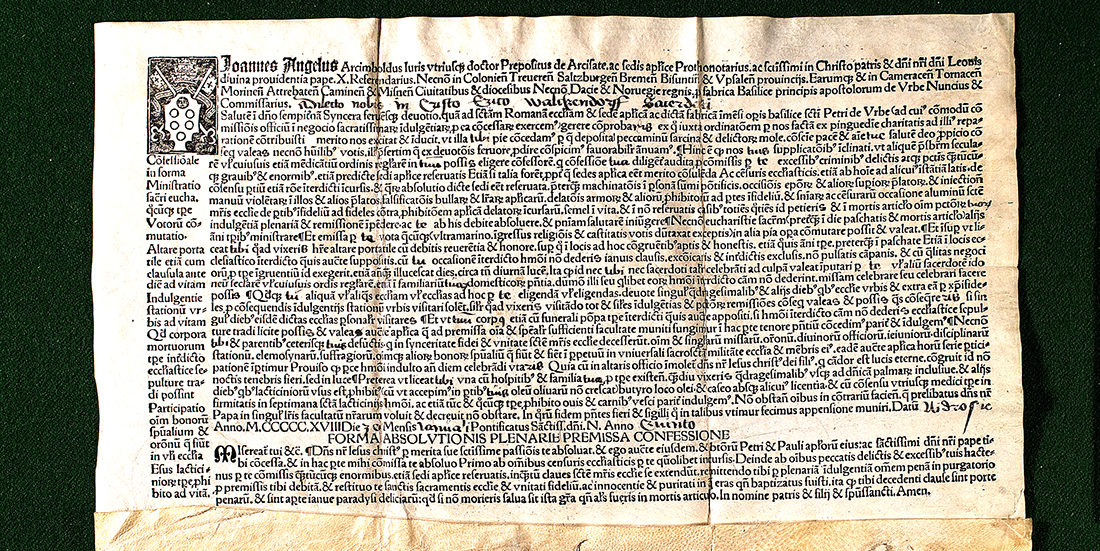
Indulgence trading was big business before the Reformation
Indulgence document, handed out after payment, assuring the full remission of sins

The words ‘sola gratia’, or Grace Alone, defined the movement as a whole, which rebelled against the idea that the cross was not enough: [Colossians 1:20… making peace by the blood of his cross]; but what makes Martin Luther such an amazing figure in church history, is that he set this movement off accidentally. He was completely unaware of the deal the Pope had made with Albert, for though the indulgences business was booming, the back door deal between Germany and Rome had not been publicized. Without knowing it, and based purely on spiritual conviction, he was unwittingly taking on two of the most powerful people in the world at that time, by criticizing their lucrative schemes.

Keep in mind that the Theses themselves were not condoning a split from the church, and were in and of themselves not overly argumentative. Based on his letters, he seemed quite surprised at the response of the Catholic church, and didn’t realize the political trap he had just stepped on. In fact, as a professor, it was a common way to present a theory or argument for debate so you could hear the other side in case you were wrong. The build up to it, and the actions that followed were the domino effect of that one event that Luther considered a innocuous statement. It wasn’t until the hornet’s nest had been accidentally kicked, that Luther had to muster his courage to stand firm on his interpretation of scripture.

Historians know much about Luther’s death, February 18, 1546, because they were recorded in detail by his deathbed confessor, Justus Jonas. Jonas wished to give an account in case false rumors might arise from enemies (which did happen). One rumor was that Luther had died suddenly or in his sleep. Back then it was falsely believed that if a person was wicked, they would die without time to confess their sins, condemning them to hell, a doctrine also not found in scripture. Likewise, Roman Catholics circulated the claim that Luther had died in a state of terror, believing he would be eternally condemned. But, Jonas recorded that Luther’s last hours were lucid and conscious. He confessed his sins and affirmed his faith in Christ, along with everything else that he had taught.

It is safe to say that we don’t always know how God will use people, and it is interesting that such a seemingly benign action by a professor could spark not only so many deaths, but the eventual Reformation itself, where people were grateful to learn the true power of the cross, and were grateful to have a Bible written in their own language. It wasn’t always so.

So when you think upon Reformation Day, this October 31st, let us remember all that transpired to put the true gospel of Jesus Christ in our hands, as recorded in our New Testament. A gospel of grace, instead of works.

Titus 3:4 But when the goodness and loving kindness of God our Savior appeared, 5 he saved us, not because of works done by us in righteousness, but according to his own mercy, by the washing of regeneration and renewal of the Holy Spirit, 6 whom he poured out on us richly through Jesus Christ our Savior, 7 so that being justified by his grace we might become heirs according to the hope of eternal life.