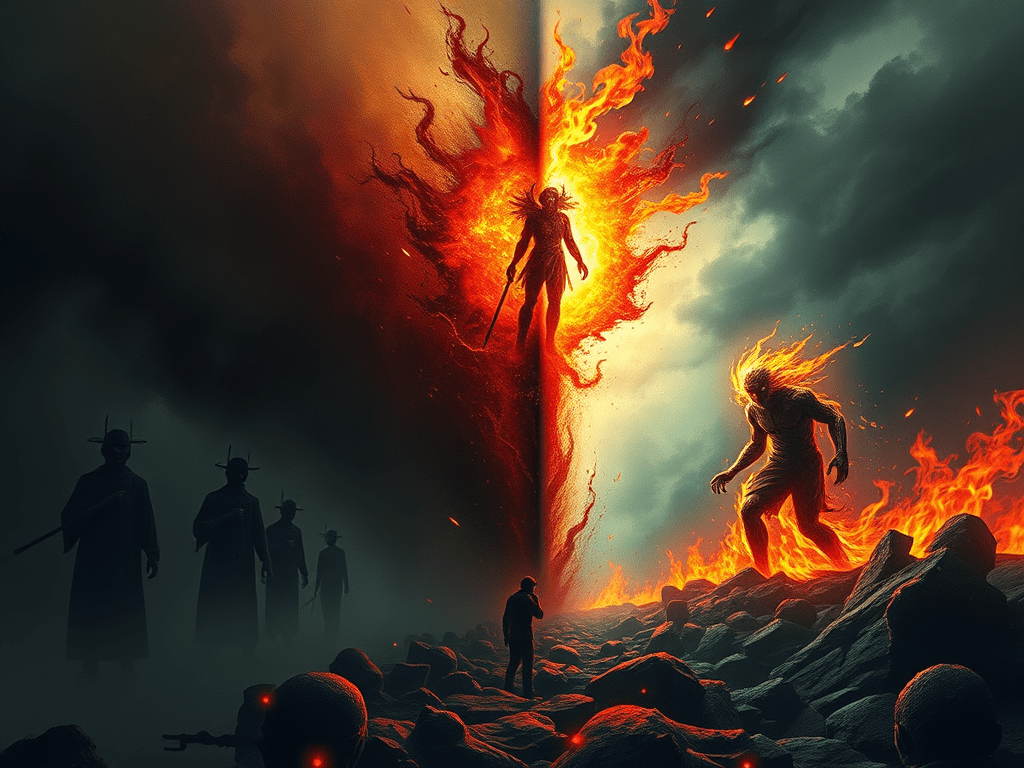
Hell – Annihilationism

After much study, it has become my position that Annihilationism, referring to those not found in the Book of Life at the end of all things being destroyed, and ceasing to exist, is a logical position to take, rather than the Orthodox position of ECT (eternal conscious torment).

After much study, it has become my position that Annihilationism, referring to those not found in the Book of Life at the end of all things being destroyed, and ceasing to exist, is a logical position to take, rather than the Orthodox position of ECT (eternal conscious torment).

It was customary for leaders and educators back at the time of the reformation to state plainly their position and be public about it to allow for contradiction, to see if it can be defended. This practice is what led to the 95 theses from Martin Luther. I would stand on the annihilation position, but with a reasonable amount of humility, as I am not seminary trained, nor do I have an advanced degree, and I could most certainly be wrong. I would also not choose to teach it in church, as my church does take the orthodox view, and if ever called to teach, I would operate under parameters we agree on, and would not choose to disagree with the elder-led position. I think that is only fair, and we must respect the umbrella we are under, and have each other’s backs. But I also recognize that healthy disagreement, whether debating free will vs predestination, sprinkled babies or immersed believers, premil or postmil, billions of years or seven days of creation, or any smattering of topics, it is fruitful to disagree, and spar from time to time, so that we may all benefit by staying engaged in the scriptures, seek answers, hone in on truth.

That being said, it is not a salvation issue, and therefore, taking a hard line on it, like I do with Salvation through Christ alone, or the Trinity, is perhaps a bit heavy handed. Nevertheless, despite running in to many Christian brothers who would prefer a more peaceable church journey, I tend to enjoy stirring the pot from time to time, if nothing else, then to at least practice girding up our loins. Iron sharpens iron, after all.

Let’s define the orthodox view:

It would be said by orthodoxy that ECT (Eternal Conscious Torment) Is Clearly Taught in Scripture:

Matthew 25:46 – “And these will go away into eternal punishment, but the righteous into eternal life.”

The Greek word aiōnios (eternal) is used identically for both outcomes: punishment and life. If “eternal life” means unending life with God, “eternal punishment” must likewise mean unending punishment — or else the parallel collapses?

Revelation 14:11 – “The smoke of their torment goes up forever and ever, and they have no rest, day or night…”

The phrase “forever and ever” (eis aiōnas aiōnōn) is the strongest Greek construction for endless time. The torment described here is conscious and unceasing — “no rest, day or night” — clearly not annihilation, right?

Daniel 12:2 – “…some to everlasting life, and some to shame and everlasting contempt.”

“Everlasting contempt” (deraon olam) must persist to be meaningful. You can’t contempt something that doesn’t exist. If God is infinite in holiness, then sin against Him carries infinite weight. The consequence must therefore be proportionally infinite. Temporal sin doesn’t mean the punishment must be short-lived — just as a momentary crime (e.g., murder) can yield a lifelong sentence.

Jesus spoke of hell more than anyone else with words like:

“Where their worm does not die and the fire is not quenched” (Mark 9:48) — drawn from Isaiah 66. This imagery suggests unending decay, not quick destruction. This is graphic and strong language to indicate a ceaseless situation. But this ceaseless torment demands we agree with an automatically immortal soul imbued to everyone.

Let us look at where this idea of an immortal soul comes from. If you lived your whole life without Bugs Bunny cartoon depictions of hell, or any preconceived notions of a devil and a pitchfork and roasting forever, and I handed you a Bible, and you simply read through it, imagine what you’d conclude about the end. Probably that you’d “not perish but have everlasting life.” Probably that some would receive a Second Death at the end.

Where would you point to convince yourself there’s millions of years of burning alive? I’m suggesting that as a layperson, without listening to what all these traditions tell us to think, can easily imagine walking away from the scripture and simply concluding a result as it is written; i.e. obvious death.

So why this axiom that a soul is automatically eternal? This is despite compelling verses such as, “And do not fear those who kill the body but cannot kill the soul. Rather fear Him who can destroy both soul and body in hell.” – Matthew 10:28.

The answer is, Plato! It was his assertion during a deeply philosophical time, that the soul was an immortal thing. The soul was to him eternal, immaterial, pre-existent, and indestructible by nature. So, by the time the Old Testament was being completed, and long before the New Testament, Plato’s views were already influencing the wider intellectual world — including the Hellenistic Jews and later Greco-Roman converts to Christianity. In ancient Hebrew though (pre-Plato), the soul (nephesh) was not seen as inherently immortal. People lived, died, and went to Sheol —but there was no clear doctrine of ongoing consciousness or immortality. Egyptian and Babylonian beliefs had afterlife ideas, but those were very different — ritual-based, not philosophical, and often only for the elite, rather than a unilateral belief.

Plato was one of the first to systematically argue for the soul’s immortality as a universal, philosophical truth. So no — the idea that the soul can’t die is not original to Hebrew or early biblical theology. It’s more Greek than God-breathed. But before we had Baptists, and Bugs Bunny, and horror movies, we had early church fathers, during the expansion of Christendom throughout the Greek and Roman world, and those steeped in church history are well aware that much of the culture crept in to early Christianity. The prior rituals were gone, and other than love God, love your neighbor, baptize one another, and take communion, there was not much left to take the place of the highly ritualized polytheistic world view. In the same way, philosophy and culture would have been prevalent even among genuine converts, and Greeks would inherently “know” that the soul was immortal before, and then after adopting the scriptures as true.

Origen (3rd c.) and Augustine (4th–5th c.) both inherited strong Platonic influence. They sincerely tried to synthesize Scripture with what they considered the “best” philosophy of the time — and Plato was the gold standard. So when they spoke of immortal souls, they weren’t quoting Scripture — they were echoing a Greek philosophical paradigm. It sounded right to them because it matched both their culture and their education. Origen in his work On First Principles, wrote:

“By an immortal and eternal law of equity and by the control of divine providence the immortal soul is brought to the height of perfection.”

This reflects his belief in the soul’s pre-existence and its journey toward perfection, concepts aligned with Platonic thought.

Augustine (354–430 AD), in The City of God, stated:

“The soul is therefore called immortal, because in a sense, it does not cease to live and to feel; while the body is called mortal because it can be forsaken of all life, and cannot by itself live at all.” Here, Augustine emphasizes the soul’s continuous existence, a view consistent with Platonic philosophy. These perspectives were not directly derived from Scripture but were interpretations influenced by the cultural and philosophical context of their era.

It wasn’t until the 14th Century that Dante’s Inferno depicted hell as a place of eternal, conscious, tailored torments and vivid, poetic visions that cemented the emotional and visual imagination of hell for centuries. It was this work that truly inspired our modern idea of hell, much like Close Encounters of the 3rd Kind modeled our image of aliens that have never been seen. One could not even engage with the specific medium and still hardly get away from it! While Dante certainly drew from Christian theology, much of the imagery is medieval, philosophical, and poetic, not biblical, and used Greco-Roman mythological structure (e.g., Charon, Minos, the underworld’s geography).

As I build the argument, I can rightly surmise that the origins of general beliefs regarding hell were not always based in scripture, but it does not excuse us from having to dismiss the framework applied to it. So what would a concise (but not exhaustive) rebuttal be? Quite simply, the consistent biblical use of terms like “perish,” “destroy,” and “death” rather than “eternal suffering.” The word eternal that is referred to over and over:

Matthew 25:46: “These will go away into eternal punishment, but the righteous into eternal life.”

-is to say this is an eternal result, a permanent result. It does indeed determine things for all time, but simply indicates that the result is a permanent one. It’s either permanently life or permanently destruction. These are eternal results, meaning they last forever. But nowhere in scripture, except through faith in Jesus Christ, is life itself offered.

The prior discussed notion within orthodox Christianity that the soul cannot be destroyed is being asserted in ECT, but number one, if God created it then of course he can destroy it – “Rather fear Him who can destroy both soul and body in hell.” Number two, this automatic right to eternal life is never offered outside of Jesus! It is only congruous with Christ. He is the way and the hope, and the life, whoever believes in Him shall have eternal life, have life and life abundantly – and what is eternal life? It is literally defined for us by our creator as existence with him, and getting to know him:

John 17:3 And this is eternal life, that they know you, the only true God, and Jesus Christ whom you have sent.

We literally have the Creator of all things defining eternal life that only He can grant, and it is a perfectly defined truth, and non-existent without Him, in whatever form!

If eternal life is only ever offered to a sheep, as part of the bride of Christ, then what must be the opposite side of that coin? The bible never offers life without Him; quite the opposite, it always offers destruction. And to reiterate the initial point, this resurrection unto damnation, The White Throne Judgment in Revelation is described as the resurrection of those not found in the book of life, who will be cast into hell, explicitly called the second death, again very clear to the layperson.

We cannot just assert, but must back the assertion with scripture, and of course I’d encourage everyone to examine the truthful scriptures, whether to agree or rip me to shreds. But here are a few verses that touch on this repeated idea of a death:

“Whoever believes in the Son has eternal life, but whoever rejects the Son will not see life, for God’s wrath remains on him.” – John 3:36

“Enter through the narrow gate. For wide and broad is the road that leads to destruction and many enter through it. But small is the gate and narrow the road that leads to life, and only a few find it.” – Matthew 7:13-14

There is only one lawgiver and judge, the One [God] who is able to save and destroy. – James 4:12

For the message of the cross is foolishness to those who are perishing (apollumi); but to those who are being saved, it is the power of God. – 1 Corinthians 1:18

They perish (apollumi) because they refuse to love the truth and be saved. – 2 Thessalonians 2:10b

He is patient with you, not wanting anyone to perish (apollumi), but everyone to come to repentance. – 2 Peter 3:9

Jesus said to her, “I am the resurrection and the life, he who believes in me will live even though he dies (apothnesko); 26 and whoever lives and believes in me will never die (apothnesko). Do you believe this?” – John 11:25-26

if he [God] condemned the cities of Sodom and Gomorrah by burning them to ashes and made them an example of what is going to happen to the ungodly; – 2 Peter 2:6

You should know that whoever brings back a sinner from wandering will save that sinner’s soul from death (thanatos). – James 5:20

In flaming fire taking vengeance on them that know not God, and that obey not the gospel of the Lord Jesus Christ: 9 Who shall be punished with everlasting destruction (olethros) from the presence of the Lord, and from the glory of his power. – 2 Thessalonians 1:8-9

The first part of this passage shows that God will punish those who reject the gospel and verse 9 reveals exactly what this punishment will be: everlasting destruction. This obviously refers to destruction that lasts forever and not to an endless process of destroying without ever actually destroying, as supporters of eternal torment declare. After all, to perpetually be in the process of destroying without ever actually succeeding isn’t really destruction at all! This would be everlasting torment, which of course is never once described in scripture.

There are many more verses… so many more, and each reiterating this same obvious theme. We read perish, destroy, die, destruction. We read of chaff, and weeds being no more. This particular beaten horse, if it be not dead, is at the very least in immediate danger of expiring, with just a cursory reading through our Bible.

But, the ECT position may say, what if “death” is separation, not cessation?

In the Garden, God told Adam: “In the day you eat of it, you shall surely die.” But Adam didn’t die physically that day. So what happened? He died spiritually — separated from the life of God. This understanding of death as separation is carried into the New Testament: “You were dead in your trespasses and sins…” (Eph. 2:1)

“She who is self-indulgent is dead even while she lives.” (1 Tim. 5:6)

So if “death” means estrangement from the life of God, then the second death could be eternal separation — a living death, conscious and unending. Is “separation” a satisfying interpretation of “death” in Revelation 20:14? Or does it stretch the meaning too far from what the text plainly says?

I do not find this idea of separation while alive, and annihilationism to be mutually exclusive. I think there is great harmony in fact – this spiritual separation leading to an eventual permanent separation in death. The dread of such a solemn fate is taught and pondered and felt, and with it fear and wisdom.

But logically I would push back on someone who uses this as a pillar for their argument and ask this: if God is omnipresent, the creator of both heaven and hell, and his presence and his justice are throughout both, then how else could one actually be separate from God, other than ceasing to exist?

Where shall I go from your Spirit? Or where shall I flee from your presence? If I ascend to heaven, you are there! If I make my bed in Sheol, you are there! – Psalm 139:8

If God is omnipresent. and His justice and authority uphold even hell itself, then true separation — not just relational or moral, but actual existential separation — can only mean nonexistence. As long as something exists, it remains upheld by God. So if ‘death’ is complete separation from God, the only coherent way to understand that is annihilation — because anything else still requires divine sustenance, even if it is some form of ordained torture, as it would remain part of His creation.

This reframes the debate:

For the ECT side to say hell is separation from God, they must clarify: separated how? Not spatially — because God is omnipresent. Not ontologically — because nothing can exist apart from Him. So what is left? Relational separation? That feels weak compared to the finality Scripture seems to portray. This is not metaphorical ruin, but ontological finality — God withdrawing the sustaining breath, and the soul collapsing into nothingness.

This could be expanded into an extensive series of articles, or a book, so again, let us not be exhaustive and obnoxious in our detail. But if we truly believe that death is swallowed up in victory, then immortality is something that we must “put on”, immortality being a gift, and again is only every mentioned in synergy with Christ. We shall not perish but have everlasting life.

One final issue, saved for the end, because it is perhaps the only place in the bible where one could fire back at my position with a particularly poignant verse. I speak of course of this:

“If anyone worships the beast and his image and receives his mark on the forehead or on the hand, he, too, will drink of the wine of God’s fury, which has been poured out full strength into the cup of his wrath. He will be tormented with burning sulfur in the presence of the holy angels and of the lamb [Jesus].  And the smoke of their torment rises forever and ever. There is no rest day or night for those who worship the beast or his image, or anyone who receives the mark of his name.” – Revelation 14:9-ll

The phrase “forever and ever” (eis aiōnas aiōnōn) is the strongest Greek construction for endless time. Would the ECT Christian not be correct in referring to this?

It would seem to fit the narrative if not for a couple of key points. For starters, this is a book of apocalyptic language, obviously steeped in hyperbole, designed to color the pages in extreme illustrations, and to paint the most vivid depictions. Regardless of your position on interpreting Revelation, it is obviously dripping with descriptions beyond our imaginings, and to have a picture of death overstated here is not out of touch with the surrounding literature. Secondly, these verses have a sister verse in Isaiah:

Edom’s streams will be turned into pitch,

 her dust into burning sulfur;

 her land will become blazing pitch!

It will not be quenched night and day;

 its smoke will rise forever. – Isaiah 34:9-10

As we can plainly see, there are terrific parallels in language between the two verses. Do we get the impression that the kingdom of Edom will burn forever and ever? Of course! But the rest of the chapter renders this interpretation impossible. It shows us an Edom that becomes a desert, that is filled with wild animals, where the people are “totally destroyed” and slaughtered. So how can the burning day and night forever mean what it is saying? Let’s view the terminology in parallel:

her dust [will be turned] into burning sulfur               – He will be tormented with burning sulfur

its smoke will rise forever                   – the smoke of their torment rises forever

It will not be quenched night and day                        – There is no rest day or night

Our conclusion must be that just as the rest of the Isaiah passage renders the literal interpretation moot, so it is with the rest of the Revelation passage, as the Lord follows through with His plans for total redemption, and a new heaven and earth. Night and day in this context must obviously mean that it will burn continuously until the utter destruction of the place is carried out in accordance with the will of God. Then we see the ensuing result, a desert fit only for animals, and a destroyed people. In the same manner, so also will the continual burning of the lost be, until they are destroyed; not tortured endlessly in some non-stop incomplete destruction process never to be fully carried out.

With this thought we come to the final crux of the issue at hand – What possible good would it do for redeemed and new world to have a large corner of it designated for endless torture? We imagine the mothers of unsaved children enjoying heaven knowing their kids are roasting in hell the entire time. Are their memories wiped, or can we be honest with ourselves, and say that logically we can all reconcile the justice of God’s wrath without the need for endless torture? We allow for hierarchy in hell, and degrees of punishment, the regret and pain of outer darkness, and gnashing of teeth, of course. But at a certain point it starts to become a warped version of justice, imagining 100,000 years of torment and death because you spent 60 years on earth being selfish. Or how about 1 million years? At what point does it become cruel that the person was ever made? Is this the character of God? Hasn’t this notion always struck caring Christians as a bit maladroit? Does speak well to the character of God, where we all celebrate the redemption of mankind, as millions of people scream in agony forever? Hitler might deserve it, granted, but at some point I’m going to be wishing that the old agnostic lady who made me cookies down the street would be let off the hook.

Bottom line is, when we read the bible without the shackles of cultural dogma, where in the word would we point to convince ourselves there’s millions of years of burning alive?

If I had only the Bible and no cultural baggage — what would I conclude? From the Old Testament:

“The soul that sins shall die” (Ezek. 18:4)

“They shall be as though they had never been” (Obadiah 1:16)

“The wicked are like chaff that the wind drives away” (Psalm 1:4)

From the Gospels and Epistles:

Repeated language: perish, destroy, burned like branches, die, second death.

Jesus warns of Gehenna — a valley of destruction, not eternal torture chambers.

John 3:16 again: the contrast is perishing vs. everlasting life.

From Revelation:

Even the Lake of Fire is explicitly called “the second death” (Rev. 20:14).

No verse shows unending screams — it shows final judgment, then new creation.

So what would I conclude?

Life is offered through Christ. Death — real, irreversible death — awaits those who reject Him.

Do you think the Church is ready to claim this? Or will tradition hold it back?

I imagine the church would remain rigid, unable to differentiate between gentler matters such as this, and serious matters, such as a watered down gospel, or justifying sin. They will see any attempt at weakening orthodoxy as an assault on the whole. Christians will not abide countering  any part of their beloved Confessions of Faith, which of course are lovely, wonderful guardrails and tools for discipling. But they are not scripture, and conversation about any tenants of them can cause defensiveness. Because in their view:

If this piece of doctrine is reconsidered, what’s next?

Is this the beginning of compromise?

Are we letting culture soften us?

Are we undermining the urgency of evangelism?

But I am not trying to attack orthodoxy, within which I am firmly ensconced for the most part. I am simply examining scripture for truth and a cohesive understanding of the Word. Could it be possible that automatic immortality is and was always pagan? If the wages of sin is death — why are we describing it as unending life in torment? And that’s a question that deserves to be heard without suspicion about my motives. There is nothing wrong with earnest study between brothers in Christ, and even if I’m totally wrong, it is worth it to present the argument precisely so it can be refuted. In debates I have been called gross, heretic, stupid, and Satan, by well-meaning Christians who believe so strongly against me that I am a rude offense to them, but we should not be scared to engage if our goals are to seek truth, and simply talk about what the scripture says. And if we part loving brothers in Christ who happen to disagree about something, then we are blessed to have been challenged, and sharpened, and to have sought truth in fellowship together.
Unholy Trinity

The legend of the first unholy trinity is an approximate history around the time of Babel. A nexus that would have dire consequences for all remaining time. People often ask if Christianity has borrowed its truths from other myths and cultures, but the bible tells us “…we wrestle not against flesh and blood, but against principalities, against powers, against the rulers of the darkness of this world, against spiritual wickedness in high places.” (Ephesians 6:12) It is my opinion that every false and opposing religion that detracts from the truth of the gospel has been orchestrated by such powers, and that casting doubt on a plan of redemption known about since the Garden of Eden is an efficient way for enemies of God to muddy waters. Let’s take a look back in time at this important period, where many lies began.

Noah landed on the mountains of Ararat after the flood around 2350 BC, and our greatest geological features were laid down all over the world. Mountain ranges and gorges were formed, as great spillways washed millions of tons of sediment into oceans. Animals were swirled and broken and buried all over the earth, creating fossil graveyards, placing whale bones in deserts, and burying sea creatures on every continent high above sea level. Pillow lava formed great swatches of land, fault lines settled and cooled, and sedimentary layers were deposited over vast areas of the world. One such rock layer called the Cretaceous chalk beds of southern England can be traced to Ireland, across France and Germany, down to Israel and Egypt, and remarkably all the way to the mid-west United States, all having the same distinctive strata both above and below, and the same fossils within, an impossibility without the world-wide, calamitous flood of Noah. Mud and rock travelled hundreds of miles, exposing layers on canyon walls that had no erosion between, indicating catastrophe and rapid burial. From a Niagara Falls that would not exist had it millions of years to run its course, to the limiting factors of the Sahara Desert and the Great Barrier Reef, I unabashedly believe the great deluge of Noah’s day formed the world we see now.

            Biblicists can trace all mankind back to that very ark. But the perfect world God had created was no more. You remember your Genesis, yes? Men lived to 900 years old. But the sky fell, the atmosphere changed, and the days of men were reduced. Going by a biblical timeline, people forget that it did not happen right away. This meant that the earliest patriarchs, such as Shem who lived to 600, Heber who lived to 464 years, Terah who lived to 205 years, would have been revered, even idolized by generations of people. Just for reference, Noah who died in 1998 BC could have known a two year old Abram (Abraham) if he had been in the same city. This would have been his great, great, great, great, great, great, great, great grandfather.

            Certainly, if those of the line of Christ lived so long, other lines did as well. As beautifully complete a history as the bible is, it is only a history of the Hebrew nation. But Ham, and Japheth had sons and daughters, and it is quite conceivable that men of old who desired adoration let themselves be perceived as gods. Consider, according to Genesis chapter 10, Ham begat Cush, who begat Nimrod. It says Nimrod was a mighty one in the earth, and the beginning of his kingdom was Babel where history records severe idolatry. He then establishes Erech, and Accad, and Calneh, in the land of Shinar, which makes up the Khabur Triangle.

The pieces of the legend begin with what we know from the word of God. In Babel, Nimrod, as this mighty hunter, wished to erect a tower. This building of a great tower was not for the worship of God, but rather in the face of God, and for man’s own exaltation and benefit. Nimrod, this self-proclaimed god-man, was the impetus behind its construction, for the sole purpose of challenging heaven with glorified self. The languages were confused, and the people were dispersed. But they all learned the same wrong way to worship, and all had the same champions to idolize.

            There is no way to get this next part exactly right, for no ancient history of any peoples is even minutely comparable to the continuous and specific history of the Hebrew witnesses. Archeology often misses this, and it is to their peril, rather than the bible’s. No scholar worth his salt would dismiss biblical records over that of the incomplete, disfigured records of any other culture. And this is not a small point; Hebrews are the only ancient culture to have told the truth when logging their own defeats. The common practice was for losses to be erased from history, so that civilizations, such as Egyptian, Mesopotamian, Assyrian, could retain their perceived glory. But we know who glory belongs to, don’t we?

                        The bible tells us that Nimrod established the next cities, and history says Ninus established cities as well, Nineveh being one of them. Legend says that along the way, Nimrod picked up a bride named Semiramis. Some construed she was found on the street, perhaps engaging in the ‘oldest known profession’. No one knows for sure. But as men followed Nimrod for his prowess and civic leadership, the same citizenry looked to her for guidance in spirituality. Nimrod gave her the reigns as queen, allowing her to control the hearts of men.

            The kingdoms that were established delved into debauchery. It was the beginning of opiates, and prostitution, and revelries of questionable intensions. There was of course drinking, and plenty of gossipy scandal, but worse than that were the sacrifices made under the guise of religious fervor. Virgins and I’m sorry to say, first born sacrifices were common occurrences. Amidst the cultish practices run amuck, Semiramis became pregnant. Now, who could say if it was Nimrod’s baby, or one of the frequent guests of the palace beds? There is insinuation, however, that the coup which ensued to avoid aspersion was also an epic power play, and quite possibly the most damaging thing the devil has ever concocted.

            One night during a banquet, an evening of wicked carousing, Semiramis stepped up the intensity in every way. It became a raucous and sexual affair, and the queen made sure that the wine flowed, and the hallucinogens were ardently consumed. At the peak of the celebration, she had convinced her husband to be the sacrifice for the evening. Folklore indicates that he willingly allowed for his limbs to be tied to horses in the courtyard, and in his stupor was convinced he would survive, or be reborn. He was not.

            Semiramis was not only the queen, but had become the high priestess of this ceremony, and when she gave the word, the party goers obeyed her wish, and goaded the horses into a frenzied gallop, ripping asunder the mighty king. Now, with a son in her belly, and her promising the king would return, she, like the Grinch, thought up a scheme, and thought it up quick. She promised that if his body was ripped apart and spread to the corners of Mesopotamia, or Shinar, then those cities who had a piece of Nimrod would flourish. She then, most promptly, asked for the pieces back, so she could reassemble her husband. She received almost every piece, if you believe the stories, save one. And based on Obelisk monuments built in his honor, I think you can guess which piece did not return to the palace. That’s right, it was his hand… Just kidding, it was his royal man-business.

            This, of course, disallowed her to perform the reanimation of her late husband, and she convinced the people that since he could not return, his spirit had instead entered the sun, and had become the sun god, Shamash, which later became Baal. Semiramis had her child, and named him Ninus. She also told tales about herself, to dispelled reports that she had been a mere prostitute, and had given birth to someone else’s baby. The myth that she had never been born a baby, but was instead divine, spread throughout the known world. The moon had given birth to her full grown after one of its 28 day cycles by floating a great egg down to the Euphrates River. One distortion suggests that she was birthed by the river, or by the sea, and came to shore on a large seashell, similar to the story the Greeks would adopt about their goddess Aphrodite. This of course meant that Ninus, or Tammuz, had now become the defacto son of a sun god and of a moon goddess. You would think that this would be enough distortion for one super villain, but it was not. The rumor was also spread that Ninus was in fact the reincarnation of Nimrod. This was the justification Semiramis used to marry him.

            The son of this trinity was known by many names, an amalgamation of real and fictional leaders throughout the ancient world. The name Ninus is not found in any cuneiform literature, the ancient writing of Mesopotamia, but Nineveh is ‘the city of Ninus’ in Greek, and Tammuz, his alternate name, is Akkadian, the language of Mesopotamian cultures such as Assyria and Babylon. He was known to be fond of rabbits, and also became a hunter like his father, which eventually led to his demise. The day came when he was killed by the wild boar he was hunting. The queen told the parishioners that a forty day period of sorrow each year prior to the anniversary of his death was to be recognized. During this time, no meat was to be eaten. Meditation on Tammuz was to be commenced, shown outwardly and publically by making a ‘T’ on ones chest. Semiramis, also known by her Akkadian name Ishtar (pronounced Easter), soon dedicated a day of celebration in spring to her growing and mysterious religion, revering the queen of heaven’s fertility and sexuality, and her birth from the full moon. It became the tradition, of course, to utilize eggs and rabbits, and to dine on a pig, the source of her son’s demise.

Semiramis was soon worshiped as the ‘queen of heaven’. In Babylon she built the first obelisk, 130 feet high, to honor the husband she destroyed with horses, which of course represents the non-returned phallus. It is interesting to note the obelisks that have been erected – if you will pardon the pun – in history, and by whom. The largest obelisk in the world, for example, is in front of the capitol building in Washington, D.C., the Washington Monument; certainly food for thought. The obelisk in front of St. Peter’s in Rome is one hundred thirty-two feet high and came from Heliopolis in Egypt, where Semiramis took the name Isis, and Ninus was known as Horus, or Osiris. The Egyptian mother and child were worshiped there, with the infant Osiris seated on his mother’s lap, an all too familiar image. The mother and the child. Countless Babylonian monuments show the goddess-mother Semiramis with a baby in her arms. After Babel, different names were applied. Just as Tammuz was an Akkadian name, so Semiramis had the Babylonian alias, Ishtar. Ancient Germans worshipped the virgin Hertha with child; Scandinavians called her Disa; in India, the mother and child were called Devaki and Krishna, and also Isi and Iswara; pagan Rome had Fortuna and Jupiter; in Greece, she was Ceres, or Irene, and he was Plutus; and in parts of Asia they were known as Cybele and Deoius. When Jesuit missionaries finally visited the Far East, they were incredulous to already find Madonna and child in Tibet, Japan, and also China, where Shing Moo was holding a child with glory around her head, painted as if it had been done by Italian artisans.

            The fallout from this tangle of lives reverberated through the ages, and in these three persons, you have the origin of false idols, polytheism, reincarnation, self worship, virgin and first born sacrifices, prostitution, paganism, and witchcraft. What took place there at Babel so long ago was arguably the most detrimental series of events to mankind’s salvation ever conducted. The unholy trinity of Nimrod, Ninus, and Semiramis saturated the globe with unhealthy rituals, and it peaked in influence when Babylon set the tone for the world. Babylon, Assyria, Ur, they all eventually fell, but the poison had already seeped into every culture. With the languages confused, man spread from that nexus of abomination, and walked aspects of all false religions to come across the earth. The worship of fabricated gods has been a tool of evil ever since these traditions were set in motion, and mankind has suffered in its wake. It was such anathema to the Lord’s will that He wrote

‘Ye shall have no other gods before Me’

with His very finger. A command often mistook, when it is not seen for the love and protection it provides.

Language

Ignoring observations of flood features, and population growth, and DNA complexity, and the myriad of other science that can easily be interpreted to point to created complexity, we can take a brief aside, and consider language for a moment. The spoken word, beautiful in its complexity, freedom, and innovation, allows mankind an additional unique place above the animal kingdom.

As a Christian who believes in the authority of scripture, it is simple enough to consider man created in God’s image on day 6, and immediately engaging the Lord in conversation. The animals were named, the creation account was communicated, in order to be passed down, whether verbally, or in writing. We even see phrasing from Adam that he is utilizing language far beyond simple communication, and adding flair and poetry to his thoughts:

Gen 2:23 Then the man said,

“This at last is bone of my bones

and flesh of my flesh;

she shall be called Woman,

because she was taken out of Man.”

Evolutionists, of course, must take the unenviable position that somehow animalistic grunts and noises, grew in complexity and became language, the record of which goes back the expected 5000 years of a biblical world view. Furthermore, the evolutionist must contend with the fact that it seems language is MORE complex the farther back you go, rather than less. In English, we can easily point to the 1600’s writing of Shakespeare, a study deemed so difficult that it has been all but abandoned by public schools, and is not even required reading for some English Literature majors in college. Even going back a century or two, and cracking open some classic literature, realizing they did not have google, or dictionaries, or thesauruses, and to witness the colorful and beautiful command of language that is being written, even an intelligent person of today can appreciate how elevated it used to be.

Beyond this though, language experts concede that Sanskrit, and other ancient languages, are more complex in their grammar, than our modern ones, though this fact is hardly publicized. The Société de Linguistique de Paris literally banned discussion on language origin, which lasted more than a century, because it conflicted with Darwin’s gradual processes, and was so filled with speculation.

The evolution of linguistics is an idea only, and has no evidence. And to further complicate matters, linguistic experts concede that multiple ancient languages arose unrelated to each other. Akkadian, Semitic, Sanskrit, Sumerian, and others; regardless of how you break it down, not only are they severely different, but they are all complex, and complete.

So the evolutionist, while denying that a creator had split tribes through language, must concede that multiple and different complex languages emerged within different people groups all over the world. This is to say nothing of the fact that within the ancient people groups, similar flood stories exist, indicating they all share the same history. There are over 270 ancient flood legends and traditions recorded in ancient history, 80% of them mention a large vessel saving the human race. 88% involve a favored family. In 70%, survival was due to the boat. In 95%, the flood was responsible for the death of mankind.

Again, I find myself in the pleasurable comfort of knowing the authority of God’s word matches easily with what I observe. Hopefully, this is a small building block of support and faith for you as well.

THE IPUWER PAPYRUS

As a mater of interesting archeology, the Ipuwer papyrus, also known as the ‘Admonitions of Ipuwer’, is an Egyptian text written on papyrus from around 2000 to 1600 BC, which would put it right at the period of time coinciding with the Exodus. This makes the document a very controversial one, for several reasons.

As a matter of interesting archeology, the Ipuwer papyrus, also known as the ‘Admonitions of Ipuwer’, is an Egyptian text written on papyrus from around 2000 to 1600 BC, which would put it right at the period of time coinciding with the Exodus. This makes the document a very controversial one, for several reasons.

Firstly it is incomplete, very damaged, and is missing the beginning, and the ending. Secondly, it makes reference to circumstances happening in the surrounding culture that parallel very closely with events of the Exodus. Since the Bible’s critics maintain that the exodus was fictional, and Christians maintain that the old testament records accurate historical narratives, the assertion of bible critics would be to maintain that the two references have no correlation.

Let’s be clear about a couple things. Christians do not need to find corroborating archeology to believe, or bolster faith. Critics mistakenly insist that evidence must be found outside the Bible, which is an unfair bias, as the Bible itself is a library of many books of antiquity, not only remarkably preserved, but uniquely self-corroborating, despite authors being separated by time and distance. In fact, the Bible’s preservation is so well respected by historians, that if one were to dismiss it outright, they would be forced to dismiss all books of antiquity, all of them having far less evidence of reliability. Critics who demand evidence “other than the Bible,” mistakenly assume it is an invalid source of information.

Also, Egyptian history is notorious for deleting negative or embarrassing details. Unlike the embarrassing testimony of sin, confusion, and lost battles, recorded truthfully by the Hebrews, it was not uncommon for Egyptian or other cultures to erase kings they didn’t like, destroy records of wars they lost, or keep details of enemies from notoriety. The result being a highly edited, and favorable account of an empire’s history, coupled with an untenable timeline of kings and events.

That being said, it is always fun when archeology and other sciences do indeed support the authority of scripture, which happens often. As an example, in 2 Kings 18, it says:

13 In the fourteenth year of King Hezekiah, Sennacherib king of Assyria came up against all the fortified cities of Judah and took them.

Critics often maintained such a king never existed, the Bible was wrong, and secular lists of ancient kings should be held in higher esteem than made up, untrustworthy scripture… that is until 1849, when Henry Layard uncovered the city of Nineveh, and found Sennacherib’s name at the gates.

Arguing that because we haven’t found proof yet, means the scripture isn’t accurate is an argument from silence, and joyfully, often backfires when more evidences are found. But, let is digress back to the Papyrus in question.

Here we have a rare look into some of Egypt’s difficulties, sufferings, and defeats, at a time where most historical records preserve only a sterling façade of power and glory. I highly recommend the documentary Patterns of Evidence regarding the Exodus, if you haven’t seen it, but let’s explore some of what is illustrated by the poetry on this Ipuwer papyrus.

“The door [keepers] say: “Let us go and plunder.”… and the servant takes what he finds” (Exodus 12:36, The Jews plunder the Egyptians upon leaving)

“poor men have become owners of wealth, and he who could not make sandals for himself is now a possessor of riches” (took silver and gold)

“Indeed, the women are barren, and none conceive. Khnum fashions (men) no more because of the condition of the land.” (everything destroyed)

“pestilence is throughout the land, blood is everywhere” (plagues)

“the river is blood, yet men drink of it” (Exodus 7:24 And all the Egyptians dug along the Nile for water to drink, for they could not drink the water of the Nile)

“Indeed, gates, columns and walls are burnt up, while the hall of the palace stands firm and endures… towns are destroyed and Upper Egypt has become an empty waste.”

“I have separated him and his household slaves”

“Indeed, runners are fighting over the spoil [of ] the robber, and all his property is carried off.” – (This is an interesting one, because it is possible citizens are fighting over what has been left in the abandoned homes of the “robbers,” those who plundered the great city. They would be fighting over spoils out of great need.)

Indeed, all animals, their hearts weep; cattle moan because of the state of the land.

“Indeed, the children of princes are dashed against walls, and the children of the neck are laid out on the high ground.” – (tenth plague, death of Egyptian firstborn – At midnight the LORD struck down all the firstborn in Egypt, from the firstborn of Pharaoh, who sat on the throne, to the firstborn of the prisoner, who was in the dungeon, and the firstborn of all the livestock as well. 30 Pharaoh and all his officials and all the Egyptians got up during the night, and there was loud wailing in Egypt, for there was not a house without someone dead.)

“Behold, the fire has gone up on high, and its burning goes forth against the enemies of the land.” – Pillar of fire)

“Behold, things have been done which have not happened for a long time past; the king has been deposed by the rabble.” – (slaves victorious over a king)

“Behold, he who had no property is now a possessor of wealth, and the magnate praises him.”

“Behold, the poor of the land have become rich, and the [erstwhile owner] of property is one who has nothing.”

What an amazing document! So many parallels it is hard to ignore. This is by no means exhaustive, and many additional details can be determined by reading all of it, including consequences of the event. Details about barbarians looting afterwards, lead us to believe there was much devastation, and loss of power, opening the city up to looters. Remember, much of the army would have been destroyed in the Red sea.

Of course, we have the perfect authority of scripture, and Jesus stamp of approval for the Old Testament, which He quoted often, in His fulfilling of the law. There are a great many other evidences as well that support the always trustworthy Scriptures. Kahun as an example could have been a slave village, was poor, and nearby. It had buried infants under the floors, possibly from the Egyptian slaughter of Hebrew babies, as well as evidence that the people left suddenly and definitively.

The Amarna letters, ancient writing between Egyptian and Middle Eastern rulers, accuse tumult on a group labeled as Habiru, a probable term for Hebrews. Also at this same time we have evidence of cities like Jericho falling, an amazing discovery in its own right, since the walls somehow fell outward, unlike the collapse of normal walls in war.

The bible, in proper exegesis, interprets itself, and is God breathed and certainly trustworthy. But, wow, is it fun to see amazing historical evidences that paint a clear picture, and support the truth that was known all along.

Should Creationists Be scared of Quantum Mechanics?

Quantum Mechanics is an innovative physics field, the math of which is certainly beyond my expertise, and that has merit as a study of how sub-atomic particles behave and interact. But despite physicists’ insistence, specifically those dedicated to evolutionary processes, it concerns operational sciences rather than origins. And what we run into is the lesson told many years ago by Socrates, that the smartest of us often think themselves wisest because of expertise in one subject they deem most important. This is born out in the poor philosophical conclusions of Hawking, and others, in my opinion, and since they were wise in one area, and share a world-view with main stream scientists, their perceived intelligence and respected reputations prevented critical examination of their philosophical conclusions.

So much so that Hawking gets a pass when he says “because there is a law like gravity, the universe will create itself from nothing.” When he makes the truth claim that “free will is an illusion” without realizing he is admitting we have no reason to trust his own truth claims, including that one!

Or how no one bats an eye when Biologist, Richard Dawkins has to remind us to ignore the appearance of design during his never-ending campaign against a designer: “Biology is the study of complicated things that give the appearance of having been designed for a purpose.”

Without evidence of any kind, Dawkins appeals to faith-based occurrences beyond nature while in the same book, (God Delusion) smugly attacking Christians for doing the same: “There are probably ‘superhuman’ alien civilizations elsewhere in the universe.” “There may well be a plethora of universes.”

He is not rebuked for obvious circular reasoning: “We exist here on Earth. Therefore Earth must be the kind of planet that is capable of generating and supporting us.” Brilliant. (insert eye-roll emoji.)

According to Socrates (and Plato) it is okay to be ignorant, because you can remedy it by learning. What is a dangerous enemy of knowledge is being caught in the illusion of knowledge while in fact being ignorant, because of pride.

In the age of google warriors, and misinformation, it is often those who are smart at one subject who have the strongest opinions about many others, especially that which they don’t know much about. (The fact that atheists and scientists would levy this same charge at me is not lost on me. I am a student of many things, but do certainly attempt to hang my world-view on an authority higher than my own whenever possible. That being said, I would stipulate that I am not immune to that criticism either).

Since Max Planck’s Nobel prize in 1919, Quantum Mechanics has been a tangent from classical physics (Newton) and was furthered by guys like Heisenberg, Einstein, and Bohr. The math supports the theories, and it solved problems that classical physics could not.

But here is where the practicality and the problems lie. When you examine the functions, the math shows that wave functions exist as a superposition of all possible states. In this way, we can describe the characteristics of a particle. This makes all positions true simultaneously, and each position inevitable. Extrapolated to the absurd, this acceptance that all possibilities are true is one of the reasons for atheist/evolutionary appeals to a multi-verse, yet another unprovable fudge factor needed to explain the Big Bang Model in naturalistic terms, due to how impossibly finely tuned our universe is. (Stephen Hawking tinkered with this idea late in his life).

It is already well documented in many works the dedication modern scientists have to materialism, evolution, and the anathema of Intelligent Design within the halls of academia; accept anything to prevent a “divine foot in the door”, even that which is absurd, by their own admission. This leads of course to faith in the impossible, the unprovable, the unobservable, and faith in these things, they persist, is supported by QM, because all possibilities exist at once.

In this New Age, or post-modern age, this leads to a morally relativistic view of QM, that reality should be taken as subjective, or based on the observer. Both Einstein and Schrödinger didn’t like the mysticism known as “the observer collapses the wave function,” and even the Schrödinger’s Cat experiment, a now famous pop-culture reference from the Big Bang Theory show, was actually a purposeful reduction to the absurd, as Schrödinger relied more on the law of non-contradiction, rather than relativism.

The basic, true laws of nature and logic, like causality, identity, non-contradiction, were not abandoned by the fathers of QM theorists, but has been popularized today as more and more appeals to a Godless universe meet headlong with direct observable facts that keep proving the Big Bang theory is poor science. Hence the need for faith based beliefs and fudge factors, such as dark matter, dark energy, the Inflaton, the multiverse, etc. You will notice, all of these fudge factors, the physicist and cosmologist must have “faith” in to keep hoping that the universe is Godless. But they do not attribute it to faith, as they lean on the crutch of relativity that QM provides for them. Since it is their specialized, elite field they hold in high esteem above the average plebian’s paltry understanding, they fall into the trap of valuing their elegant math-based conclusions over obvious empirical observations we see and understand every day. They surmise in their own minds every possibility is inevitable without God, as long as they don’t have to observe those conclusions today in real time. This appeal to deep time, or enough time, is the magic elixir poured into each opinion to add credence, and is done so with impunity, since this pillar of evolution is automatically ensconced in the public’s mind as “fact.” In this manner, they can criticize the Christian as ignorant, stupid, or insane (Richard Dawkins) while employing the same tactics themselves, faith being the evidence of things not seen (Heb 11:1).

When we speak in laymen’s terms, it boils down to very smart scientists and mathematicians being so hyper focused on the minutia of QM, that they miss the forest for the trees. This is of course coupled with utter dedication to the presupposition that inorganic evolution is true, as it must be if we are to believe that directionless, purposeless, unthinking inorganic material somehow create intelligent order. We are once again faced with this persistent axiom, Romans 1:22 Professing themselves to be wise, they became fools. Again, this is simply because all possibilities exist simultaneously, including one where there is perfect order.

Doctor of Physical Chemistry, Jonathan Sarfati, a respecter of Newton, science, and a creationist, states it this way: “It is typical of these cases that an indeterminacy originally restricted to the atomic domain becomes transformed into macroscopic indeterminacy, which can then be resolved by direct observation. That prevents us from so naively accepting as valid a “blurred model” for representing reality. In itself, it would not embody anything unclear or contradictory.”

Bottom line, QM works, has strong support, and is not a threat to creationism. In fact, some studies highlight its usefulness in nature, (sense of smell, photosynthesis, bird navigation). But with presuppositions on both sides, what we see is the confusing of QM with interpretations of QM. Luckily we have observable reality to rely on, and in that reality, we know how nature reacts unmanipulated by intelligence, and no amount of insistence that explosions create perfect order naturally will change that.

Truth: How important is it in a post-modern world?

It’s an ever-increasing era of metaephysic, existential, new-age, post-modernism, where aside from well-studied philosophers who know the names of Kant, Hume, Foucault, Derrida, and Lyotard, the common layperson stays caught in an elusive and eclectic mindset against any assertion of absolute truth. It has become the focal point of Culture War, of critical theory and CRT, and has damaged judeo-christian moorings within acedemia, and by extension, social responsibility and morality.

With enough counter-culture arguments to appease anyone looking to be excused from objective moral standards, its followers, again, unless trained in specifics, leave philisophical instruction with just enough bumper-sticker theology, and general malaise to float somewhere between openness or total abandonment of truth.

Post-Modernism coupled with the inexorable conclusions of being an evolved accident in the universe with no purpose or meaning, has taken its toll on an already fragmented and indifferent society. By most metrics, whether reading, community, fatherlessness in homes, crime, church attendance, not only is the truth missing, but the very desire to seek it.

And yet, upon study of the word, the truth plays a monumental role in how we percieve the world. Jesus says in John 14:6, “I am the way and the truth and the life. No one comes to the Father except through me.”

1 John 1:8 says, “If we claim to be without sin, we deceive ourselves and the truth is not in us”; pointing to a moral truth that definitively exists. In 1 John 3:18, children are encouraged to act in truth: 18 “Dear children, let us not love with words or speech but with actions and in truth.” Even one of the very 10 commandments demands truth for a stable and moral society set apart by God: 16 “You shall not give false testimony against your neighbor.”

And many times throughout our studies, we find the term, “Amen.” According to Encyclopedia Brittanica, the basic meaning of “Amen” or its Semitic root, is “firm,” “fixed,” or “sure.” The Greek Old Testament usually translates amen as “so be it”; in the English Bible it has frequently been written as “verily,” or “truly.” So every time Jesus says, truly I say to you… these moments of surety and promise, and their truth will outlast the earth itself.

So what then do we do to bypass these high-minded concepts that alleviate whole societies from the responsibility of standing firm on anything. In the cacophany of social media, it becomes passé to boldly proclaim truth. Any time in a comment section will assure you that there is a much larger crowd that is more comfortable lobbing grenades at any and all truth claims than there are people making them. As one apologist says, it is always much easier to throw rotten eggs than it is to lay a good one.

But what if that person denying absolute truth was building a new home? Or a person found out they had treatable cancer? Think of when you or someone you know was walking through the stressful decisions aligned with each life event.

Suddenly when faced with the very real consequence of having a poorly built, or poorly designed home, and wasting hundreds of thousands of dollars on it, finding a reputable builder doesn’t seem relative, does it? It seems imparitive!

When faced with death unless you attack the cancer in your body in the most effective way, finding an experienced expert in the truth of your diagnosis, your treatment, and the chances of that treatment working, become eessential to your life!

Suddenly, when the rubber meets the road, whether you teach there is no truth or not, the real, actual, unvarnished truth becomes vital to your well-being. And it isn’t some version of it, one man’s opinion of what it might be. It is the pure, unvarnisheed truth that you are after. Only with a clear scope of reality in these situations, do you have enough trusted information to move forward. If you spoke with 17 doctors, friends, shawmen, witches, and holistic consultants, and trusted each opinion as equally relevant because it was “true for them,” I dare say your path would be unclear, and your disassociation from reality would effect you not only physically, but mentally as well. How can you plan for something so serious without an objective truth to go by?

It is with this same energy and gravity that one should determine their salvation. Like Philippians says, “with fear and trembling.” When Matthew 10:28 says, “And do not fear those who kill the body but cannot kill the soul. Rather fear him who can destroy both soul and body in hell,” this implies the obvious to us all, that the decisions that affect your eternal life, are of far greater consequence than cancer, or home-building. It’s not even close.

And yet, it is in this area, where theology meets philosophy, and where we have gotten so comfortable watering down every truth, from who Christ is, what the gospel is, to even what a woman is, that committing to anything at all seems an offense, and a violation of some victim’s civil rights.

Standing for truth, and especially for truth in the word, will have increasingly difficult consequences in the Western world. Society does not want to hear it, will reject it, will reject you and cancel you for speaking it, and wants to be protected from it. But the truth, the unvarnished, important, vital, absolute truth is, was, and will be, and that will never change.

Christians Say Other Religions Lead to Heaven?

The world entire celebrates the Advent of Jesus, Emmanuel, God with us, during the beautiful Christmas season. The world stops, and we take time to acknowledge the season, indirectly for non-believers; and specifically the birth of Jesus for believers. We collectively acknowledge the most important birth in all creation, an incarnate Lamb of God. But with it, we must also acknowledge the truths that came with Him.

In an article from the Christian post, it stated “Nearly 70% of born-again Christians say other religions can lead to Heaven: study”

Despite being in a post-modernist, pluralistic society, the percentage was staggering. I would expect a percentage that high from all peoples, or from non-believers, but seeing as how Christ Himself said “I am the truth, the light, and the way, and no one gets to the Father but through me,” and seeing as how this is a major defining doctrine of Christianity, it is disturbing that as a whole, the church is this far off base.

I personally ran in to this twice during conversations with two different Christians, but both of whom had family members that were Muslim. In both cases, it was apparent that the belief was an emotional one, not one based in study of the word, and not one they were willing to reconsider at the time. These mental commitments to falsehoods were born of love and concern, born of fear, and of being unwilling to face an unpleasant reality that would exclude past and present family members from eternal life with God and Jesus Christ.

This sadness, and angst I can certainly understand. In times past, this tension would cause people to evangelize with great fervor. But today, in a watered down, luke warm society, where all manner of doctrine are considered mainstream, and doctrinal truths are preached as out-dated and misunderstood, is it not concivable that one can enjoy church themselves as a comfortable truth, but in a weak enough church to not force them to commit to the absolute truth of the word?

Let us look at a couple examples of how exactly eternal life is offered:

I give them eternal life, and they shall never perish; no one will snatch them out of my hand. My Father, who has given them to me, is greater than all; no one can snatch them out of my Father’s hand. I and the Father are one.
John 10:28-30

And this is the testimony: God has given us eternal life, and this life is in his Son.
1 John 5:11

For God so loved the world that he gave his one and only Son, that whoever believes in him shall not perish but have eternal life.
John 3:16

I write these things to you who believe in the name of the Son of God so that you may know that you have eternal life.
1 John 5:13

Now this is eternal life: that they know you, the only true God, and Jesus Christ, whom you have sent.
John 17:3

For the wages of sin is death, but the gift of God is eternal life in Christ Jesus our Lord.
Romans 6:23

Enter through the narrow gate. For wide is the gate and broad is the road that leads to destruction, and many enter through it. But small is the gate and narrow the road that leads to life, and only a few find it.
Matthew 7:13-14

There are many more, and a study of this could be extensive. But from this sampling, it is quite obvious that not only is eternal life presented in conjunction with Jesus Christ alone. More than that, it is dependent upon Him alone. This is to say nothing of the fact that many warnings exist about the narrow path to salvation, such as the above mentioned narrow gate from Matthew. In John chapter 10 when Jesus says, I am the door. Or how bout the clear, definitive, and powerful statement from Acts 4:12, “And there is salvation in no one else, for there is no other name under heaven given among men by which we must be saved.”

With these clear distinctions made in the word of God, we can be certain that if someone believes there is another way to eternal life with the Creator, than he or she does not believe the Bible. I don’t mean to be cruel, and I speak from a broken heartedness at the willingness of churches, mentors, and believers to soft sell this point for so long that a possible 70% of Christians are scared to proclaim this truth. But it is truth.

Imagine the logical confusion that would naturally follow if God, who came to make himself of no reputation, and took upon him the form of a servant, and was made in the likeness of men, who made clear that no other gods exist, none save Him should be worshipped, and that there is but one creator, decided to for some reason allow any worship of any false thing to diminish His work on the cross. Imagine pantheism or polytheism, multiple gods countering the commandment God wrote with His very finger somehow leading to fellowship with Him. Just pick your own god. any god will do! Imagine Him allowing the complete dismissal of His act of love and sacrifice, and acknowledging false religions who not only don’t think Jesus is Lord – demanded for salvation in Romans 10 – but many who think He was merely a teacher, on par with Confucius, Gandhi, Siddhartha, thereby making Him a liar. Was He not Resurrected? Not according to many. Is He not the only mediator? Not according to many.

The bottom line is this. If faith, specifically faith in the Resurrected Christ, is nullified as a means of salvation, you have turned your back on the gospel. You have tried to render unnecessary the very thing that God did to take judgement and sin from you, the very person all of creation itself is made by, and for. I can only hope that this poll is wrong, that the numbers are inflated.

The Bible asks us to repent, and believe. Believe! Believe that He is Lord, and that God raised Him from the dead. Not believe in whatever you want. Believe in the truth. The one and only way. Though intimidating to commit to truth sometimes, being afraid to acknowledge this truth with loved ones, and with church congregations, is not love. It is to protect yourself from uncomfortable feelings, difficult conversations, and from people nowadays thinking you are a close-minded, judgmental, bigoted Christian.

The absolute truth is not popular in our society anymore, but if Christ is truth, then exclusivity was always intended. And it may be easier to navigate society pretending faith in anything equates to faith in Christ, but unless we throw out the bible, we must square with its exclusivity. This Christmas season, let us meditate on Christ alone, as our singular perfect hope that only He could have provided.

Reformation Day October 31st, 1517

Dayhoff: Martin Luther started the Protestant Reformation 500 years ago on  Oct. 31 - Carroll County Times

On October 31st, I reflect on the acts of Martin Luther, Reformation Day, and the 95 Theses. Martin Luther was a flawed man, and certainly is due some criticism, as are we all, much the same as Constantine, King James, Columbus are all flawed, and therefore vilified by many a likewise-flawed individual despite certain great accomplishments, the benefits of which we still reap to this day.

Often when anyone is celebrated, it becomes human nature to tear that person down for wrongs, or missteps, a lack of perfection, and the legacy of that person is painted with that brush; yet who among us, whether now or even moreso ensconced in those cultures of yesteryear, can claim perfect judgement in tumultuous times.

But what is celebrated on Reformation Day is the day that Martin Luther walked up to the church doors of Wittenberg, and nailed his 95 theses to it, 95 propositions that he was prepared to defend. This event caused a fight over truth that reverberated throughout history, and ripped the fabric of the Christian church down the middle.

The Reformation had been seeded in other areas already, and contains many other important reformers and events. People worked to allow the bible to be produced in native languages, rather than only Latin, illegal at the time; a mission of John Wycliffe, and William Tyndale, who translated the bible into English, and some of whose followers were burned to death for what the Pope considered a heresy. Tyndale himself was tied to a stake and strangled in the town of Filford in 1536 before being burned. Before this martyr’s death, he stood with zeal shouting, “Lord, open the king of England’s eyes!”

Before these major players of the Reformation, Jan (John) Hus of the Czech Reformation was burned at the stake for heresy on July 6th, 1415. He is considered the first church reformer, living before Martin Luther, John Calvin and Huldrych Zwingli. After earning two degrees, he was ordained a priest in 1400, and after only 2 years, was calling for reformation, and speaking out against indulgences (to be discussed later). Hus wrote, “One pays for confession, for mass, for the sacrament, for indulgences, for churching a woman, for a blessing, for burials, for funeral services and prayers. The very last penny which an old woman has hidden in her bundle for fear of thieves or robbery will not be saved. The villainous priest will grab it.”

Even earlier than Hus, however, we can see efforts to spread the gospel of grace over works. Valdes (founder of the Waldensians), and his followers were banished and forbidden to preach by Pope Lucius III, and were the subject of relentless persecution in the 12th century. They were formally condemned in 1184, and suffered such severe persecution by the Catholic Church, they were forced to travel and teach in secret, usually in two’s, and usually unmarried men, as they expected to die for their choice.

And no write-up of the Reformation would be complete without mentioning John Calvin, a man who’s clarity of thinking we bring to bear to this day, and a man who’s strict adherence to the scriptures, and whose battle with Arminianism deserves its own in depth study, regardless of where you fall in that debate. Calvin strongly stated, regarding Solus Christus (Christ alone), “Whoever is not satisfied with Christ alone, strives after something beyond absolute perfection.”

But on this day, October 31st, Martin Luther’s act of defiance in 1517 began a chain reaction that led ultimately to the Reformation, and the reclaiming of the New Testament Church, as well as the doctrine of Grace Alone, rather than the rampant use of Indulgences, or paying the church to absolve sins and reduce the time one must spend in purgatory, a pervasive part of religious life at the time. Martin, despite how artwork depicts the scene, was not surrounded by a throng of angry people, and did not expect the series of events that followed. He was simply, after studying, pointing out the misuse of religion to accrue money, and wanted people to be focused on Christ and saving grace . The collecting of these indulgences made their way to Germany, and that was where he made his stand. Indulgence was a well established part of culture, and over the last couple hundred years had grown not only to incorporate paying for remission of sin for an individual, but accepting payments for dead relatives believed to be in Purgatory as well. Paying the Catholic church, it was taught, would move them right along to heaven, for a fee.

Late in the 14th Century was introduced the “Treasury of Merit” concept, which is the idea that with a long history of saints having stored up good works, a bank of good deeds had been saved up. It became customary to believe that the works beyond their own salvation the saints had accrued, could be applied to others, again for a fee. The Popery had control over who would be allocated this saved up merit, thereby holding salvation for ransom. This of course is not found in the bible.

Romans 3:21–28; Galatians 2:16; Ephesians 2:8–9; Philippians 3:8–11

21 But now the righteousness of God has been manifested apart from the law, although the Law and the Prophets bear witness to it— 22 the righteousness of God through faith in Jesus Christ for all who believe. For there is no distinction: 23 for fall have sinned and fall short of the glory of God, 24 and are justified by his grace as a gift, through the redemption that is in Christ Jesus, 25 whom God put forward as a propitiation by his blood, to be received by faith. This was to show God’s righteousness, because in his divine forbearance he had passed over former sins. 26 It was to show his righteousness at the present time, so that he might be just and the justifier of the one who has faith in Jesus

27 Then what becomes of our boasting? It is excluded. By what kind of law? By a law of works? No, but by the law of faith. 28 For we hold that one is justified by faith apart from works of the law

16 yet we know that a person is not justified by works of the law but through faith in Jesus Christ, so we also have believed in Christ Jesus, in order to be justified by faith in Christ and not by works of the law, because by works of the law no one will be justified

8 For by grace you have been saved through faith. And this is not your own doing; it is the gift of God, 9 not a result of works, so that no one may boast

8 Indeed, I count everything as loss because of the surpassing worth of knowing Christ Jesus my Lord. For his sake I have suffered the loss of all things and count them as rubbish, in order that I may gain Christ 9 and be found in him, not having fa righteousness of my own that comes from the law, but that which comes through faith in Christ, the righteousness from God that depends on faith— 10 that I may know him and the power of his resurrection, and may share his sufferings, becoming like him in his death, 11 that by any means possible I may attain the resurrection from the dead

The back story? The catalyst was a man named Albert of Mainz, a German in a high and powerful office within the Church, an Archbishop. It took substantial monies to secure this position, and Indulgences were a way to pay these loans back after securing a position of power. He had to ask permission of course, but as luck would have it, the St Peter’s Basillica built by Constantine was in dire need of a renovation, and Pope Leo X allowed Albert to institute Indulgences in Germany, as long as he split the profits with Rome.

The practices of extorting the layety’s money is well known:

Indulgence Chest

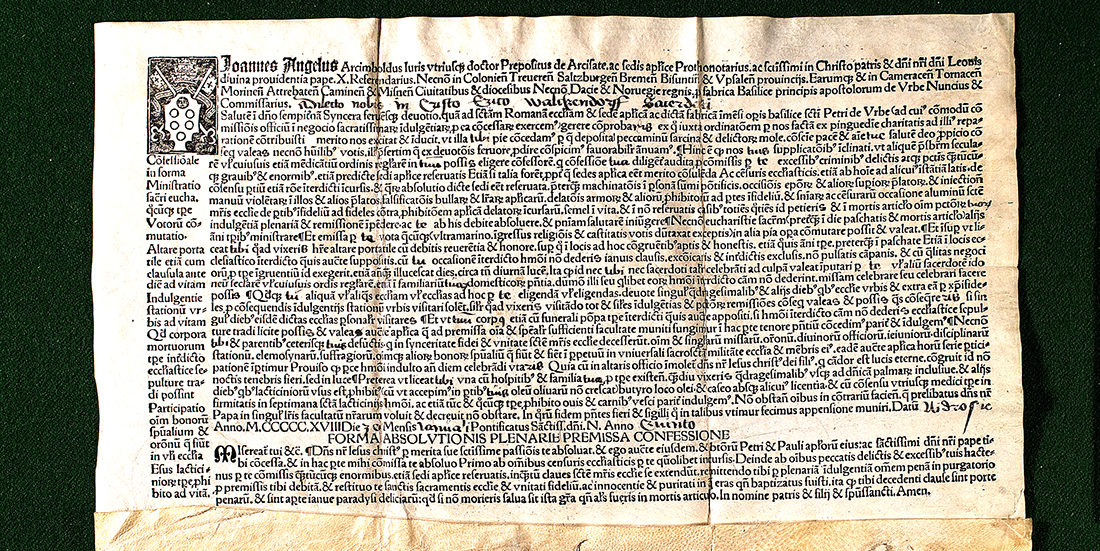
Proceeding the fiery preaching about how dead relatives were suffering, the indulgence chest would arrive. Then came the sermon about how loved ones are needlessly tormented and suffering in penance and agony day in and day out, painting the bleakest of pictures. At the end, they would offer a way out if you paid, an official signed document from the Catholic Church for the remission of sins, and finish with the now infamous statement: “As soon as a coin in the coffer rings, a soul from Purgatory springs.”

Indulgence trading was big business before the Reformation
Indulgence document, handed out after payment, assuring the full remission of sins

The words ‘sola gratia’, or Grace Alone, defined the movement as a whole, which rebelled against the idea that the cross was not enough: [Colossians 1:20… making peace by the blood of his cross]; but what makes Martin Luther such an amazing figure in church history, is that he set this movement off accidentally. He was completely unaware of the deal the Pope had made with Albert, for though the indulgences business was booming, the back door deal between Germany and Rome had not been publicized. Without knowing it, and based purely on spiritual conviction, he was unwittingly taking on two of the most powerful people in the world at that time, by criticizing their lucrative schemes.

Keep in mind that the Theses themselves were not condoning a split from the church, and were in and of themselves not overly argumentative. Based on his letters, he seemed quite surprised at the response of the Catholic church, and didn’t realize the political trap he had just stepped on. In fact, as a professor, it was a common way to present a theory or argument for debate so you could hear the other side in case you were wrong. The build up to it, and the actions that followed were the domino effect of that one event that Luther considered a innocuous statement. It wasn’t until the hornet’s nest had been accidentally kicked, that Luther had to muster his courage to stand firm on his interpretation of scripture.

Historians know much about Luther’s death, February 18, 1546, because they were recorded in detail by his deathbed confessor, Justus Jonas. Jonas wished to give an account in case false rumors might arise from enemies (which did happen). One rumor was that Luther had died suddenly or in his sleep. Back then it was falsely believed that if a person was wicked, they would die without time to confess their sins, condemning them to hell, a doctrine also not found in scripture. Likewise, Roman Catholics circulated the claim that Luther had died in a state of terror, believing he would be eternally condemned. But, Jonas recorded that Luther’s last hours were lucid and conscious. He confessed his sins and affirmed his faith in Christ, along with everything else that he had taught.

It is safe to say that we don’t always know how God will use people, and it is interesting that such a seemingly benign action by a professor could spark not only so many deaths, but the eventual Reformation itself, where people were grateful to learn the true power of the cross, and were grateful to have a Bible written in their own language. It wasn’t always so.

So when you think upon Reformation Day, this October 31st, let us remember all that transpired to put the true gospel of Jesus Christ in our hands, as recorded in our New Testament. A gospel of grace, instead of works.

Titus 3:4 But when the goodness and loving kindness of God our Savior appeared, 5 he saved us, not because of works done by us in righteousness, but according to his own mercy, by the washing of regeneration and renewal of the Holy Spirit, 6 whom he poured out on us richly through Jesus Christ our Savior, 7 so that being justified by his grace we might become heirs according to the hope of eternal life.

Dark Matter; Why Does It Matter?

Disclaimer: I am not a cosmologist.

But here is what I do know. The model used to get from the Big Bang explosion from nothing to today’s observable universe, via naturalist or materialist means simply does not work without Dark Matter. (well, it doesn’t work for a myriad of other reasons too, but even assuming the rest fit, the naturalist needs Dark Matter).

Definitions are important, and sometimes I take for granted that everyone knows what I mean when I say things. So let’s take a second and define what I mean when I say a few terms:

Cosmology is a branch of astronomy concerned with the studies of the origin and evolution of the universe, from the Big Bang to today and on into the future.

When I say naturalist, or materialist, it is simply a person who supports the theory that nothing exists except matter and its movements and modifications. Things only developed through natural means, without a designer. Essentially this is the normative atheistic point of view.

And Dark Matter? What is it? Well, the definition provided is “a nonluminous material that is postulated to exist in space and that could take any of several forms including weakly interacting particles or high-energy randomly moving particles created soon after the Big Bang.”

These “particles” mind you, are not detectable by any means we now possess. Not visible or observable on any known spectrum. Can’t see it. Can’t feel it. Can’t hear it.

Then how, you might ask, do we know it is there? The answer is, it has to be, because if it wasn’t, the Big Bang model falls apart. In other words, those who operate under the presupposition that the universe propagated itself via natural means know that Dark Matter exists, because it has to exist for the presupposition to be true. This is the atheist’s own version of the “god of the gaps” argument. There is a major scientific gap in how stars can form and how galaxies have been able to maintain their shape (the wind-up problem) and in order to add the correct amount of gravity necessary to make the computer simulations work, they have invented, made up, concocted, pretended, that Dark Matter exists so that the observable universe is more mathematically feasible.

You see, without Dark Matter, the first stars could not have formed in the vacuum of space. If Hydrogen and Helium were floating around in a vacuum, physics tells us the particles would expand. Certainly if they were somehow inclined to coalesce into something more dense, and the temperature would rise, making them expand more, curbing any tendency inorganic, purposeless particles might have to form into a star. A star that must get so dense that it weighs 4,400,000,000,000,000,000,000,000,000,000 lbs, the weight of our own sun. Out of Helium. And hydrogen. In space.

The solution, enter Dark Matter. A plugged in and specified amount of un-detectable, un-observable gravity, that is there, simply because it must be, that would push these air particles together hard enough, and long enough to force them into creating the first stars.

I’d like to point out here that this is the self-same scientific community that prides itself on being the paragons of logic, who have market cornered on beliefs that are securely moored to facts, and who are quick to point fingers at believers in God as anti-science. The Berkeley science website even states, “Modern science does not deal with supernatural explanations because they are not scientifically testable.” – (understanding science, 2014).

And what is supernatural? It is defined as a force beyond scientific understanding, or the laws of nature. A force beyond observable nature.

A good example of such a supernatural force would of course be Dark matter.

Why am I so adamant, and even occasionally snarky about this subject? Because I feel the ridiculousness of these theories are obvious. The fudge factors are well known within the scientific community, and yet these obvious pleas for legitimacy are never presented to students. Only big words, and the repeating drums of the big bang being fact, along with great animation, and spectacular fairy tales propped up by eons of time. When spoken of in common language, explained in laymen’s terms, and splashed with the cold water of reality, with the physical laws of the universe, scientists are knowingly making up different types of matter, that no one can see, with the exact properties they need them to have, so that they do not have to be wrong. Dark Matter is one of several.

When I explain the reality of Dark Matter theory to my nine year old, she has the common sense to laugh at those silly scientists. Of course the atheist who sees Christians raise their kids with the notion that stars are a special creation, just like humans are, accuses the Christian of child abuse, negligence, and bad parenting.

But the materialists make up fudge factors with impunity, and without compunction. They call it good science, because it supports their idea of a Godless universe, and they manipulate data and simulations to tell the story they want to believe in. This has not been a search for truth. This has instead been a scramble to defend a dying cosmological model. Dark Matter,  and it’s perfect and uncanny gravity, is just another example of this dishonest practice.

My question is, how many made up components of the Big Bang model must their be, before the materialists admit that they too are faith based, and that their faith is in that which is beyond nature, beyond the ability to observe, and in that which contradicts the laws of physics? The difference between concluding that there is a God and concluding that there is Dark Matter, is that the heavens declare the glory of God, it is obvious to any nine year old who looks up to the heavens in awe. Dark matter is declared by no one but the scientists who invented it, and use it in hopes that it will keep the truth of God at bay for a little while longer.


UPDATE: In addition to this article, I will add here an excerpt from the article, “Evidence for dark matter in the inner Milky Way”, sciencedaily.com, February 2015.

““The existence of dark matter in the outer parts of the Milky Way is well established. But historically it has proven very difficult to establish the presence of dark matter in the innermost regions, where the Solar System is located. This is due to the difficulty of measuring the rotation of gas and stars with the needed precision from our own position in the Milky Way.
“In our new study, we obtained for the first time a direct observational proof of the presence of dark matter in the innermost part of the Milky Way. We have created the most complete compilation so far of published measurements of the motion of gas and stars in the Milky Way, and compared the measured rotation speed with that expected under the assumption that only luminous matter exists in the Galaxy. The observed rotation cannot be explained unless large amounts of dark matter exist around us, and between us and the Galactic centre,” says Miguel Pato at the Department of Physics, Stockholm University.” (emphasis added).

This statement, “The observed rotation cannot be explained unless large amounts of dark matter exist around us”, is the obvious and continual bias coming from the scientific community. The effect of the presupposition of deep time is pervasive, and endlessly sabotages attempts at good science. It is the reason they must cling blindly to faith in made up fudge factors.

Also, this author claims “direct observational proof!” Of a substance they cannot detect! How did they directly observe it? They measured the rotation speed of heavenly bodies while assuming only detectable matter exists! In other words, they simply observed the natural universe. And since the conclusion makes deep time impossible, they know dark matter is proved! Are you kidding me?!

Here, from their own lips, you have faith in a made up element, rather than ever consider that their underlying assumptions about the universe are dead wrong.


He is Risen, Indeed!

Happy Resurrection Sunday! He is Risen!

A fellow church goer friend of mine wrote, “To my atheist friends:
Atheists spend a lot of time and energy attacking the Bible, complaining about Churches and pointing out the flaws of Christians in an effort to bring an end to Christianity. There is only one thing that needs to be done in order to bring Christianity to its knees. It’s simple, too. Prove that Jesus’ tomb was not empty.”

In instances where Jesus Christ prophecies His demise, He always references that He will again rise from the dead, but of course, those closest to Him were plagued with disbelief, even after seeing Him with their own eyes! They just knew that this type of miracle couldn’t happen, but after many appearances, mending Peter’s broken heart, letting Thomas touch His wounds, eating with them, and ministering and appearing to hundreds of witnesses, His defeat of death itself was realized.

History already knows Jesus was real and historical, and we, through evidences and eye witness accounts know more about Christ’s death than the death of any other one man in the ancient world.

My friend is correct in his challenge, that all it would take is to prove that Jesus Christ the Messiah did not defeat death. There are many articles and books on rebutting the skeptic arguments, but rest assured, the challenge exists, for any and all to seek, to knock, to research so that you can find truth for yourself, for as the word says, it shall set you free. And when faced with the historical truth of a real and physical resurrection, you will be then faced with deciding whether you choose to love Jesus or hate Him.

The Bible even claims if you can do this one thing, prove He never rose on the third day,  it would make all of Christianity empty and worthless.

1 Corinthians 15: 12 But if it is preached that Christ has been raised from the dead, how can some of you say that there is no resurrection of the dead? 13 If there is no resurrection of the dead, then not even Christ has been raised. 14 And if Christ has not been raised, our preaching is useless and so is your faith. 15 More than that, we are then found to be false witnesses about God, for we have testified about God that he raised Christ from the dead. But he did not raise him if in fact the dead are not raised. 16 For if the dead are not raised, then Christ has not been raised either. 17 And if Christ has not been raised, your faith is futile; you are still in your sins. 18 Then those also who have fallen asleep in Christ are lost. 19 If only for this life we have hope in Christ, we are of all people most to be pitied.

Many are already familiar with Lee Strobel, who wrote the case for Christ. An investigative reporter, who was challenged by his wife to actually seek and try to disprove the Resurrection, only to find it was undeniable. This led to his book in 1998, as well as a follow up, The case for Faith.

Two men at Oxford, Gilbert West and Lord Lyttleton, were determined to disprove the bible as well. Lyttleton set out to prove Saul (Paul) was never converted, and Gilbert set out to prove Jesus never rose again.

Sheepishly meeting some time later, they had discovered that each had failed in their attempt. Saul of Tarsus had become a radically new man, and evidence unmistakably pointed to the fact that Christ rose again. The book that emerged from their study was, “Observations on the History and Evidences of the Resurrection. 1747.

One final story, (out of many converts who came from setting out to destroy the bible’s credibility), is from Frank Morison, from England. An unbeliever, Frank promised himself that one day he would write a book disproving the Resurrection. In the early 20th century, he was granted enough downtime to study, and make his case.

His book that emerged, after he accepted Christ as his savior, was the paperback, “Who Moved the Stone, published in 1930.

William Lane Craig points out “Without the belief in the Resurrection, the Christian faith could not have come in to being. The disciples would have remained crushed, and defeated men.”

So in strange and unprecedented times, on a holiday where we are all forced to take a look at our own mortality, and the relationship we have with God, the world, and those closest to us, on this Easter Sunday, my fellow brothers and sisters in Christ proclaim triumphant, in love, hope, faith, and truth, He is Risen Indeed!

And my friends who do not believe, all you must do is prove that the Historical Jesus never predicted His own death and Resurrection, and then fulfilled that very thing. I must confess in love though, that I do hope all who take this journey in earnest, reach the same foregone conclusions that these men mentioned in this article did, and that it plants a hope in your heart that will never be taken away. Happy Easter.