
Genetics and Evolution

With molecules to man evolution hanging on the possibility that despite the complexity of DNA, mutations must somehow add to the genetic make up of an organism over time, the theory is truly struggling. Genetics is NOT a friend to evolutionary theory. Ignoring the magic elixir of “time” that evolutionists add to the mix in order to devise an acceptable probability ratio, we must conclude firstly that enough mutations will slowly (or quickly) transform one kind of animal into another (I sometimes can’t even believe this still needs to be discussed).

A couple of short points: You have heard of a gene pool, yes? This is an invention, a constructed idea of early population geneticists who were dedicated to Darwinism. The problem they faced is that most genetic mutations aren’t catastrophic in nature. They instead degrade, and interact with other nucleotides, to create a long term minimal effect. Genes are poly-dimensional, working many different ways as a language. Imagine a book that could be read forwards, and backwards, and using every other word, and using a cipher. This is the type of complexity we encounter. It is well known in genetics that one nucleotide, since it doesn’t affect enough of the whole organism, would not be enough to be selected or mutated beneficially to bring about a change. Rather, we know that several nucleotides would have to be changed productively at once. The gene pool constructs a visual that sells well, promoting the idea that out of this “pool” nucleotides can be mutated to change the overall composition of the organism over time without consideration for those other nucleotides it affects.

In other words, the ripple effect from being a multi-purposeful nucleotide would create so much “noise” and would affect the overall organism so little, that there is almost no correlation between that one nucleotide changing, and the betterment of the animal as a whole. You are talking about an almost atomic level of change.

We must therefore conclude that large “chunks” must change to create any real progress. So we must analyze this possibility.

Mutations within the human genome have been scrutinized and analyzed, and it has been found that most of the mutations are not “noisy” enough by themselves (changing a letter in a DNA strand, like a typo in a book) to be selected by mother nature to pass on, whether good or bad. These mutations are neutral, or un-selectable, and therefore cannot occur with enough impact to change the organism, regardless of time. Geneticists realize that most are neutral, and that because of this there would be no reason for  this information to be passed on to further a species up the evolutionary chain.

Furthermore, if we consider the ratio of beneficial to non-beneficial mutations, the vast majority are on the negative side. One experiment reviewed 10,000 mutations, and could only list 4 beneficial ones, which later all proved to be a net loss of information. Any that are actually considered beneficial mutations are usually in the neutral range anyway! This even further reduces the chance of benefit occurring, and being passed down.

Remember, evolution requires a high rate of beneficial mutations over time to succeed. This is not observably the case on any level.

There is so much more we could discuss, but this is a blog, and I just want to offer a sense of the trouble actual genetic science delivers to the evolutionary theory. Two more final notes. One is that considering that all of these nucleotides are multi-functional, if you do actually come up with a beneficial mutation that helps the organism in one way, there is no possibility that that change has also somehow benefited the way it is used in all of its other ways. It would disrupt how the information was read in all of its other variable forms, and therefore would only be beneficial in one sense, but damaging in all others.

Secondly, genetics ignores in its models the very real, and very detrimental concept of “fitness valleys”. Consider this: If 99.9996% of all mutations are either bad, or neutral, and those are occurring all the time, can you suppose a timeline whereby the positive ones somehow surpass the overall effect of all the negative ones to essentially make the organism healthier and more complex?  Food for thought.

Quick Warning on New Ageism

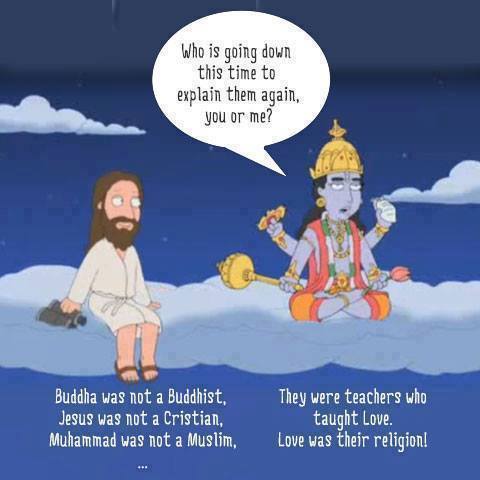
14993550_913662458770736_4124813955337659607_n

I am seeing this a lot lately. A feel good platitude. A slogan. A new age, anything goes, faux-zen-enlightened bumper sticker. Upon close examination, it doesn’t hold water. I hope those who consider their salvation can think past this, and truly don’t hang their eternal souls on the slogans of new age inclusiveness. Especially since this mess of a poster violates the law of non-contradiction about six ways from Sunday. Unfortunately, most people will grab such slogans, like “the bible was just written by men”, or “God can’t make a stone so big He can’t lift it”, or “separation of church and state”, and compile them as a world view. They will then comfortably walk through life, believing wholeheartedly in a world view they spent no time investigating. H.G. Wells said this about our contemporary lives as it concerns people’s resounding inaction regarding the preciousness of life:

“But in these plethoric times, when there is too much coarse stuff for everybody and we struggle for life takes the form of competitive advertisement and the effort to fill your neighbor’s eye, there is no urgent demand either for personal courage, sound nerves or stark beauty, we find ourselves by accident. Always before these times the bulk of people did not overeat themselves, because they couldn’t, whether they wanted to or not, and all but a very few were kept “fit” by unavoidable exercise and personal danger. Now, if only he pitch his standard low enough and keep free from pride, almost anyone can achieve a sort of excess. You can go through contemporary life fudging and slacking, never really hungry nor frightened nor passionately stirred, your highest moment a mere sentimental orgasm, and your first real contact with primary and elemental necessities the sweat of your deathbed.”

If we research, even lightly, the veracity of this poster’s statement, we will find it severely lacking in truth. Without even addressing the glaringly obvious, commandment-breaking image of putting one of the million false Hindu gods on an even plane with Jesus Christ, God and Lord, creator of all things, we will ask were they all merely teachers of love? Does this discount the necessity of judgement, and offer only pleasure with no recognition of sin, and therefore render our desperate need for grace and Christ moot?  There is a flood to square with, as well as the destruction of Sodom, and the Canaanites, and the existence of hell. Does escaping the reality of a promised judgement for sin require us to simply pick a teacher/deity we like, and try to be loving?  And if you have been following along on my series, you know by now that other gods, other religions, don’t come close to the loving God of the bible. For more on that, please read through that, but one quick example for you is in the year 627; Muhammad decapitated 900 Jewish men in front of their families, and ordered troops to rape women, and enslave them. This was the last Jewish tribe in Medina. Ransoms and beheadings were common place. So judging by these actions, as well as other conquests in the name of Allah, to say nothing of polygamy, and the consummation of a marriage with a 9 year old, was Muhammad a teacher of love, like our feel-good poster suggests? Or were his actions self-serving?

What about Buddhism? Very zen and peaceful, yes? The value of human beings must be quite high in their thinking, right? An interesting story, since we are on the subject, has to do with the killing fields of Cambodia. The maimed and injured were pouring in to medical camps run by Christian missionary volunteers. The country was filled with Buddhists, but Christians were there in droves helping the wounded, ministering to the sick and dying. The Christians asked the local doctor why the Buddhists, considering their peace-filled worldview,  weren’t here helping any of the refugees, and why was it only European and American Christians. He said it was because in Buddhism, it is believed that karma determines your fate, and that these suffering people must have earned these troubles in a past life. It was their Karmic fate that brought them to this, not the sin of a fallen world. So they felt no obligation to help or “love” as our poster suggests.

Perhaps we can find love of people in a place that favors Hinduism, such as India? India, where rats swarm crops, decimating sometimes up to 50% of the food grown for the citizens there. The result of course is famine, and the poor health of India’s massive population. But in years past, they have continually chose not to exterminate these rats. Why? Because in their religion, these rats may be the reincarnated ancestors of peoples’ families, so their lives are important as well. As we zoom out and logically consider this world view, we can ascertain that these rats are being given equal consideration and worth as the human beings in Hindu culture. Even at the expense of their lives.

Does this reflect the same love as our Creator God? A love so great that He declares He knows every hair on your head? That He made you in His image? He came to earth to die for you? Do you sense your value as a son or daughter of the Lord, as compared to other world views? It is interesting that for all the bumper sticker slogans we have, when you get down to it, there is one God of love, and there is the harsh reality of other religions, and how much they devalue life. In these others, upon actual examination, you will find the worth of people on par with animals (Hindu), left to the fate of the universe (Buddha), solely dependent upon the whim of a conquesting god (Islam), or completely fluid based on moral relativism (New Age). The truth is much more beautiful, and hopeful, and yes, loving, then the slogan. But, this does not dismiss us from having to consider the truths of a holy God. That with perfect love, we must also examine perfect judgement. Both infinite attributes of a perfect Creator. So again we say, “determine your salvation with fear and trembling” – Phil 2:12

I’m a Fanatic, or a Hypocrite

I have previously defined myself as a biblicist. This means that I Believe the bible from cover to cover, a rarity, and absolute foolishness to most. Some would retort, “How can you take literally that which was intended as metaphor, or poetry?” The response is of course, I don’t. I realize that different styles of writing are utilized to unfold the entirety of biblical canon. Dr. Floyd Nolen Jones puts it this way:

“The word [biblicist] connotes one who, while taking both the immediate and the remote context in to account, interprets and believes in the bible literally.”

He goes on to say that despite continual biblical criticism, the biblicist believes the promises and concepts therein, and also recognizes the rarity of such a belief, even among pastors, priests, and seminary professors, a shame in my opinion. But we can rest assured that this doesn’t mean I am so dense that I don’t understand prose and allegory are used.

Some other critic might say, “But how can you trust what was written over 2000 years ago!” A great question, not for this article, perhaps, but one that every believer and non-believer needs to answer for themselves. My studies have led me to believe in the truth of the word for many reasons, such as fulfilled prophecy, expert eye-witness accounting, corroboration with history and archaeology, just to name a few. Despite being amazingly unique in its circulation and teachings, it has been preserved better then any ancient book, the next closest being Homer’s Illiad. Just to clue you in to how much better the Bible is preserved, we possess 643 ancient copies of the Illiad, while we possess over 25,000 of the new testament. John Warwick Montgomery said this: “To be skeptical of the resultant text of the New Testament books is to allow  all of classical antiquity to slip into obscurity…”

For more on this subject and others regarding the text, try reading Josh Macdowell’s “New evidence that Demands a Verdict.” The first 200 pages of this book alone will change your world.

Regardless of how I answer critics, the point is that I always do, and zealously so, usually leaping from a sketchy foothold of slight coolness or quiet reserve, (which admittedly is very little to begin with) into an emotional soap-box diatribe, that causes any listener I may have to regard me thereafter with caution. If they don’t know me well, they will say I am a Fanatic, way too zealous and over the top, a bible-beater, a Jesus freak, a literalist who needs to relax because I take ‘religion’ way too seriously.

If the person does know me, then I fear in their hearts, they regard me as a hypocrite. Anyone who believes the word of God so fervently, they must think themselves righteous beyond reproach; a Christian who knows he is better then those he preaches to; a saint among sinners. I must seem so false to those who know my struggles, because the fact is, I fail every day, and they know it. They have seen me stumble, they have seen me fall. They have seen a filthy mouth, and a worse mind, a heart that fights darkness, and a mind that fights anger. They have seen my insecurities cause me to act out in hopes of public approval. They have seen me weak with drink, with words, and with action. They have seen my life, and all of its failures, and they know intuitively that this is not a saint that stands before them. This is not a so-called ‘good christian’. This isn’t a person who should be preaching to anyone. They must watch me wax on and on about my favorite subject, sometimes hotly, sometimes over too many glasses of wine, sometimes after trying to fit in, and they must immediately chalk me up as a fraud. A Hypocrite.

And they are right.

But also, they are not.

It is my favorite subject, because of how beautiful the mosaic is. How intricate the history of redemption is, and how it offers endless study that leads you deeper and deeper into awestruck wonder as you go. And at the bottom of it all, when all is said and done, if the conversation will allow and anyone is left to listen, they will find I am not judging, but just excited. They will find the whole reason that it is my favorite subject is indeed because I am so broken, and so imperfect, and so sinful. It is precisely because of the unique grace offered to us, and that I recognize I need it, that I drone on and on beyond what social protocol dictates. I do not mean to. I just love the material.

So yes, I am a hypocrite, because I am quite imperfect and am preaching. But I am not, because I recognize my imperfection, and therefore recognize my absolute need for grace. This makes me fanatical.

To address fanaticism, let us consider the bible. In it, God claims to have made the very world you stand upon. literally, the ground beneath you. Not only do you draw each breath by His grace, but every beautiful thing you have ever smiled at, ever enjoyed, ever felt, was because of Him. Not only that, He continued to love you, despite your sin, and offered you the inheritance of His son, Jesus Christ, who made all things. It says every single thing, the universe, everything was made… for Him. Even you.

It says this. There is no getting around it. It says fear the Lord, and work out your salvation with fear and trembling. It promises one of two results upon death, either the judgement seat of Christ, or the white throne judgement. If you don’t know which one you will be present for, it should scare you. Why am I fanatical? If it is not true, and is just a religion like all the others, to appease the weakness of man, and lessen the reality of death’s sting, then to be zealous would be foolishness. But being a Christian is hard. Why would we put ourselves through it, when we could instead fill our days with carnal pleasure, self-service, and indifference? There wouldn’t be a need to bother others with our beliefs, and persecution would be someone else’s problem. So why then, if it is so counter-intuitive to be Christian, do we allow God to be Lord over our lives?

Because it’s true.

And I for one would rather live a difficult truth, even with all its problems, then live a comfortable lie, and face the reality of God’s holiness when I die. Upon studying the Bible, to be honest, I find it hard to believe we all aren’t fanatics. I know one day I will wish I had been even more so.

So if I get excited talking about it with you, please know, I’m just a flawed person trying to love you, because God loved me first.