

Old Earth Christians

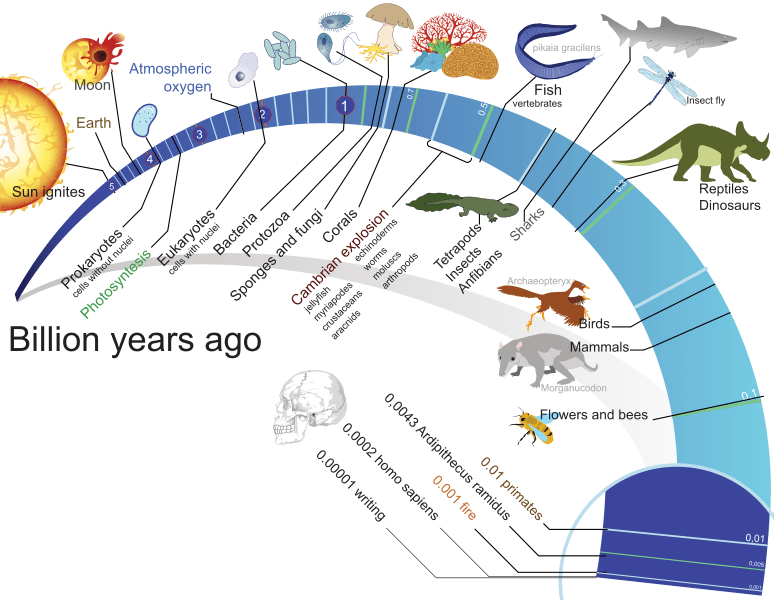
From Prior article on SES National Conference on Christian Apologetics: “…and of a most interesting conflict among the scholars was of course young verses old earth opinions. I may do a follow up article on that, as it was quite unique the way scholars who believe in the big bang theory have to explain themselves under the paradigm of a creator. They certainly have rebuttals and evidences all neatly decided upon, however, to me (though I am no astrophysicist), these explanations fall very short, and completely contradict what we find in God’s word. You can play interpretation games all day long, but as Ken Ham said quite correctly at the conference, you do not get the idea of millions of years from a simple reading of bible. It is a man-made worldview, which must then be shoehorned into the text to make it seem to fit.”

Two  apologists whom I had the pleasure of meeting, and hearing speak, are both adamantly resigned to the “facts” of the Big Bang, and therefore are forced to explain the creation in a seemingly convoluted way, in my opinion. Dr. Hugh Ross, one such apologist, an author of many books, including Improbable Planet, is a proponent of a version of the Day-Age theory, whereas billions of years of prep and design happened during the overlapping “days” of creation. It is impossible to reconcile a plain reading of the bible text as a whole, and not be at the very least, inconsistent in understanding it when you try to force man’s world view into it. Though some of these old-earth Christians are learned scholars, have advanced degrees, and are smarter than I am, (I realize this puts me in precarious waters, though I’d also point out I met many doctors and scientists with my shared opinion as well), they also simultaneously  deny macro-evolution, Darwinism, and abiogenesis. (These processes, if given any serious thought without the philosophy of naturalism, have way too many holes to be viable, so much so that even the great atheists of our day are forced to kick the can of responsibility down the road.) This means they have to somehow imagine a scenario where God lays the groundwork of creation in stages, or steps, leading up to the existence of man, and during the great lengths of time, He must intervene intermittently in order to spur along the groundwork for mankind’s arrival at some later date.

This certainly conjures up many important questions about God, His infinite power and abilities, and why such a lengthy, slow, and clumsy process would be utilized. As stated, the bible certainly doesn’t even imply this process, and we have stated a “good” world in the beginning that stands as an example of what should have been, and that we will one day be redeemed to. This supposed history that led to our “good” and perfect Eden was apparently arrived at through, chaotic volcanoes, cosmic explosions, millions of years of death, carnage, flooding, cancer, thorns, and suffering. Not exactly a lion laying with the lamb scenario.

The problem is exacerbated when a Christian spends some time studying the actual history of evolution theory, Charles Lyell and his hate for God, how Chalmers reacted to save face for the church, and how over the years, coming up with naturalistic causes for creation and design has allowed for man to use theory in order to assert his own godhood, and how these theories have slowly become axiomatic facts that should not be questioned. (For an amazing book on that subject, read In the Minds of Men, by Ian Taylor.)

Bottom line is, I am not necessarily smart enough to argue with a doctor of astrophysics, and I’d point out that when I read his book, I can see not only his love of God, and Christ, but also his extensive knowledge about astrophysics. But it is obvious that all of his conclusions are based on the presupposition that the Big Bang is true, and that the days of creation are overlapping eras; a problematic position when one considers the importance of resting on the sabbath in the Old Testament, a particular day to honor God, not a roving, malleable representation of His glorious work (imagine an OT Hebrew resting on the 5th and 6th overlapping days in order to work on the seventh as a representation of creation week). So, if the Big Bang is true, then……

(for example) …. if it is true then we explain the collision that created the moon this way, its craters were formed this way, and Mars must be this size, and Jupiter must have formed first in our solar system, and the asteroid belt must have… etc etc, all based on computer models. One model states that there is, based on star observation, a conclusion that the Milky Way tilts up and down every 66 million years, and that the edges of this tilt are too full of radiation for mankind to live, so, of course it is ordained by God that we just happen to be in the center of this tilt process after billions of years at the exact time man arrives on the scene. A whole string of intelligent thoughts, conclusions and theories, based wholly on the fact that the group explaining it is dedicated to a Big Bang model creation. The easiest answer, from a seven day creationist standpoint is, this is where we were placed in the galaxy, and things can simply be observed moving.

Big Bang “proofs” are full of fudge factors, and faith based premises as well, and its problems are glossed over, and not addressed most times in speeches or books presented by Christians. The smoothness problem, dark matter theory, the horizon problem, all serve to discredit an already unscientific theory that challenges logic, laws of causality and energy. Ross even invokes the ridiculous Oort Cloud theory as if it were accepted fact, primarily because it needs to be in there to explain the Big Bang model, our comets, and our solar system, despite it being literally imagined (this passes for science in evolution theory). These issues are sufficient to make any Christian question this as the method in which God used to bring about mankind. But most damning to the theory is of course the bible itself, and how it clearly stands irreconcilable next to the theory, without presenting a myriad of verbal gymnastics, interpretation tricks, and imaginings.

… the earth was formed out of water and by water.

The earth was without form and void, and darkness was over the face of the deep. And the Spirit of God was hovering over the face of the waters.

For they deliberately overlook this fact, that the heavens existed long ago, and the earth was formed out of water and through water by the word of God,

For in six days the Lord made the heavens and the earth, the sea, and all that is in them, but he rested on the seventh day. Therefore the Lord blessed the Sabbath day and made it holy.

Therefore, just as sin entered the world through one man, and death through sin, and in this way death came to all people, because all sinned—

The suggestion, therefore, is to once again, stick to the bible as authoritative, as always, in matters of history, and forensics, for as it has time and time again, despite thousands of years of criticism, it will prove true, and man’s hope that it will be proven false in its accuracy will continue to fail. If we do this, we are less apt to look foolish in retrospect, even if our current contemporaries consider us foolish now. This was the case with many kings listed in its pages, ancient cities, civilizations, and scientific observations up to this point. It will continue to be the case moving forward.

Is There a God? How Do We Answer?

Obviously, to become a Christian, you must come to believe that there must be a Creator God of the universe. This is an essential step between non-belief and Christ as Lord of your life, but this very basic and obvious truth is attacked, and done so with such vigor, and under the guise of logic, materialism, and science, that it can be an intimidating hurdle for Christians to even explain how it is we know there must be a God.

Certainly there are many ways to unpack this particular question, but the three main logical responses are:

Cosmological

Teleological

Moral

Certainly our bible tells us “For since the creation of the world God’s invisible qualities–his eternal power and divine nature–have been clearly seen, being understood from what has been made, so that people are without excuse.” – Romans 1:20, This is a true claim, does prove to be accurate, but cannot necessarily be used as an argument against an atheist who gives no credence to the Bible yet. In other words, though the bible is true in its message, if a person doesn’t believe in a god, much less the God, why would they believe in anything that God says.

It used to be quite obvious that people were created, designed, that all of this organized world could not have come from nothing. The axiomatic truth was known to great philosophers, such as Aristotle, who called the creator the “Unmoved Mover.” It was clear to him that someone or something must have started everything, because science, is ultimately the search for causes, and something must always cause other things. Things do not, and never have been observed to have been caused by nothing whatsoever.

Cosmological, simply put, is the shared opinion of both naturalists and theists alike that the universe had a beginning. Things like the 2nd law of thermodynamics, and the general theory of relativity have led both theistic and non-theistic scientists to conclude that the universe had a beginning. Einstein himself stated being “irritated” that his equations pointed to a beginning, so much so that the great mathematician put a fudge factor into his work (dividing by zero!) in order to perpetuate a steady state theory. Arthur Eddington found this proof “repugnant” and said, “The beginning seems to present insuperable difficulties unless we agree to look on it as frankly supernatural.”

Like it or not, both sides are forced to deal with a beginning, and science continues to drive home the point that not only is a slow heat death occurring, but that “nothing” cannot cause something. There must be a first cause. Whether we believe that nothing caused the universe, or God did, both would qualify as anti-naturalistic miracles.

Teleological proof is simply the watchmaker theory, or an argument from design. There is much research on this, from the irreducible complexity of the eyeball, and human knee, to the detail and beauty of the peacock feather, to the written coded language in our genetic code, 1000 encyclopedias-worth of messages written into each cell in the correct order, in order to create and sustain life. We could walk into a cave and see a picture or message written simply by an ancient culture, and know that it was created, yet this obvious complex and stunning language to make and sustain life is somehow viewed as mere chance. Design is a powerful argument for a designer. In Dawkin’s book, the blind watchmaker, Dawkins himself states how things have the “appearance of design,” a logical and scientific conclusion, but rejects this based on his philosophy and world view, not because of any scientific reason, merely because for him it cannot be true. This is a philosophical rejection.

Thirdly, the moral argument, a basic standard of right and wrong. How do we know things are wrong? What makes the Nazis, baby killers, rapists wrong, and helping people right? An atheist would say that that it is a natural response to help perpetuate a society, but that is subjective, and when analyzed, does not hold water. If we can agree that any one thing is objectively wrong, above and beyond our own opinions and subjective standards, then there must be an objective good. A correct law (yes, written on our hearts) demands a law-giver. Without this, it is simply he who has the bigger stick that makes the laws. We have seen the results of this throughout history, Lenin, Stalin, Hitler, from slavery, to genocide, to abortion. Without moral law, people do not by default fall into a paradigm that “works best” for society. It is a matter of opinion. If there is in fact a moral objective, then we should of course find it, and try to follow it. Seeking which morality is correct is maybe another topic, but agreeing that there is one, at this stage, is the goal.

These three arguments define quite simply why it is logical to believe in a creator. It is obvious from observing causes, winding down of the universe, time space and matter, life, that there must be a timeless, space-less, immaterial, personal, intelligent creator. This is the description of the God of the bible. It is merely good science, good logic, good philosophy.

Keep in mind, it is okay to doubt things, doubting helps us adjust our thinking, and leads us to research and find truth, but the evidence doesn’t change. If you go back and forth, good day you believe, and a bad day you struggle with faith, it is you and your emotions that change, not the evidence. The evidence for God, for historicity of the New Testament remain constant and readily available.


Renewal of My Mind

Romans 12:2 Do not be conformed to this world, but be transformed by the renewal of your mind…

Living with joy is not always an easy endeavor, and yet, as a Christian, I know that my life is supposed to be a letter to others:  2 Corinthians 3:3 “And you show that you are a letter from Christ delivered by us, written not with ink but with the Spirit of the living God, not on tablets of stone but on tablets of human hearts.”

This joy that Paul discusses over and over, and the reason he is able to praise God in even dire circumstances is due to the transcendent purpose of Christ in His life, and in the lives of those whom he cares for. This allows for a person’s heart to be filled with gladness, and love, and hope, even when all earthly pleasures have been stripped away. But our daily thoughts can be consumed by things we want, things we lack, people we are envious of, false idols, people or powers that stand above our love of Christ in our minds. So how do we renew our minds, and focus on the only thing that truly matters? (For why it is the only thing that matters, check out this blog from last year.)

I would state first that this is something I have not mastered, and am presently working on. My goal is to eventually live with the joy of Christ fully, and for my life to be a letter, a testament to that hope I have in Him. But putting away all the messy darkness must start with prayer, and there are several verses I pray and meditate on daily as I work towards keeping Jesus Christ as the transcendent purpose of my life:

Romans 12:2 “Do not be conformed to this world, but be transformed by the renewal of your mind, that by testing you may discern what is the will of God, what is good and acceptable and perfect.”

In regards to putting the past behind me, old idols, old hopes, old sadness, old worries, I use this: Philippians 3:13 “Brothers, I do not consider that I have made it my own. But one thing I do: forgetting what lies behind and straining forward to what lies ahead, 14 I press on toward the goal for the prize of the upward call of God in Christ Jesus. 15 Let those of us who are mature think this way…”

Him alone? Psalms 62:1 “For God alone my soul waits in silence;
from him comes my salvation.
2 He alone is my rock and my salvation,
my fortress; I shall not be greatly shaken.”

All those things we attempt to gain by our flesh, do we someday realize that God intends to give us these freely, if we but humble ourselves:

“And after you have suffered a little while, the God of all grace, who has called you to his eternal glory in Christ, will himself restore, confirm, strengthen, and establish you.”
1 Peter 5:10

“Humble yourselves, therefore, under the mighty hand of God so that at the proper time he may exalt you.” 1 Peter 5:6

This is so powerful. This is freedom from all anxiety, all regret, all pain. I’ve tried to establish my life on my own, my heart on my own. I failed. All was impasse, what love I could muster was selfish, half measures, and insufficient to establish anyone, least of all myself and those I loved. I died there, at the dead end of my decisions, my will. Luckily the mighty hand of God is expert at resurrection. I am thankful for my failures, for there is nothing more humbling than the death of all the best efforts of my heart.

So… the question is, are we humble enough to be truly care-free? I ponder this, and how to walk forward with a renewed mind, singularly focused on the only source of lasting joy. I am free then, to love others as He would have me love others, under His power, and because He first loved me. I hope this is a renewal of my mind, for I need the will of God to replace my own. My own is flawed, and only hurts. I trust His far more.

The Power of Simplicity (abstract)

I was shaving, using an old-fashioned boars hair brush, and homemade farmer’s market shaving soap that smells like sandalwood and lavender, listening to Sinatra, and slowing the haste of the world with my breathing.

This idea of transcendent purpose has affected me as of late, a clinging to a purpose I can serve, one that is larger than the vanities of our day. King Solomon told us that “All is vanity” (Ecc. 1:2). If not but for God, it would seem that Solomon ended up a nihilist. He felt what we all feel eventually, that the toil of life mixed with the purposelessness found in the perfunctory grind of our daily action is the legacy of dead men walking.

We work diligently in thought and deed for great swaths of time towards goals we find give us a sense of relevance. These are different for all. Maybe you are saving the manatees. Perhaps you follow the political battles of Washington D.C., working hard each day to know and understand your platform, so you can defend it, prepared to forgive the trespasses on your side, and militantly oppose the other. You may march with signs. You may work towards a financial goal, or strive to build a business. Perhaps you pursue love, and escape in the delirium of intense desire. You build a world around a hope, an earthly hope that has no choice but to crumble under the weight of your expectations. No matter your interest, as it pulls you from ecstasy to the depths, and back again, any achievement or reciprocation received is short lived, and leads only to bitter unrest at the knowledge that any joy it brings will not endure.

Does this foreknowledge of failure make you negative? A pessimist? Being able to see the collapse of hope in the distance, and unable to stop it often makes us even more dedicated to our dream. It could even be stated that doubt and uncertainty are part of a recipe necessary for coveting that which we cannot live without. It is shocking the violence that takes place in the mind when our desires and fears mix. Compulsive daydreams infect how we perceive reality, and despite the real understanding that all will burn, along with the knowledge that we are helpless to stop it, we choose to run headlong towards an ecstatic finale we know is not there.

So then, what purpose transcends this inevitable disappointment? Further, what transcends our lives? Fame? Sex? Power? Glory? We would need a purpose that exists beyond our time here. One that makes us part of something much grander than our accomplishments. Robert Lewis wrote: “A transcendent cause must be truly heroic, timeless, and supremely meaningful.”

Upon reflection, there is only one thing in the universe that qualifies. That is Jesus Christ. And lo and behold, He has offered to make us a part of His transcendent story.

So these items we cherish, wine, love, money, they as blessings cause enjoyment in one who’s focus is on Christ. They are merely things He has placed in your path as you live and grow in sanctification. But, as idols, they take, and they keep taking, and no permanent  satisfaction will ever be attained from them. The idols like those I have sought to validate me, instead have devoured me, and refusing to admit they were there, it was to the depths I went. “For when I kept silent, my bones wasted away through my groaning all day long.” (Psalm 32:3)

But to acknowledge this? How good I perceived myself as being versus how broken my actions had become? So twisted that God had to actually save loved ones from me? Deliver them from me, as I had become a catalyst for pain and lack of peace?  Who was this man I never meant to be? My heart desired what I dare not speak aloud, much less pray for. I coveted. I had false idols. I wished to steal (not just material things, but love, dignity, respect of others, time, freedom, for the most dire things stolen are not things at all). I am angry. I lust. This all means I bear false witness. A liar, especially to myself. One then who is blind to sins known since childhood, sins known to have been written by the very finger of God. What a pretty picture of a Christian.

And the result? Distance from God. Silence in prayer life. Anxiety. Inability to properly love others. Self-loathing. To be the clanging cymbal that has no love in his heart. Despair. And how much more, in these depths, did I rail against the world for my causes, or grasp harder for my purpose, my secular validation? Or, how much more did I escape, self-medicate, choose negligence, indifference. Has the man who militantly blames society for his pain examined his character?  Do the high ideals in the public square extend to his wife and kids? Does he bring the whole of himself home each night, as priest of it? Does he grab his wife’s hand and pray with her, or teach his son or daughter why the bible is true, or how to love? Does the daughter witness from him what she should expect out of a husband someday, or is this not a consideration the father should concern himself with? Can he put himself last and still hope for fulfillment when all the magic he desires is rationed to the fortunate unworthy standing in the wake of his life’s disintegration? Look in his eyes; he is simply not there.

Unfortunately, recognition of who we truly are must proceed change. When we all started this journey, we thought to ourselves, I will be this type of Christian, or this type of spouse, or this type of parent. My intentions are to be purposeful and knightly, and full of honor. But all is vanity; and distractions erode us; and idols fill us; and it isn’t long before we have forgotten how to love, because we have forgotten who loved us first.

The simplicity of life: “But I am afraid that, as the serpent deceived Eve by his craftiness, your minds will be led astray from the simplicity and purity of devotion to Christ.” (2 Corinthians 11:3) The Alpha, the Omega, and your transcendent purpose. It need not be more complicated then this. All else, blessings to be enjoyed, or not.  In a world of distractions, and the great whirlwind of lives to compare and contrast yourself with, and the pressure of forcing idols to answer wishes for love and money, what if we take Christ at His word. What if it is enough? And in this power, as it allows you to love properly again, you live out the life you were meant to?

I was shaving, using an old-fashioned boars hair brush, and homemade farmer’s market shaving soap that smells like sandalwood and lavender, listening to Sinatra, and slowing the haste of the world with my breathing. Starting at the center of myself, and working out. The parts I could control. I could be thankful for the music, and the steam, and be blessed to feel the satisfaction of a proper shave, and the calm in which this romantic chore took place. Like an artist who paints a leaf, there was beauty in the smallness of the moment, and I was “allowed” to be part of it. From here, what man would I chose to be? I could step out and complain about money, or Washington D.C., or be anxious for investment returns, or escape into a fantasy of love never actualized. Would these actions help me love others the way they needed to be loved? The way they deserve to be loved by me?

Or can I step outside the walls of my bathroom and be a different man; a simpler man, and not concentrate on the periphery of the world, but on my walk down the hallway, the embrace of my child, the prayer that my loved ones deserve, the health and wellness my body deserves, the study of scripture that my God deserves. I could ask God to teach me to love others better, and then make efforts to do that. Imagine it! Edifying others without seeking gain!

But I wanted them all to think I was smart, and special, and attractive. I wanted to be worth something to everyone.

But would my worth, according to them, change at all how I could love them, if I was loving them properly? Can I change that? No. I can change only me.

This will change my home. Which will change my church. Which may change my town. Which may change the state. Which may change the country. Which may change the world. But I leave this to God. I won’t yell at you about who you are supposed to be. I will do better at what I should have been doing. Overtime, perhaps I can be forgiven for having loved so badly, and so selfishly. But, it was coming from my flesh, not Christ, so it was bound to an inherently faulty foundation. If I can truly make Christ first, then how I see the world, how I love the world, everything changes. And everything is simplified into one transcendent purpose. Suddenly, I feel blessed just to be allowed to enjoy any of this silly old world at all.

Micah 6:8 – He has told you, O man, what is good; and what does the Lord require of you but to do justice, and to love kindness, and to walk humbly with your God?

Colossians 3:23 – Whatever you do, work heartily, as for the Lord and not for men,

Hebrews 12:1 – Therefore, since we are surrounded by so great a cloud of witnesses, let us also lay aside every weight, and sin which clings so closely, and let us run with endurance the race that is set before us

Isaiah 49:4 – But I said, “I have labored in vain; I have spent my strength for nothing and vanity; yet surely my right is with the Lord, and my recompense with my God.”

And so, I was just shaving, using an old-fashioned boars hair brush, and homemade farmer’s market shaving soap that smells like sandalwood and lavender, listening to Sinatra, and slowing the haste of the world with my breathing. And I thanked God.

How Geisler Defeated Skepticism

The great apologist, Norman Geisler, was battling the growing philosophy of skepticism back in the mid-sixties, made popular by David Hume over 200 years earlier. Hume’s skepticism regarding truth led other philosophers to follow suit, to expound on his ideals, leading to the pervasive skeptic movement that still exists today in academia. Hume’s assertion was that things were only actually meaningful if, and only if:

  1. The truth claim is of abstract reasoning, such as 2+2=4, or all triangles have three sides;
  2.  the truth claim can be verified by the 5 senses.

According to his book, if it does not have reasoning concerning quantity or number, and it does not contain experimental reasoning, it should be “committed to the flames” as an illusion.

This of course does away with almost everything forensic in nature, not to mention relegating every religious book to usefulness only as fuel for a book burning.

God within philosophy was hard hit, and it opened up avenues for skeptics that are alive and well even now.

We have discussed The Law of Non-Contradiction, a self-evident first principle of philosophy in the previous article linked here. As a review, the law of non-contradiction states that contradictory statements cannot both be true in the same sense at the same time, e.g. the two propositions “A is B” and “A is not B” are mutually exclusive.

This Law gives logical ammunition to those who know how to use it as Geisler did, and in a college professor’s class at the University of Detroit in the ’60’s, he did just that. Hume’s philosophy was called ’empirical verifiability’, and was the second chapter of the subject matter being taught during this 14 week course. The professor, a professed atheist, allowed Norman to give his presentation on a chapter. He chose the empirical verifiability chapter.

That morning, the professor said to keep the speech at 20 minutes, so there was room for discussion after. Norm didn’t need that long. He stood up in front of the class, and stated this:

“The principle of empirical verifiability states that there are only two kinds of meaningful propositions: 1. those that are true by definition, and 2. those that are empirically verifiable. Since the principle of empirical verifiability is neither true by definition, nor empirically verifiable, it cannot be meaningful.”

He then sat down, and the class and professor both were silent.

Just like that, Norm had shown concisely, that the principle contradicted itself, and was not internally logical. It was self-defeating. The professor later blamed the train wreck of a semester, and all of its volatility on that one statement.

When we are faced with these world views, notice often that the writer or espouser always wishes to be excluded from his or her own statement. This occurs again with Kant, when he claims that no one can know the real world. In this premise he himself claims to know something about the real world.

We do very much believe in a God of logic, and who is reasonable. There is objective morality, objective truth beyond ourselves, and this should comfort us. Without it, we could not know anything at all. This is not to say we understand everything, for what kind of God would that be if we could comprehend all His glory. But, I dare say, it is more comforting believing in Him, then filling your worldview with doubt. What hope is there in doubt?


For I know the plans I have for you… or does He?

Do you know this one?

Jeremiah 29:11 “For I know the plans I have for you, declares the Lord, plans for welfare and not for evil, to give you a future and a hope.”

Of course you do! Favorite verse? Hanging on your wall? Grandma cross-sticked it in your throw pillow? Memorized for inspiration, and hope in your life? I have seen it often as of late, and I do agree, this verse will aid and inspire you greatly… if…. if what? if you are who he is talking to, more specifically the surviving elders of the exiles, and to the priests, the prophets, and all the people, whom Nebuchadnezzar had taken into exile from Jerusalem to Babylon! (Jeremiah 29:1)

The bible does not actually have verses, and chapters. They are there as a quick reference. Jeremiah was not talking to you.

A rule of biblical interpretation: The bible cannot mean today what it didn’t mean when it was written, especially just because you want it to. Does God know your future? Yes. Is He omnipotent, and omnipresent? Yes. But He uses many things to accomplish His will, and furthermore does not necessarily impart welfare and goodness to all who believe in Him.

Quite the contrary, many further His work and His will for a future kingdom by suffering hardships, loss and pain. Does He know these plans as well? Yes. And yes, there is hope in that. But we must be careful not to ignore the context of a passage when we simply scripture-grab for our own personal peace of mind. One apologist goes so far as to say, “Never read a bible verse!”

In this way he emphasizes the importance of getting context with your statements, and of not imparting historic descriptive passages with prescriptive powers upon our lives.

You can see the error of this method much more clearly if we approach it from a different angle. For example, your friend or loved one approaches, and says, “man, I am having such a rough time. I am so anxious, and depressed lately, I just need to seek God.”

And you respond, “Hey, just remember, friend, Jeremiah 6:11-12 says to us, ‘Therefore I am full of the wrath of the Lord;
I am weary of holding it in.
“Pour it out upon the children in the street,
and upon the gatherings of young men, also;
both husband and wife shall be taken,
the elderly and the very aged.
Their houses shall be turned over to others,
their fields and wives together,
for I will stretch out my hand
against the inhabitants of the land,”
declares the Lord.'”

Hang that on your wall! Thought you were feeling bad before? How about applying this verse randomly to your situation?

You can see the point here. We cannot just pluck and plug things that make us feel better. God was using His prophet to speak with the elders at that time. It is historical, and instructive, and does teach us about the Israeli nation, and further bolsters our understanding about the line of redemption and His good works. But again, unless Nebuchadnezzar took you into exile 2600 years ago, and you are a surviving elder of this time period, you cannot simply apply this to your life. It may feel good, but as stated many times in these articles, we aren’t Christians because it is easy, or because of an emotional payoff. We are Christian, simply because it is true.

There is a great and bloody history in the bible. The thin red line of the redemption of Jesus Christ is fraught with many a fallen person, doing many unspeakable things. There is murder, rape, incest, war, prostitution, theft, idol worship. These are there for us to learn truth. These are not prescriptions on how to live.

Did I ruin your favorite verse?

Let us respect these verses in context.

You Have Two Choices

There are really only two games in town. Both Christian scientists and atheistic scientists agree that the universe had a beginning. I have spoken with post-modernists who offer up alternatives to these two possibilities, such as a past eternal universe, or mere relative understandings of truth. Without getting into the weeds too much, your main theorists and thinkers on both sides reject these ulterior notions based on sound evidence, such as heat death, entropy, and others.

Biblical creationists already have a Genesis account of a beginning, corroborated by Christ, and many writers of scripture, so this news does not pose issue in and of itself.

On the other hand, when scientists discovered that the universe had a beginning, they were not happy.

Physicist Arthur Eddington wrote: “philosophically, the notion of a beginning of the present order of nature is repugnant to me… I should like to find a genuine loophole.”

When Einstein discovered that space-time-matter had a beginning, he was quoted as saying the result “irritates me”, due to its theological ramifications. You could surmise that a multi-verse would somehow change the implications, but it does not. Mathematically (since a multi-verse is hypothetical and un-explorable), a theorem that explains a multi-verse, created by Cosmologist Alexander Vilenkin and his scientific team, proves that even if one exists, there is a beginning to them all.

Vilenkin, a believer in a multi-verse rather than God says,  “It is said that an argument is what convinces reasonable men and a proof is what it takes to convince even an unreasonable man. With the proof now in place, cosmologists can no longer hide behind the possibility of a past-eternal universe. There is no escape, they have to face the problem of a cosmic beginning (Many Worlds in One [New York: Hill and Wang, 2006], p.176).”

So to the point: the two games in town are

a) The universe created itself, i.e. nothing created something, or

b) A creator outside of time, space, and matter created it. Therefore He is timeless, spaceless, and immaterial.

We have delved into space travel, the Big Bang, and other related topics on this site, but to now bring up an additional bit of information in the realm of philosophy, there is a self-evident principle of causality with which we must contend. In its simplest form, the law of causality simply states that everything has a cause. A house has a cause, yes, but that is an easy one. But I can go pick a leaf off a tree, and determine its cause, or a rock laid down by an ancient flood, and it will have a cause. Now, we may disagree on what the forensic evidence points to as an initial cause, but we will not disagree that said object does indeed have one.

This self-evident first principle of philosophy is there, along with others such as the law of non-contradiction, identity, and so on, to prevent the need for an infinite regression of explanations. In other words, if you have to explain everything, then you will never get to the end of explanations, and truth ceases to exist. This is why we must stop with certain obvious realities, or these first principles.

Of course a common retort is, who caused God then? But being outside of time, space and matter, being infinite, there is no logical reason to need a cause. Like our first principle, He is self-evident, or the un-caused first cause – Aristotle said, the unmoved mover. Hence why He refers to Himself as I AM. There is no “was”,  there is no “will be”. For us yes, but not for Him. Besides, you cannot have a higher god that is “more infinite” than infinite. This also is illogical.

Now, in regards to anything within the forensic sciences, something repeatable, observable, or demonstrable, we are looking for causes at the most basic level. Science is basically the search for knowledge, or search for causes – causality.

Therefore, one must now ask him or herself, do I abandon the law of causality when it comes to origins? This isn’t about age of the universe, or dinosaurs, all which do have answers according to a biblical world view. But simply regarding the beginning of it all, do I base my life on the natural and material sciences only, dismissing all possibility of creation, and force myself to choose a beginning that happened in eons past against the laws of all I claim to hold dear?

The great skeptic and atheist Christopher Hitchens was debating Frank Turek, and equated the Big Bang to a suitcase about to pop open, “and everything that is ever going to be is inside that;  that was the best I could do.” He went on to say, “And I don’t think many people could do, if I say it myself, that much better.” For such a revered and intelligent man, to state that the historical narrative of the Genesis account, in all of its beauty, and mastery, revered for thousands of years, and preserved through the ages doesn’t compare with this suit case analogy is quite telling. But in the end, an avid atheist will always struggle with how to articulate a result with no definable cause, because to repeat the point, both sides agree there was a definitive beginning.

There are only two choices. Einstein knew this. I commend atheists for being consistent in their take on naturalism, but as we view all manner of explanation and mental gymnastics to explain godless possibilities, and then relegate those possible happenings to the far unobservable past, do we not firmly place it in the category of faith? Faith in that there must not be a God.

Both sides, as human beings will try to identify the three basic life questions:

Where did I come from?

Why am I here?

What happens when I die?

The last two questions are bound inexorably to the first. Einstein was right, it can be irritating, since there is a beginning. But if nothing can cause something, or more than that, everything, then we have undone what is self-evident, and have removed meaning from all we observe.

There are only two choices.

Supposed Final Words of Steve Jobs

Widely reported as the last words of Steve Jobs, though inspired and interesting, is most likely a false deathbed speech. We can easily imagine thoughts such as this passing through our minds at the end. Though most likely not genuine, it is interesting to consider them, and how they reflect our hopes for our lives:
“I have come to the pinnacle of success in business.
In the eyes of others, my life has been the symbol of success.
However, apart from work, I have little joy. Finally, my wealth is simply a fact to which I am accustomed.
At this time, lying on the hospital bed and remembering all my life, I realize that all the accolades and riches of which I was once so proud, have become insignificant with my imminent death.
In the dark, when I look at green lights, of the equipment for artificial respiration and feel the buzz of their mechanical sounds, I can feel the breath of my approaching death looming over me.
Only now do I understand that once you accumulate enough money for the rest of your life, you have to pursue objectives that are not related to wealth.
It should be something more important:
For example, stories of love, art, dreams of my childhood.
No, stop pursuing wealth, it can only make a person into a twisted being, just like me.
God has made us one way, we can feel the love in the heart of each of us, and not illusions built by fame or money, like I made in my life, I cannot take them with me.
I can only take with me the memories that were strengthened by love.
This is the true wealth that will follow you; will accompany you, he will give strength and light to go ahead.
Love can travel thousands of miles and so life has no limits. Move to where you want to go. Strive to reach the goals you want to achieve. Everything is in your heart and in your hands.
What is the world’s most expensive bed? The hospital bed.
You, if you have money, you can hire someone to drive your car, but you cannot hire someone to take your illness that is killing you.
Material things lost can be found. But one thing you can never find when you lose: life.
Whatever stage of life where we are right now, at the end we will have to face the day when the curtain falls.
Please treasure your family love, love for your spouse, love for your friends…
Treat everyone well and stay friendly with your neighbours.”

I have never personally faced a life threatening illness. But I have had my life threatened, as well as watched the life of a loved one deteriorate. I have watched helplessly at a bedside, when the only power I had was to pray to God. And the only hope that I had in my heart was that if that loved one passes from this world to the next, I will get to see them again, and stand with them before a God who saved us both through His mercy and grace.

These final words go far, and they are serious, and wise, but do they go far enough? The author mentions God, but if there is one and only one infinite God, He alone is to be sought. And if that God has declared the one door to Him is through His son, Jesus Christ, then I would lovingly declare this statement does not go far enough by any stretch of the imagination. An atheist who lived out Steve’s advice would die with memories, and still with no hope. And those who remembered them, would also perish, and so the love that had been attained in a lifetime of wholesome philosophy would be lost to history. This alone is not the answer. That is why I often repeat my favorite verse in these articles, “Wherefore, my beloved, as ye have always obeyed, not as in my presence only, but now much more in my absence, work out your own salvation with fear and trembling.”

In John 10:9, Jesus says, “I am the door: by me if any man enter in, he shall be saved, and shall go in and out, and find pasture.”

In John 14:6 Jesus answered, “I am the way and the truth and the life. No one comes to the Father except through me.”

This may seem narrow-minded to some, or dogmatic, and I assure you it is, unless it is the truth.43dc6e87710d1c4d4f780482f310a7df If it is the truth, if God entered His creation to die for our sins, and that sacrifice resulted in the legal and moral substitution for a judgement we deserve, then it would indeed be the only way, and the truest act of love. The author mentions God, and speaks of the importance of love in this life. True words, sir, and a very fine philosophy for living. Yet those with money, and those with loving memories both still stand to lose all if they do not address the truth of salvation.

The bible is not ambiguous on this point. There isn’t one way for Christians, one for Muslims, one for Buddhists, and another path for New Agers. There is one door, which is why Christ Himself includes that He is the truth, as well. It is a warning, given in love, and providing hope for all, for all are fallen, and all face death. To Mr. Steve Jobs, I say, boldly and beautifully said, a sad and grave wake up call against the things that drive us. But, I also say, your love and memories cannot save you. Living for a fallen version of love will still leave you wishing and hoping in a hospital bed. There is only one door. Though it is now, more unpopular than ever to state, and offends many, we cannot be so timid as Christians that we cannot claim the truth, and that is that Jesus Christ is our door to salvation. It is said that this speech, despite its lack of authenticity, has inspired many. But we must ask, does talk like this truly help? or does it give a false sense of meaning, and therefore provide a complacency more dangerous than the position of men who admit they are evil. Change is only possible when one realizes it is necessary.


Taphonomy

Taphonomy is the branch of paleontology that deals with the processes of fossilization. It is like investigating a crime scene to find out the best possible explanation for the evidence. In laymen’s terms, it is attempting to find out what killed the animals in question. In the case of the paleontological dig in Wyoming run by Dr. Arthur Chadwick, it is about finding what cased the death of many dinosaurs.

Art explained: “We’re doing what’s called taphonomy.  Taphonomy it’s like CSI, Crime Scene Investigation.  Our goal is to find out what killed the dinosaurs, what they were doing when they died, and then what happened after they died.  Did they sit around and rot, or were they buried right away?  And then what happened after they were buried to preserve the bones and change them?”

The area that he was excavating for study was over 80 acres in size, and had millions of fossilized bones in it, most disarticulated. This just means that they are found disconnected from the adjacent bones. This indicates some swirling pressure, and some rot (enough to separate bone from connective tissue). Fascinatingly, most of these bones in Arthur’s bone bed are found in the first 3 feet of mudstone. In 80 acres and only a meter thick, we find millions of bones laid out together!

So what is the doctor’s conclusion as to how they got there? He explained: “These animals had to die and then their carcasses had to have time to rot. So we’re talking days or weeks or months during which time the bones and tissue were either eaten away or rotted away. And then the bones that remained were deposited instantaneously in this environment because they’re in a graded bed with big bones at the bottom and little bones at the top, and you can see that here. The big bones are all down at the bottom. When they start digging up here, they start to find smaller bones. So that condition requires a sorting process that can only take place during a catastrophic emplacement.”

“The only way I know how you could develop a graded bed is if you had a catastrophic process that transported these bones and laid them all in as a single event.” – Art Chadwick, PhD

So, take a minute and think about the environment that this must have taken place in. Not the slow gradual environment that they try to teach in school. That would not explain this, nor a plethora of other fossil graveyard sites. In a millions of years scenario, there would not be sorting. They would not all be so close to the surface. They would not be so densely packed, and over so wide a range (if say deposited by an ancient river). How would this occur slowly over time, and somehow carcasses  not be consumed by nature too quickly for fossilization (like we observe in nature today). This, according to tophonomy is best explained by a single catastrophic event. You have many dinosaurs which all died together, swirled in muddy eddies, rotting and breaking apart over weeks or months, and then settled in mud and water. And most of these animals that found themselves in these swirling, violent, muddy deathtraps would indeed be disarticulated.

Picture100Remember, this is a forensic science. Studies current data to explain a past event. We have two events to consider, the slow depositing of animals world wide who all were buried in mud and water (not occurring today), or a recorded world wide deluge, corroborated by the bible, over 270 flood legends, and evidence such as bone-beds like this picture. Could this happen all over the world with slow natural processes? These observations are made, knowing full well the disdain modern scientists have for studying data in light of the reality and authenticity of Genesis. But our education is our own, not someone else’s. You must decide which model makes sense to you.

Archeological/Geological Response to Atheist Part 5 of 5

Atheist: Here’s a very incomplete list of things that cannot be explained by your flood or fit into the young earth creationist’s timeline (continued):

(for part 1, click here)

(for part 2, click here)

(for part 3, click here)

(for part 4, click here)

nor [evidence for] the global flood,

As you can see from the many examples given in this 5 part series (not exhaustive by any stretch) we can be encouraged and edified in trusting the word of God to be accurate,  and to be a realistic telling of the events that occurred in history, as it is embedded within observable science and laws. Many of our major geological features are not only explainable in a deluge model, but this is in fact the easiest way to explain them all at once! If someone says, there is just no evidence of the flood; its ridiculous.

Particularly difficult to apply the principle of uniformitarianism to:
1. Cause of mountain building
2. origin of geosynclines
3. origin of petroleum
4. Cause of continual glaciation
5 overthrusting mechanics
6 cause of peneplains
7 volcanism causing vast volcanic terrains
8 origin of mineral deposits
9 saline deposits
10 granitization
11 origin of coal measures….. and others….

One geological note about where I live specifically:

There are over 1700 water gaps in the Appalachian mountain ranges alone, where water should have gone around, not through mountains. This could only happen if water was carving valleys while over the mountain tops such as in the great flood of Noah’s day. Water doesn’t run uphill, and takes the path of least resistance, an embarrassment to uniformitarianism. The geology of the Blue Ridge Mountains could not have been formed, except through this catastrophe.

Geological evidence is being pointed to, forcing geologists to admit to catastrophism and the quick twisting and reshaping of the earth’s surface. Evolutionists such as Gould, and Krynine admit to it, stating uniformitarian thinking is contradicted by facts. Gould says “”present is key to the past” is a smokescreen hiding confusion for both teacher and student.” – Is uniformitarianism useful?- 1957

Evolutionist and geologist, KE Caster states, “the vast bulk of stratified rock is shallow water deposits.” These layers are riddled with fossils. FOSSILIZATION DOES NOT NORMALLY HAPPEN TODAY. IT REQUIRES SUDDEN DEATH, SUDDEN BURIAL, AND GREAT PRESSURE. There are no fossils in the bedrock granite. Fossil creation is so rare, and yet Millions of animals died SUDDENLY! Evolutionist Colbert states,”At this spot in Wyoming… the concentration of fossils was remarkable; a veritable mine of dinosaur bones; piled in like a log jam.”

The many fossil graveyards means, at some point in history, vast amounts of animals were buried suddenly, all over the earth. For anyone to look at the earth’s crust and state there is no evidence… must be trying very hard not to see it.


I encourage more study into any areas of interest, but in regards to the flood being actual history, one note to be made is that we have presently over 270 ancient flood legends from different people groups around the globe! There are over 270 ancient flood legends and traditions recorded in ancient history, 80% of them mention a large vessel saving the human race. 88% involve a favored family. In 70%, survival was due to the boat. In 95%, the flood was responsible for the death of mankind. This is remarkable evidence that a flood occurred to the ancestors of all people groups. In fact, you could even imagine if there were no flood legends, this would be quite the effective criticism from atheists, saying how come there is no written or oral history to back up the story other than the bible? 

Also, the  city of Nineveh in the Bible had its Library of Ashurbanipal excavated in the 1850’s. But in 1872, George Smith of the British Museum discovered cuneiform writing that had to be deciphered. It said, “The mountain of Nisir stopped the ship. I sent forth a dove, and it left. The dove went and turned, and a resting place it did not find and it returned.”

This Babylonian flood legend, along with the much older Atrahasis epic, and Sumerian deluge story, make up some of the over 270  legends we have catalogued in archaeology, all having astonishing areas of agreement with the Bible, lending veracity to its historicity.


nor a couple million Hebrews wandering in the desert (zero trace of that), and in fact contradicts several parts of the bible, like cases where the stories reference a city that did not exist at the time the story supposedly took place (but DID exist hundreds of years later when the bible was actually written).

These points were mostly addressed. Often critics accuse the bible of being written later than what is reported, therefore explaining the exactitude of its prophecies. Unfortunately for the critic, this doesn’t hold water either. Again, archaeology proves time and time again that even the people groups, cities, economies, and famines described were true. From the price of a slave, to the grave of Joseph, to many eye-witness accounts, we do not have to fall for the critic’s accusation here. These continue to be either arguments from silence, or in most cases now, ignorance of the embarrassing amount of evidence we have.

They try this with the New Testament as well, since it predicts many things about Jesus’ life in great detail. How accurately was prophecy fulfilled? Could a book have predicted accurately over 500 years before in OT: Zec: 11 “I took the thirty pieces of silver and threw them into the house of the LORD to the potter.”
NT: Matthew 27 – Judas returns 30 silver coins to the chief priests and the elders, they decided to use it to buy the potters field.

or

Micah 5:2-5 But you Bethlehem Ephratah, though you are small among the clans of Judah, out of you will come for me one who will be ruler over Israel, whose origins are of old, from ancient times…

Fulfilled over 500 years later: Matthew 2: 1-6 After Jesus was born in Bethlehem in Judea, during the time of King Herod, Magi from the east came to Jerusalem and asked, “where is the one who has been born king of the Jews?”

or

Born of a virgin Isaiah 7:14 Matt. 1:18, 25
Born at Bethlehem Micah 5:2 Matt. 2:1
He would be preceded by a Messenger Isaiah 40:3 Matt. 3:1-2
Rejected by His own people Isaiah 53:3 John 7:5, 7:48
Betrayed by a close friend Isaiah 41:9 John 13:26-30
His side pierced Zech. 12:10 John 19:34
Crucifixion Psalm 22:1,
Psalm 22:11-18 Luke 23:33,
John 19:23-24
Resurrection of Christ Psalm 16:10 Acts 13:34-37

So, it must have been written after to be so accurate, yes? Josh MacDowell teaches us this:

“If you are not satisfied with 450 BC as the historical date for the completion of the Old Testament, take into consideration the following: The Septuagint, the Greek translation of the Hebrew Scriptures, was initiated in the rain of Ptolemy Philadelphus (285-246 Bc). It is rather obvious that if you have a Greek translation initiated into 250BC, can you had to have The Hebrew text from which it was written. This will suffice to indicate that there was at least a 250 year gap between the prophecies being written down in their first fulfillment in the person of Christ.”
There is nothing scientifically accurate about the bible.

This absolute statement shows the bias against the bible. Even scientists who believe in evolution have used the accuracy and history of the bible to find many discoveries. To say there is “nothing” is to show the true and emotional disdain towards the idea of a creator God. That being said, evolutionists and materialists often criticize the bible for its belief in miracles at large. If something is claimed to be a supernatural event, science will automatically dismiss it, and therefore, if anything supernatural exists at all, science will never find it. But consider, if the first verse of the bible is true, that means all miracles within it are indeed possible. This goes not only for the creation itself, but miracles like the parting of the Red Sea, healings, Sampson’s strength, and of course the Resurrection. So with the realization that the bible is a book about a supernatural, or beyond-natural being who is above space time and matter, we can conclude that He can act supernaturally within His creation.

But there is more evidence within the bible that proves its natural scientific accuracy as well. It spoke of many things long before science proposed it, or understood it to be true:

Stars are innumerable (Genesis 22:17; Jeremiah 33:22)
Stars differ in glory (1 Corinthians 15:41)
Stars follow a predictable pattern (Jeremiah 31:35)
Earth is round, not flat (Isaiah 40:22; Psalm 103:12)
Earth hangs on nothing (Job 26:7)
Water cycle (Ecclesiastes 1:7; Isaiah 55:10)
Sea currents (Psalm 8:8)
“Fountains of the deep broken up” (Genesis 7:11)Job 38:16, God asked, “Have you entered the springs of the sea? (water coming up into the ocean from the crust)
Life in the Blood, Blood circulation (Leviticus 17:11)

Many of these may seem obviously true to us now. But much of history was ignorant to these simple truths. We thought the world sat on the back of a tortoise, and blood letting was performed even up to recent history.

Considering these biblical truths, inspired and breathed by the God who created them, we would expect them to be accurate. And as it turns out, that is precisely what we find. As I always state, the bible is not a science book, nor a book on taxonomy, biology, or geology. It is much much more. But nevertheless, if it is full of true history, and we would expect to find a great many explanations in it that fit with what we observe today. After all, science just means knowledge. For one to claim that within God’s word there is no knowledge… well, we can only pray that one day, like it says in Phil 2:12, that the atheist who said it will continue to work out his salvation with fear and trembling.

Science tells us it is impossible that the current human population of the world came from a single breeding pair, or even three pairs. The minimum estimated population during the most severe bottleneck in our past was at least a few hundred, and probably closer to a few thousand individuals.

Our final point, and again the more ludicrous of the two options is the evolutionary premise, which would have us believe that mankind in one form or another, has existed between 1 million and 7 million years, depending on who you ask and when you start counting them as man rather than some ape ancestor. The premise is that in these pockets of slowly evolving people  lived in nomadic tribes, and that life was so harsh that the population remained stable until about 5000 years ago when agriculture was discovered. This is the catalyst that skyrocketed the population. As you can imagine, this creates a long, long, long long long, ridiculously long timeline of no population growth until just about the exact time that the flood occurred. According to creationists, the population sprang up from the 8 people on the ark about 4500 years ago. Tracking basic population rates, longevity in different periods, death rates, etc, we easily and rationally can surmise the 7 billion people of today coming from just a few people a few thousand years ago.

“In the “out of Africa” model of genetics, evolutionists say that humanity went through a near-extinction bottleneck before a population expansion. Why is the bottleneck part of their model? Because they are trying to explain the lack of diversity among people spread across the world. The diversity is much less than they first assumed. The bottleneck is an ad hoc addition to evolutionary theory. But low diversity, and all coming from very few (a bottleneck) has been part of the creation model from the start.”  -Dr Robert Carter.

The fact is, the creationist population growth analysis makes perfect sense, and what’s more, the history laid out within the word of God supports what we observe in genetics as well. It would be quite unreasonable to assume a mankind only slightly more sophisticated than apes, with no art, or music, or play stations, or golf clubs, and virtually no forms of escapism from everyday life, to not do the one thing that seems to come naturally to all mammals. The math here is unmistakable,  which is why we have the agriculture story to try and prop up the cave-man mythology. If the population doubles 29.5 times between now and the flood (once every 152 years) we have achieved the current population. (The world’s population was approximately 600 million in the year 1650 and increased to about 2,400 million by 1950. This means that it would have doubled twice in 300 years, at an average rate of once every 150 years). It fits perfectly.

So again this point is slung like so much spaghetti against the wall, to see which strands stick. Unfortunately it isn’t rooted in facts. This is why evolutionists must assert presumptions into an un-testable model. Agriculture, nomadic tribes, population wiped out several times. At the end of the day, I would hope that hanging one’s faith upon the hopes of a weak evolutionary model isn’t the determining factor on whether or not that person considers a relationship with a God who loved us enough to come die for us.


Again, these 5 articles are not meant to be exhaustive. But as an enjoyable exercise for myself, and hopefully to bolster the faith of other bible believing Christians who are constantly being told that the bible is ridiculous and inaccurate, it was neat to counter typical atheist criticisms for a bit. I would encourage you to keep reading, keep praying, and keep building your relationship with God, or if you haven’t then start by reading of His love in the word. We know by now Romans 1:20 – “For from the creation of the world the invisible things of Him are clearly seen, being understood through the things that are made, even His eternal power and Godhead, so that they are without excuse.”

We know there exists within us a moral law, a realization that design and beauty is all around us, that it couldn’t be random chance, and that God wishes for all to come to know Him. I pray you keep studying, keep seeking, keep searching. The answers are out there. But remember, if the supernatural does exist, and you refuse to believe it possible, you will of course never find it. Not in this life. Your faith instead will be in chance, in time, and in self, three things that cannot offer salvation.