

What if We Destroy all Religious Books? – Ricky Gervais

“If you took all the works of fiction and holy books and destroyed them, in a 1000 years they would still be gone. But if you took all the works of science, in a 1000 years they would have all come back. Because all the tests would bear the same results.”

Ricky Gervais is a popular, frankly hilarious, and talented actor and comedian. Whether you like his particular brand of non-pc humor, you cannot deny his success, bravery, and wit. Personally I like most of his stuff, other than the poignantly anti-Christian stuff, but as a person who appreciates free speech, and a free market, I support his rights to speak on whichever topics in whatever way works for him.

I bring Mr. Gervais up today, on my little blog, to verbalize a thoughtful retort to one of his famous challenges against religion: “If you took all the works of fiction and holy books and destroyed them, in a 1000 years they would still be gone. But if you took all the works of science, in a 1000 years they would have all come back. Because all the tests would bear the same results.”

He has stated this multiple times in interviews, and remains one of the funniest and most likeable atheists, but upon hearing this over and over for years, I felt compelled to provide contrary ammunition for the Christian who may not know how to respond. The assertion itself is faulty, and as is usually the case with atheists, they paint themselves as logical, reasonable believers in empirical data and truth alone, while the religious appeal to unprovable magic and miracles.

I have explained the difference between empirical and historical or forensic sciences before, but a quick recap of how we must interpret data.

The Eiffel tower has testable attributes. Some of these are:

1,063 ft tall
Wrought Iron Lattice Tower
Weight is 10,100 tons
Located on the Champ de Mars in Paris, France

If one were inclined, one could test and re-test for the accuracy of any of these statements. In Mr. Gervais’ example, yes, if these facts were all lost, they could all be recovered again, and restated in books as demonstrable, observable, repeatable, without any deviation, just like the boiling point of water. But what about these facts?

The Engineer was Gustave Eiffel-
The Tower was finished in 1889-

How do we know these are correct? If this information was lost, what would the tower be called? What date would be attributed. We might try to date the metal based on rust, and chemical tests, get some some spectrum of years with a tolerance between 1715 and 1940. If we do not have trusted historical sources to conclude facts from, we would be lost on all lost forensic data! This means that for many disciplines, we must find those historic, written sources, accurate, not tampered with, and found to fit the proper historical context. No one questions these two historical facts today, but it brings about an interesting point. The facts in this case must be believed; they are not testable, and repeatable.

All history is this way, including Biblical history, Cryptology, Archeology, Criminal forensics, Geology, Paleontology, and Cosmology.

So to Mr. Gervais’ assertion, would we indeed have the exact same books with the exact same facts? Yes, the math, experimental physics, chemistry, engineering, all empirical books would be recreated almost exact, and learned the same by Christian and atheist alike.

But what if we look at a couple of presuppositions disappearing, such as evolution, or the Big Bang Theory. Take dark matter as an example. This supposedly bountiful material, made up, and totally untestable, is used as an explanation of how first generation stars were formed in a vacuum of space (still very unclear how that process would work even if this imagined material existed). Dark matter is also needed to explain the gravity keeping spiral arms in tact on a spinning galaxy such as the Milky Way, because when you apply billions of years to it, actual science and math determine that it should have dissipated into a blurry mess by now.

Is it conceivable that if Dark Matter theories were destroyed, and a new people in a thousand years were offered the same exact data points, they might conclude that first generation stars could not have organized themselves naturally, and no mysterious material was aiding the impossible process? Is it conceivable that upon building back up all the lost observable data about the visible universe, and its motion, scientists might have to conclude that the spiral arms can’t be that old, that the clock like precision of the solar system looks designed, and that comets are young? Perhaps these scientists rebuilding all lost scientific knowledge in the future would refrain from invoking make-believe fudge factors to bolster a naturalist point of view. Afterall, that is exactly what the fathers of modern scientists thought when they first began to discover these things! It was obvious to them that a Creator organized the universe! Were they not in the exact same position that Gervais was describing once upon a time? And they concluded that God was a reasonable, and more likely answer!

What about scientists stumbling across the Grand Canyon 1000 years from now, and having to determine a geological cause? Without dedication to presupposition of deep time, a non-empirical belief, they would have to draw conclusions from what they observe, yes? Perhaps these scientists of the future would note data such as:

„Middle is higher elevation than the head waters (Kaibab Plateau)

„Both sides agree uplift of center occurred before the river was there (water doesn’t run uphill; another great observation for second graders)

„Gargantuan river delta that should be present is missing if the 1000 cubic miles of mud and rock were washed away slowly

„Stable, shear cliffs, little rock fall – not slow erosion, but washed out

„No Talus at base of cliffs – Amphitheaters hundreds of feet of sheer Cliffside over one mile from water, with no debris (washed out)

„It is relict – unchanged from what formed it, stable in current condition.

Perhaps without the tainting of modern uniformitarian paradigms, these hypothetical scientists would indeed conclude that this geological feature is quite obviously the result of a massive flood. Slow erosion could not have created it, nor could any river system imaginable, or observable on this earth.

This is only two of MANY examples of how present day scientists interpret facts to explain an observation. Using wisdom, and maturity, Mr. Gervais, and anyone who is touting this clever statement as a dismissal of the religious as illogical, can quickly see that it does not hold water. In fact, many new conclusions would be present, some I’m sure closer to reality, while others would inevitably be even more ridiculous than the Big Bang model, and evolution.

Luckily, all out historic knowledge HASN’T been destroyed, and we do indeed have not only a well-recorded history of when the Eiffel Tower was built, but also of the lineage, prophecies, and narratives of the Jewish nation. We have the religious, moral, and social result of a historic Resurrection of the Messiah, Jesus Christ. And we have centuries of Christian and secular writings verifying a long and rich history that helps us interpret and understand the data we find. If not for these histories, all present data and understanding would be so fractured, it would be almost impossible to be certain of anything.

So no, this statement, while it does sound clever initially, has no bearing on Christianity. In fact, the discovery of the organized universe has led many to belief in a Creator God. “For his invisible attributes, namely, his eternal power and divine nature, have been clearly perceived, ever since the creation of the world, in the things that have been made. So they are without excuse.” – Rom.1:20

Stegosaurus

Let us consider the Stegosaurus.

This 8 to 10 ton reptile is worth considering as a fascinating piece of biological history, unique and fantastic. With two sets of bone plates extending vertically along the ridge of the backbone, and 4 large tail spikes, it possesses features no other creature has. Aside from how neat the reality of these are, we can also consider the implications in the fossil record.

Of course, evolutionists fully expected that some transitional forms would be found showing the gradual development of plates, and spikes. But like the dismal truth of all specialized creatures in the fossil record, no such transitions exist. After over a century of searching, in every case the animals appear abruptly, and in perfect form. We know this instinctively, of course, and yet are forced to continue considering the unfounded assertion of molecules to man evolution despite no evidence.

The absence of transitional fossils the world over was a problem for Darwin, and continues to be a problem for paleontologists today. But to add to the Stegosaurus observations, we will take a brief look at the magnificent jungle temples of Cambodia, produced by the Khmer civilization. Beginning as early as the eighth and extending through the fourteenth century A.D. one of, if not the greatest monarch and monument builder of this empire was Jayavarman VII, from 1181.

The relief carvings along the temple wall show various animals.

https://www.bible.ca/tracks/tracks-cambodia.htm

A monkey, parrot, lizard, water buffalo, swan, and of course this famous picture of the stegosaurus. Is it though?

Well, that would be the obvious conclusion from anyone who knew what a stegosaurus looked like, and happened upon the temple. Clearly this is a large lizard with plates along its back, and clearly there would not be many animals to choose from. Furthermore, none of the relief carvings are made up animals. But the temple was built in the 12th century, we are certainly not allowed to conclude that they actually saw one.

This is one of many ancient examples around the world of dinosaurs being depicted on pottery, tapestries, coffins, and walls all over the globe, all of which must somehow be dismissed and explained away. This one of course is no different, and the Smithsonian takes their shot at it in the 2009 article Stegosaurus, Rhinoceros, or Hoax?

In the article that can only be described as dripping with animosity against creationists, the author asserts that it cannot be a stegosaurus, and is more likely an animal surrounded by leaves, like it is in a jungle. Either that, or it must have been added later as a hoax. And to further back their claim that it MUST be something other than what it looks like, Creationists are described as those who “twist Biblical passages to support their view,” and “distort nature to fit a narrow theological view.” But calling it a bear with leaves, or saying it was carved as a joke with no evidence doesn’t sound like the creationist twisting and distorting to me.

To further back their disparagement of concluding the obvious, they invoke the evolutionary champion, Carl Sagan, and his quote: “extraordinary claims require extraordinary evidence,” then further claim that evidence of dinosaurs living with man just doesn’t exist. Again I would reiterate that this is just one example of many all over the globe of every dinosaur we have a classification for being depicted in ancient art. But it is certainly ironic that they used Sagan, because the very same late evolutionist, Dr Carl Sagan, famous host of the Cosmos TV series, squarely faced the conundrum that dragon stories/art pose for evolutionists. Namely, that such stories and artifacts are found in cultures all across the globe (the strikingly realistic-looking brass behemoths adorning a 15th century cleric’s tomb in a UK cathedral, Icca stones T-Rex, and others), and that they are amazingly like several types of dinosaurs—which no one is supposed to have seen! Recognizing it quite properly as a puzzle to be solved for long-agers, he wrote a book about it, The Dragons of Eden. In this he proposed that somehow one part of our brain (the one that was inherited from whichever of our alleged reptile ancestors, in the evolutionist scenario, were living at the same time as dinosaurs) had retained its memories of what those ancestors had seen.

Did you catch that? The great Carl Sagan said that the art appears because our brains inherited the memories and images through our DNA through millions and millions of years and countless generations, from when we were just animals living alongside such creatures. So picture it now… as you are carving your wall, and forming a monkey, a parrot, a water buffalo, things you see each day, you add the exact form of one of the most unique animals known to man, with some of the most striking features along its back imaginable, because deep in your mind you were once a reptile that saw one. This passes for science? This evolutionist is held in high esteem while at every turn, the Christian who stands on the foundation of the word of God, and who can easily observe the evidence of its truth throughout nature, is being told that we are twisting and distorting facts?!

No where in the article is there any reasonable allowance whatsoever for the obvious reality, that it is what it looks like. Occam’s Razor, attributed to William of Ockham, is a principle that suggests the simplest explanation is often the correct one. The simplest, and most direct conclusion, based on observation, is that it is what it looks like. And so are the sauropods on the coffin in England. And so are the dinosaurs on the pottery in Peru. And on the Sant Jordi Tapestry, Plaza Sant Jaume, in Spain. And what’s more, Sagan knew this, and knew it so well that he felt compelled to address it. If the Smithsonian was being intellectually honest, it would acknowledge that, and perhaps spend its time coming up with a better explanation than us having the memories of when we were reptiles 60 million years ago, rather than berating Christians for accepting obvious observable data.

Should Creationists Be scared of Quantum Mechanics?

Quantum Mechanics is an innovative physics field, the math of which is certainly beyond my expertise, and that has merit as a study of how sub-atomic particles behave and interact. But despite physicists’ insistence, specifically those dedicated to evolutionary processes, it concerns operational sciences rather than origins. And what we run into is the lesson told many years ago by Socrates, that the smartest of us often think themselves wisest because of expertise in one subject they deem most important. This is born out in the poor philosophical conclusions of Hawking, and others, in my opinion, and since they were wise in one area, and share a world-view with main stream scientists, their perceived intelligence and respected reputations prevented critical examination of their philosophical conclusions.

So much so that Hawking gets a pass when he says “because there is a law like gravity, the universe will create itself from nothing.” When he makes the truth claim that “free will is an illusion” without realizing he is admitting we have no reason to trust his own truth claims, including that one!

Or how no one bats an eye when Biologist, Richard Dawkins has to remind us to ignore the appearance of design during his never-ending campaign against a designer: “Biology is the study of complicated things that give the appearance of having been designed for a purpose.”

Without evidence of any kind, Dawkins appeals to faith-based occurrences beyond nature while in the same book, (God Delusion) smugly attacking Christians for doing the same: “There are probably ‘superhuman’ alien civilizations elsewhere in the universe.” “There may well be a plethora of universes.”

He is not rebuked for obvious circular reasoning: “We exist here on Earth. Therefore Earth must be the kind of planet that is capable of generating and supporting us.” Brilliant. (insert eye-roll emoji.)

According to Socrates (and Plato) it is okay to be ignorant, because you can remedy it by learning. What is a dangerous enemy of knowledge is being caught in the illusion of knowledge while in fact being ignorant, because of pride.

In the age of google warriors, and misinformation, it is often those who are smart at one subject who have the strongest opinions about many others, especially that which they don’t know much about. (The fact that atheists and scientists would levy this same charge at me is not lost on me. I am a student of many things, but do certainly attempt to hang my world-view on an authority higher than my own whenever possible. That being said, I would stipulate that I am not immune to that criticism either).

Since Max Planck’s Nobel prize in 1919, Quantum Mechanics has been a tangent from classical physics (Newton) and was furthered by guys like Heisenberg, Einstein, and Bohr. The math supports the theories, and it solved problems that classical physics could not.

But here is where the practicality and the problems lie. When you examine the functions, the math shows that wave functions exist as a superposition of all possible states. In this way, we can describe the characteristics of a particle. This makes all positions true simultaneously, and each position inevitable. Extrapolated to the absurd, this acceptance that all possibilities are true is one of the reasons for atheist/evolutionary appeals to a multi-verse, yet another unprovable fudge factor needed to explain the Big Bang Model in naturalistic terms, due to how impossibly finely tuned our universe is. (Stephen Hawking tinkered with this idea late in his life).

It is already well documented in many works the dedication modern scientists have to materialism, evolution, and the anathema of Intelligent Design within the halls of academia; accept anything to prevent a “divine foot in the door”, even that which is absurd, by their own admission. This leads of course to faith in the impossible, the unprovable, the unobservable, and faith in these things, they persist, is supported by QM, because all possibilities exist at once.

In this New Age, or post-modern age, this leads to a morally relativistic view of QM, that reality should be taken as subjective, or based on the observer. Both Einstein and Schrödinger didn’t like the mysticism known as “the observer collapses the wave function,” and even the Schrödinger’s Cat experiment, a now famous pop-culture reference from the Big Bang Theory show, was actually a purposeful reduction to the absurd, as Schrödinger relied more on the law of non-contradiction, rather than relativism.

The basic, true laws of nature and logic, like causality, identity, non-contradiction, were not abandoned by the fathers of QM theorists, but has been popularized today as more and more appeals to a Godless universe meet headlong with direct observable facts that keep proving the Big Bang theory is poor science. Hence the need for faith based beliefs and fudge factors, such as dark matter, dark energy, the Inflaton, the multiverse, etc. You will notice, all of these fudge factors, the physicist and cosmologist must have “faith” in to keep hoping that the universe is Godless. But they do not attribute it to faith, as they lean on the crutch of relativity that QM provides for them. Since it is their specialized, elite field they hold in high esteem above the average plebian’s paltry understanding, they fall into the trap of valuing their elegant math-based conclusions over obvious empirical observations we see and understand every day. They surmise in their own minds every possibility is inevitable without God, as long as they don’t have to observe those conclusions today in real time. This appeal to deep time, or enough time, is the magic elixir poured into each opinion to add credence, and is done so with impunity, since this pillar of evolution is automatically ensconced in the public’s mind as “fact.” In this manner, they can criticize the Christian as ignorant, stupid, or insane (Richard Dawkins) while employing the same tactics themselves, faith being the evidence of things not seen (Heb 11:1).

When we speak in laymen’s terms, it boils down to very smart scientists and mathematicians being so hyper focused on the minutia of QM, that they miss the forest for the trees. This is of course coupled with utter dedication to the presupposition that inorganic evolution is true, as it must be if we are to believe that directionless, purposeless, unthinking inorganic material somehow create intelligent order. We are once again faced with this persistent axiom, Romans 1:22 Professing themselves to be wise, they became fools. Again, this is simply because all possibilities exist simultaneously, including one where there is perfect order.

Doctor of Physical Chemistry, Jonathan Sarfati, a respecter of Newton, science, and a creationist, states it this way: “It is typical of these cases that an indeterminacy originally restricted to the atomic domain becomes transformed into macroscopic indeterminacy, which can then be resolved by direct observation. That prevents us from so naively accepting as valid a “blurred model” for representing reality. In itself, it would not embody anything unclear or contradictory.”

Bottom line, QM works, has strong support, and is not a threat to creationism. In fact, some studies highlight its usefulness in nature, (sense of smell, photosynthesis, bird navigation). But with presuppositions on both sides, what we see is the confusing of QM with interpretations of QM. Luckily we have observable reality to rely on, and in that reality, we know how nature reacts unmanipulated by intelligence, and no amount of insistence that explosions create perfect order naturally will change that.

Dark Matter; Why Does It Matter?

Disclaimer: I am not a cosmologist.

But here is what I do know. The model used to get from the Big Bang explosion from nothing to today’s observable universe, via naturalist or materialist means simply does not work without Dark Matter. (well, it doesn’t work for a myriad of other reasons too, but even assuming the rest fit, the naturalist needs Dark Matter).

Definitions are important, and sometimes I take for granted that everyone knows what I mean when I say things. So let’s take a second and define what I mean when I say a few terms:

Cosmology is a branch of astronomy concerned with the studies of the origin and evolution of the universe, from the Big Bang to today and on into the future.

When I say naturalist, or materialist, it is simply a person who supports the theory that nothing exists except matter and its movements and modifications. Things only developed through natural means, without a designer. Essentially this is the normative atheistic point of view.

And Dark Matter? What is it? Well, the definition provided is “a nonluminous material that is postulated to exist in space and that could take any of several forms including weakly interacting particles or high-energy randomly moving particles created soon after the Big Bang.”

These “particles” mind you, are not detectable by any means we now possess. Not visible or observable on any known spectrum. Can’t see it. Can’t feel it. Can’t hear it.

Then how, you might ask, do we know it is there? The answer is, it has to be, because if it wasn’t, the Big Bang model falls apart. In other words, those who operate under the presupposition that the universe propagated itself via natural means know that Dark Matter exists, because it has to exist for the presupposition to be true. This is the atheist’s own version of the “god of the gaps” argument. There is a major scientific gap in how stars can form and how galaxies have been able to maintain their shape (the wind-up problem) and in order to add the correct amount of gravity necessary to make the computer simulations work, they have invented, made up, concocted, pretended, that Dark Matter exists so that the observable universe is more mathematically feasible.

You see, without Dark Matter, the first stars could not have formed in the vacuum of space. If Hydrogen and Helium were floating around in a vacuum, physics tells us the particles would expand. Certainly if they were somehow inclined to coalesce into something more dense, and the temperature would rise, making them expand more, curbing any tendency inorganic, purposeless particles might have to form into a star. A star that must get so dense that it weighs 4,400,000,000,000,000,000,000,000,000,000 lbs, the weight of our own sun. Out of Helium. And hydrogen. In space.

The solution, enter Dark Matter. A plugged in and specified amount of un-detectable, un-observable gravity, that is there, simply because it must be, that would push these air particles together hard enough, and long enough to force them into creating the first stars.

I’d like to point out here that this is the self-same scientific community that prides itself on being the paragons of logic, who have market cornered on beliefs that are securely moored to facts, and who are quick to point fingers at believers in God as anti-science. The Berkeley science website even states, “Modern science does not deal with supernatural explanations because they are not scientifically testable.” – (understanding science, 2014).

And what is supernatural? It is defined as a force beyond scientific understanding, or the laws of nature. A force beyond observable nature.

A good example of such a supernatural force would of course be Dark matter.

Why am I so adamant, and even occasionally snarky about this subject? Because I feel the ridiculousness of these theories are obvious. The fudge factors are well known within the scientific community, and yet these obvious pleas for legitimacy are never presented to students. Only big words, and the repeating drums of the big bang being fact, along with great animation, and spectacular fairy tales propped up by eons of time. When spoken of in common language, explained in laymen’s terms, and splashed with the cold water of reality, with the physical laws of the universe, scientists are knowingly making up different types of matter, that no one can see, with the exact properties they need them to have, so that they do not have to be wrong. Dark Matter is one of several.

When I explain the reality of Dark Matter theory to my nine year old, she has the common sense to laugh at those silly scientists. Of course the atheist who sees Christians raise their kids with the notion that stars are a special creation, just like humans are, accuses the Christian of child abuse, negligence, and bad parenting.

But the materialists make up fudge factors with impunity, and without compunction. They call it good science, because it supports their idea of a Godless universe, and they manipulate data and simulations to tell the story they want to believe in. This has not been a search for truth. This has instead been a scramble to defend a dying cosmological model. Dark Matter,  and it’s perfect and uncanny gravity, is just another example of this dishonest practice.

My question is, how many made up components of the Big Bang model must their be, before the materialists admit that they too are faith based, and that their faith is in that which is beyond nature, beyond the ability to observe, and in that which contradicts the laws of physics? The difference between concluding that there is a God and concluding that there is Dark Matter, is that the heavens declare the glory of God, it is obvious to any nine year old who looks up to the heavens in awe. Dark matter is declared by no one but the scientists who invented it, and use it in hopes that it will keep the truth of God at bay for a little while longer.


UPDATE: In addition to this article, I will add here an excerpt from the article, “Evidence for dark matter in the inner Milky Way”, sciencedaily.com, February 2015.

““The existence of dark matter in the outer parts of the Milky Way is well established. But historically it has proven very difficult to establish the presence of dark matter in the innermost regions, where the Solar System is located. This is due to the difficulty of measuring the rotation of gas and stars with the needed precision from our own position in the Milky Way.
“In our new study, we obtained for the first time a direct observational proof of the presence of dark matter in the innermost part of the Milky Way. We have created the most complete compilation so far of published measurements of the motion of gas and stars in the Milky Way, and compared the measured rotation speed with that expected under the assumption that only luminous matter exists in the Galaxy. The observed rotation cannot be explained unless large amounts of dark matter exist around us, and between us and the Galactic centre,” says Miguel Pato at the Department of Physics, Stockholm University.” (emphasis added).

This statement, “The observed rotation cannot be explained unless large amounts of dark matter exist around us”, is the obvious and continual bias coming from the scientific community. The effect of the presupposition of deep time is pervasive, and endlessly sabotages attempts at good science. It is the reason they must cling blindly to faith in made up fudge factors.

Also, this author claims “direct observational proof!” Of a substance they cannot detect! How did they directly observe it? They measured the rotation speed of heavenly bodies while assuming only detectable matter exists! In other words, they simply observed the natural universe. And since the conclusion makes deep time impossible, they know dark matter is proved! Are you kidding me?!

Here, from their own lips, you have faith in a made up element, rather than ever consider that their underlying assumptions about the universe are dead wrong.


In The Beginning: Survey of the Truth of Creation 5

ME 89326. (pictured here) ME 89326

This title, ME 89326 is the name given to classify this ancient relic, dated 2300 BC. It is also known as the Temptation Seal, and is an impression of a carving off a cylindrical seal of the Akkadian Empire. The Akkadian Empire was an ancient Mesopotamian Civilization, spawned in and around the city the Bible calls Akkad.

This piece is currently held at the British History Museum and was discovered in 1846. As we continue our study on the truth of creation, we look to pieces such as this to verify that yes indeed, the Adam and Eve story was circulating within different cultures, as reflected here in the artwork of an ancient people who were not Hebrews.

Of course, a secular museum would not encourage such beliefs, being of the presupposition that the story is certainly not real, and that the beginning of the Bible is not true history. As we have seen, and will continue to see, evolutionary presupposition will dictate what must and must not be, including what an obvious piece like this cannot represent. The notes at the British Museum accompanying this relic state: “…the seal belongs to the well known Akkadian periods 2300 BC, the dated palm and the snake may have fertility significance, there is no reason to connect them to the Adam and Eve Story.”

The insistence that this is not the Adam and Eve story being depicted is quite telling. Notice that these forensic scientists don’t even allow for that possibility, and want visitors to know that they would be undoubtedly in error to assume such a thing, since the museum knows for sure that it just can’t be about that.

So let us look at the picture. The museum suggests that the figure is a man (left) seated in front of a god (right, with headdress), and that some offering is taking place. The plant offering is to worship divine fertility.

The problem: Historically in this period, neither male nor female worshipers are ever shown seated before a god. They are always shown standing with arms up, praising. Another important difference is the worshiper is always depicted smaller in size than the god being worshiped.

Now, if we look at it from a biblical perspective, we have the oral narrative of mankind’s beginnings, which must have been passed down to every and all people from Noah’s family of 8, up until the tower of Babel. Afterwards, oral, written, and artistic depictions of these same narratives, flood legends, creation, and the fall are recorded. In this case, in Mesopotamia, we have a simple enough depiction which was more than likely carved on a cylinder only 300-400 years after the flood took place.

Two human beings, a male and a female, of equal stature, and having a familiar relationship, sit across from one another to eat a fruit. They both eat of the fruit, and behind the woman, as if to tempt her, is a serpent. Further extrapolation might note that the tree is of great importance, central to the depiction, and has seven branches, the number of God and divinity.

It is hard to imagine the events of Adam and Eve being depicted more concisely then this.

Survey 4

Survey 3

Survey 2

Survey 1

In The Beginning: Survey of the Truth of Creation 4

The Torah, the first five books of the bible is written as a historical narrative. Often referred to as The Law, the Pentateuch, it sets the foundation of not only the beginning of the line of Christ, but also the beginnings of mankind, giving us insight into many things we can observe today, such as languages, genetics, geology, and the fossil record. But who wrote it?

Many critics of the bible assert that Genesis was written long after Moses, and Abraham, that it was written by the Jews in the 5th and 6th centuries BC, when The Jews went back after captivity to rebuild the temple. This would discredit the rich history, and mean that the Jews somehow borrowed and fabricated the narrative we see.

Let’s see what the bible has to say?

Luke 24

27 And beginning with Moses and all the Prophets, he interpreted to them in all the Scriptures the things concerning himself.

44 Then he said to them, “These are my words that I spoke to you while I was still with you, that everything written about me in the Law of Moses and the Prophets and the Psalms must be fulfilled.”

John 5

46 For if you believed Moses, you would believe me; for he wrote of me. 47 But if you do not believe his writings, how will you believe my words?”

John 7

19 Has not Moses given you the law? Yet none of you keeps the law. Why do you seek to kill me?”

Acts 3

22 Moses said, ‘The Lord God will raise up for you a prophet like me from your brothers. You shall listen to him in whatever he tells you

Does the bible clearly indicate who wrote the Law? If not Moses, who would you be disagreeing with?

What does it say within the Torah itself?

Exodus 17

4 Then the Lord said to Moses, “Write this as a memorial in a book and recite it in the ears of Joshua, that I will utterly blot out the memory of Amalek from under heaven.”

24:4 And Moses wrote down all the words of the Lord. He rose early in the morning and built an altar at the foot of the mountain, and twelve pillars, according to the twelve tribes of Israel.

34:27 And the Lord said to Moses, “Write these words, for in accordance with these words I have made a covenant with you and with Israel.”

It would appear that according to the law itself, Moses was asked to write these things down, and as we saw before, these writings were corroborated by Christ Himself. Does the rest of the Old Testament refer to the Law as well? Let’s see:

Joshua 1:8 (1405 BC) This Book of the Law shall not depart from your mouth, but you shall meditate on it day and night, so that you may be careful to do according to all that is written in it. For then you will make your way prosperous, and then you will have good success.

1 Kings 2: 1-3 (971 BC) When David’s time to die drew near, he commanded Solomon his son, saying, “I am about to go the way of all the earth. Be strong, and show yourself a man, and keep the charge of the Lord your God, walking in his ways and keeping his statutes, his commandments, his rules, and his testimonies, as it is written in the Law of Moses, that you may prosper in all that you do and wherever you turn,

2 Kings 14: 1-6 (Amaziah Reigned 796-767 BC) In the second year of Joash the son of Joahaz, king of Israel, Amaziah the son of Joash, king of Judah, began to reign. 2 He was twenty-five years old when he began to reign, and he reigned twenty-nine years in Jerusalem. His mother’s name was Jehoaddin of Jerusalem. 3 And he did what was right in the eyes of the Lord, yet not like David his father. He did in all things as Joash his father had done. 4 But the high places were not removed; the people still sacrificed and made offerings on the high places. 5 And as soon as the royal power was firmly in his hand, he struck down his servants who had struck down the king his father. 6 But he did not put to death the children of the murderers, according to what is written in the Book of the Law of Moses, where the Lord commanded, “Fathers shall not be put to death because of their children, nor shall children be put to death because of their fathers. But each one shall die for his own sin.”

As we can clearly see from a quick scan of the word, going back to the patriarchs of Jewish history, they had referred to the Law. If the minor prophets made it up later,  how would it makes sense that they were referring back to a Law that they were making up on the fly? Were they inventing a Law, and a history, that they were simultaneously struggling to keep? And what about Joshua, referring to it as far back as 1400 BC.

The minor prophets mention Moses and the Law many times:

Isaiah 12 times
Jeremiah 12 times
Ezekiel 6 times
Daniel 4 times
Malachi 5 times
Hosea 3 times
Amos, Micah, Habakkuk, Zephaniah, Haggai, Zechariah all mention it once.

The point of this stage of the lesson is this; if we disagree with the authorship of the Genesis account, we might as well disagree with the historicity of the entire collection of God’s word. But to do that, logically, we dismiss it’s many truths, fulfilled prophecies, eye witness details, archaeological supports, and many other facts which point to its veracity. They verify each other. Furthermore, the authorship of all 66 books spans a 1400 year period, so these are not co-conspirators. We presupposed the bible as truth in the first lesson, but obviously this puts firmly in your mind the position all the authors took in regards to the Torah. To dismiss the first five books as fable, or made-up would be folly. Plain and simple.


In The Beginning: Survey of the Truth of Creation 3

The scientific credentials that come with the name Stephen Hawking are great indeed. One of the greatest theoretical physicists of our time, cosmologist, a medical miracle in his own right, and accomplished author, and no one would question his intelligence. But does even he succumb to the pitfalls of of presupposition?

We have discussed in these blogs how alien life is assumed by many evolutionists, both as a form of creating life on this planet (panspermia), as well as a form of “just-so” science, because we “know evolution is true, and therefore it must also have happened elsewhere. Hawking had stated before he passed away that he felt mankind should be looking to escape the Earth, to find a way to leave it, and colonize elsewhere. This is caused by a world view quite different then that of a Christian theist.

Furthermore, Stephen Hawking wrote The Grand Design, and in it, agrees Universe appears to be highly fine tuned for life, had a beginning. In this book he states this: “This book is rooted in the concept of scientific determinism which implies… that there are no miracles or exceptions to the laws of nature.” – pg 34, The Grand Design, by Stephen Hawking.

We should listen, yes? Because he is a brilliant scientist? What is the problem here?

This is a philosophical assertion! Not at all a scientific one. You cannot determine this as a fact by way of a scientific experiment. How do we know, then? Because he said it. It is just so. Scientific Determinism is true, there are no miracles, therefore atheism must be true. Because he stated it.

Interestingly, his book also says, ““Free will is just an illusion.” – pg 32. This is reminiscent of his opinion in 1990 when Hawking determined we are not free, we are totally determined. If you are pre-wired to think the way you do,how can you make any truth claim? You don’t have the free will, according to Hawking himself, to make a truth claim, only produce a result caused by how stimulus is processed through a random brain. So based on his own philosophy, how could anyone trust any of his thoughts on truth at all? Is he not simply pre-wired to think the way he does?

The moment you make a truth claim, you violate determinism.

As much as they would like to deny it, materialists are forced to use philosophy, even as they deny using it. Philosophy always buries its undertakers. To deny it IS to use it. Science is Bound to philosophy and cannot be done without it. Assumptions must be made, and those can dramatically affect conclusions.

We must remember as Dr, Frank Turek says, science doesn’t actually say anything; SCIENTISTS DO! All data must be interpreted.

Let us look at an example of how we must interpret data. The Eiffel tower has demonstrable, testable attributes. Some of these are:

1,063 ft tall
Wrought Iron Lattice Tower
Weight is 10,100 tons
Located on the Champ de Mars in Paris, France

If one were inclined, one could test and re-test for the accuracy of any of these statements. But what about these facts?

Engineer was Gustave Eiffel
Finished in 1889

How do we know these are correct? We must conclude them from trusted sources, yes? This means that we must find those historic, written sources to be accurate, not tampered with, and found to fit the proper historical context. No one questions these two facts, but it brings about an interesting point. The facts in this case must be believed; they are not testable, and repeatable. They are forensic in nature.

All history is this way, including Biblical history, Cryptology, Archeology, Criminal forensics, Geology, Paleontology, and Cosmology. We must collect data, and interpret it based on our pre-suppositions. Ken Ham, the creationist, pointed this out while teaching.

As a teacher, he found that whenever he taught the students what he thought were the “facts” for creation, then their other teacher would just reinterpret the facts. The students would then come back to him saying, “Well sir, you need to try again.”

Conversely, when he learned to teach his students how we interpret facts, and how interpretations are based on our presuppositions, then when the other teacher tried to reinterpret the facts, the students would challenge the teacher’s basic assumptions.

In The Beginning: Survey of the Truth of Creation 2

in-principio-genesis-15-15-part-15-defending-genesis-the-earth-was-without-form-and-voidGod uses natural causes, to be sure, but can they explain everything? A materialist atheist, and a Christian both believe in natural causes. Of course we can find causality through natural means. But what about things that are forensic in nature, meaning, those things that are not repeatable in a lab, or observable on any level, and more to the point, contradict what we DO observe! Such as the creation of matter? Life from non-life? Creation of new elements?

Things that cannot be explained by science. – aesthetics, ethics, mathematics and logic, metaphysical truths (like there are other minds then my own).

In the 1700’s, David Hume was a Scottish Enlightenment philosopher, historian, economist, and essayist, who is best known today for his highly influential system of philosophical empiricism, skepticism, and naturalism. Hume’s assertion was that things were only actually meaningful if, and only if: The truth claim is of abstract reasoning, such as 2+2=4, or all triangles have three sides; and the truth claim can be verified by the 5 senses. Norman Geisler defeated this by simply observing,  “The principle of empirical verifiability states that there are only two kinds of meaningful propositions: 1. those that are true by definition, and 2. those that are empirically verifiable. Since the principle of empirical verifiability is neither true by definition, nor empirically verifiable, it cannot be meaningful.” A slick idea met with the swift and brutal simplicity of logic.
Kant, another skeptic, said that you can’t know the real world. Of course, then how do you know that about the real world?

The theme here is that much of what we use to interpret and understand about life, the universe, creation, is based on our faith, and our presuppositions. An example:

“I speak from experience, being strongly subject to this fear myself: I want atheism to be true and am made uneasy by the fact that some of the most intelligent and well-informed people I know are religious believers. It isn’t just that I don’t believe in God and, naturally, hope that I’m right in my belief. It’s that I hope there is no God! I don’t want there to be a God; I don’t want the universe to be like that. My guess is that this cosmic authority problem is not a rare condition and that it is responsible for much of the scientism and reductionism of our time. One of the tendencies it supports is the ludicrous overuse of evolutionary biology to explain everything about human life, including everything about the human mind …. This is a somewhat ridiculous situation …. it is just as irrational to be influenced in one’s beliefs by the hope that God does not exist as by the hope that God does exist” – Nagel, Thomas, The Last Word, pp. 130–131, Oxford University Press, 1997. Dr Nagel (1937– ) is Professor of Philosophy and Law at New York University.

I posed this question to the class; does it appear that this person’s conclusions would be influenced by his presuppositions?

Another fantastic example is from Dr. Steven Stanley, (Bioscience, vol. 36 (Dec 1986) p. 725. paleontologist and evolutionary biologist), who specialized in punctuated equilibrium. This is the reaction to lack of evidence within Darwinism. Many scientists proposed that punctuated equilibrium explained things that could not be seen by evidence, namely, that animals mutated quickly into other species, thereby leaving no evidence within the fossil record. He said, “Evolution happens rapidly in small, localized populations, so we’re not likely to see it in the fossil record.” Now, we ask again, is this conclusion based on science? He is literally claiming evolutionary change has occurred between the rock layers, where we find no evidence! Safe to say that Stanley had already made up his mind that evolution was true, and since he “knows” this, has proposed a non-scientific model to explain it.

Lastly, for this portion of the lesson, we will look at a notorious quote from Dr. Richard Charles Lewontin, Columbia University is an American evolutionary biologist, geneticist, academic and social commentator. “Our willingness to accept scientific claims that are against common sense is the key to an understanding of the real struggle between science and the supernatural. We take the side of science in spite of the patent absurdity of some of its constructs, in spite of its failure to fulfill many of its extravagant promises of health and life, in spite of the tolerance of the scientific community for unsubstantiated just-so stories, because we have a prior commitment, a commitment to materialism. It is not that the methods and institutions of science somehow compel us to accept a material explanation of the phenomenal world, but, on the contrary, that we are forced by our a priori adherence to material causes to create an apparatus of investigation and a set of concepts that produce material explanations, no matter how counter-intuitive, no matter how mystifying to the uninitiated. Moreover, that materialism is absolute, for we cannot allow a Divine Foot in the door.

Posing the same question, do we honestly think an unbiased look at evidence would be likely here? Stated another way, if the truth did rest in the fact that God was a cause, could this type of “science” ever discover the truth?

More on Creation in part 3.

In The Beginning: Survey of the Truth of Creation 1

I am teaching through a series on Genesis at my church, as an 8 week course. After the classes, I will be posting the same lessons in article form on here, so anyone may follow along as we continue forward in our study of Genesis, its authenticity, and the historicity of Creation as recorded in our bibles.

This series will be predicated upon certain presuppositions from the outset. The examination of these presuppositions has been addressed in many previous writings.

The first presupposition for the class is that truth is knowable. This means that we have done away, as far as this series is concerned, with debate from the post-modernist or relativist agenda. A simple refutation lies in the answer to the common assertion: “there is no absolute truth!”

To which  someone should answer, “Is that absolutely true?” We turn the question on itself, and realize the self-defeating nature of relative truth very easily. Most post-modernist authors want to be exempt from their own conclusions.

C.S Lewis said, in regards to the philosophical first principles of truth, “These first principles of practical reason are fundamental to all knowledge and argument, to deny them is to deny knowledge itself.” In other words, if you deny truth exists, you can’t know anything, discover anything, determine anything. All knowledge would be rendered useless.

Secondly, we would stipulate that the Bible is the inspired word of God. There are many reasons for this of course, born out through history, testimony, archaeology. Although some supporting evidence may occur during the series, the focus is not to prove the Bible is God-breathed. We will stipulate that since it has already stood the tests of time and unrelenting scrutiny, the Bible, is

John 17:17 Sanctify them by the truth; your word is truth.

2 Timothy 3:16 All Scripture is God-breathed and is useful for teaching, rebuking, correcting and training in righteousness, 17 so that the servant of God[a] may be thoroughly equipped for every good work.

2 Peter 1:20 Above all, you must understand that no prophecy of Scripture came about by the prophet’s own interpretation of things. 21 For prophecy never had its origin in the human will, but prophets, though human, spoke from God as they were carried along by the Holy Spirit.

Thirdly, we would embark on the series looking at the world from a biblical world view.  What we believe determines how we behave. This means that if our presupposition is that atheism, or evolution is true, and the only possible creative mechanism, this determines how we see the world. If God is possible, even probable, making more logical sense in the end anyway, then this allows of the possibility that the bible is true history, miracles are possible, and that determinism cannot and will not explain the existence of time, space and matter.

Need we look at everything then, as religion vs science?

Absolutely not! Science is the search for causes, essentially. Observations in our natural world SHOULD line up with the word. This means that we do not commit the folly of excluding the possibility of God, by adhering to evolutionary presuppositions, and saying things are “just so”.“Just-So Science” example: We know that life arose from non-life because we know that it is so, because evolution is true.

If nature had a beginning, then how can the cause be something natural, since nature didn’t exist. Nature was the effect. Therefore the cause must be beyond nature, or supernatural.

I do not have all the answers, (another stipulation). Yes I have a passion for this material, and the study, but I’m not a scientist or a doctor. But it would be my heart’s desire for you to walk away from the series,  and be able to stand tall and say, I am a bible thumping Christian, I believe the bible from cover to cover, and make no apology for that. Hopefully a tool of discipleship. At the very least, perhaps it helps people think of things they had not considered before.

To be continued in part 2.

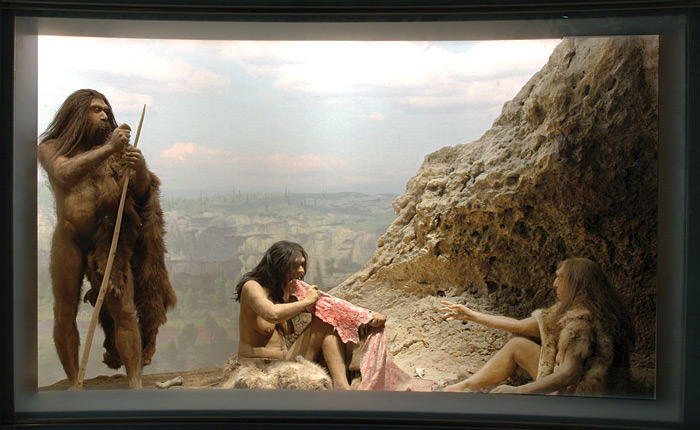
Do Neandertals Disprove Day Six Creation?

The evolutionary claim is that Neandertals split from the lineage of humans about 500,000 years ago, and are an ancestor of humans (homo sapiens) which constitute a link between us and ape ancestors. We can include the newly “discovered” lineage of Denisovans as well, a particular DNA from archaic man that appears to have fingerprints in modern DNA. The Neandertal DNA is found, too, in the modern human genome, which shows that interbreeding took place between them and us.

Let us look at three possibilities:

  1. Atheistic evolution is true, and these groups must be 500,000 year old links to our ape-like ancestral past.
  2. Progressive or ‘old-earth’ creation is true, which means these were pre-Adamic soulless non-humans, or that man existed, lived and died, long before the fall.
  3. Man was created on day 6 of creation, and these are simply humans.

1. If atheistic evolution is true, we would need to be confident in our ever-changing timeline based on each conflicting fossil discovery. But modern evolutionists such as Evolutionist Donald Johanson, discoverer of the “Lucy” Australopithecus, said this about Neandertal:

“From a collection of modern human skulls Huxley was able to select a series with features leading ‘by insensible gradations’ from an average modern specimen to the Neandertal skull. In other words, it wasn’t qualitatively different from present-day Homo sapiens.”

Prof. Clive Finlayson of the Gibraltar Museum, an evolutionist, says the scientific community will have to accept that the Denisovans, like Neandertals, were, like us, Homo sapiens.

If this is true, on an evolutionary timeline, we have broader acceptance of humans being humans, having interbred, and moved about the world as merely people groups of the same homo sapien species for the last 500,000 years, with still no connection to apes. Hence, we are only examining the genetic interbreeding of different people groups from different parts of the world.

But were Neandertals truly like us? Consider the archaeological evidence, discovered and corroborated regardless of belief in an intelligent designer:

Tools make of stone.

Leather working skills.

Ability to control fire, and make pitch.

They had jewelry.

They used make-up (cosmetics).

They had culinary skills, and used herbs to spice food.

Burial customs for the dead.

They had an understanding of music, and instruments.

They made glue.

Understanding of architecture, even building large structures underground.

Care for the disabled among them (evidence shows some members of the community living long past an injury).

Created shelters, much like native Americans, covered with animal skins.

Evidence of a voice box (they could speak to each other).

This to me does not sound like a group of evolving apes based on evidence, and there is no need to even assert biblical beliefs to conclude this.

2. If Old Earth creation or progressive creation is true, then we must ask of the timeline. Adding the dates of the bible, even with a liberal understanding of its chronology, you cannot add up the dates and get to 10,000 years, 100,000 years, or the 500,000 years that Neandertals supposedly lived. Stretching out the lineage in this case is of no help. The progressive creationist must accept secular dating. Therefore they must decide if Neandertal is a soulless non-human, (can’t be true based on their ability to breed with modern humans, making them the same created kind), or if they lived and died for half a million years to bring about God’s timeline in dealing with modern man.

I have mentioned Frank Turek many times in my writing, and he continues to be a wonderful apologist, well spoken, and so very smart. I have the utmost respect for him, and his Cross Examined ministry. But as he does not prescribe to a biblical timeline for the universe, I still find myself in conflict with him on this point. I bring him up now, because I just watched him in a debate with atheist Michael Shermer. Frank was amazing as always, articulate and logical, and only got backed into a corner at one point. And that was when Michael had the wherewithal to press Frank on the millions of years problem. Shermer asked, “…Christianity began about two thousand years ago, what was God doing that 99.99% of all that time, if this is all beautifully designed and elegant[ly], teleological and purposeful, and it’s all here for us so that we would be here, boom, here we are, why the 13.7 billion years of nothing, and then, I think I’ll send my son to this desert place in the bronze age culture… and I’ll give them the message?”

He goes on to ask of the supposed souls of Neandertals, of Australopithecus, all the way down to his dog. Frank, normally confident, was stymied, and forced to quip back with sub-par responses, because his world view on this point does not line up with scripture. Death before sin, of course. But Shermer’s point is obvious, and engaging, and yes, logical! Why indeed would an all-powerful God mill about for 13 billion years then finally deliver a message 2000 years ago. What a cosmic waste of time for a God who can create from nothing, who is love, who desires a relationship with us. From a biblical perspective it makes no sense.

Dr. Turek was forced to take a weak position, responded first with a joke, and say blandly that yes Christ died for the Neanderthals if they had a capacity to make moral decisions, as well as Lucy, and homo erectus. He is correct in asserting that Christ’s sacrifice was retroactive, and still based on faith retroactively, but now you have a sub-species of ancient man who didn’t make the morality cut off line, who perhaps didn’t have souls, and who were so far from homo sapiens that they would have no capacity for religion. More than that, you have now inadvertently implied that religion is a modern (aka man-made) construct that had no relevance to certain ancient groups. Apparently God was sitting back and watching them live, and die, until they became moral enough to start interacting with them, a process He decided to start only 6000 years ago.

God also revealed to us by special revelation (God-breathed word, the Bible) that by one man, Adam, sin entered into the world. A pre-Adamite group who suffered the penalty of sin (death) for millions of years before the fall would make this claim a lie, and would therefore be heretical. It would seem that once again, if man’s interpretation of data is accepted, based on the pre-supposition that we evolved, it would clearly undermine the authority of scripture. When even brilliant men like Dr. Turek, and Dr. Ross try to blend the two, it inevitably waters down the word of God.

3. Since Neandertal DNA is present in modern man, the interbreeding indicates they were in fact the same species, just a different people group. If these are robust post-flood, post Babel decedents of Adam, then all of the evidence fits perfectly. They lived and died as human beings, nomadic for a time, in a world that was just destroyed in deluge and was unsettled. They suffered from malnutrition, buried their dead, and exhibited normal tribal behaviors. Furthermore, they were alive at a time where the bible records long life (hundreds of years), which explains robustness of the skull and skeleton, and is backed by scientific understanding of the changing oxygen, air pressure, and magnetism of that time as compared to present day.

Once again we find that logic and evidence answers the riddle of Neandertal using a biblical framework with relative ease. The historicity of the word of God continues to be a tremendous source for understanding the ancient pre and post flood world.