Unholy Trinity

The legend of the first unholy trinity is an approximate history around the time of Babel. A nexus that would have dire consequences for all remaining time. People often ask if Christianity has borrowed its truths from other myths and cultures, but the bible tells us “…we wrestle not against flesh and blood, but against principalities, against powers, against the rulers of the darkness of this world, against spiritual wickedness in high places.” (Ephesians 6:12) It is my opinion that every false and opposing religion that detracts from the truth of the gospel has been orchestrated by such powers, and that casting doubt on a plan of redemption known about since the Garden of Eden is an efficient way for enemies of God to muddy waters. Let’s take a look back in time at this important period, where many lies began.

Noah landed on the mountains of Ararat after the flood around 2350 BC, and our greatest geological features were laid down all over the world. Mountain ranges and gorges were formed, as great spillways washed millions of tons of sediment into oceans. Animals were swirled and broken and buried all over the earth, creating fossil graveyards, placing whale bones in deserts, and burying sea creatures on every continent high above sea level. Pillow lava formed great swatches of land, fault lines settled and cooled, and sedimentary layers were deposited over vast areas of the world. One such rock layer called the Cretaceous chalk beds of southern England can be traced to Ireland, across France and Germany, down to Israel and Egypt, and remarkably all the way to the mid-west United States, all having the same distinctive strata both above and below, and the same fossils within, an impossibility without the world-wide, calamitous flood of Noah. Mud and rock travelled hundreds of miles, exposing layers on canyon walls that had no erosion between, indicating catastrophe and rapid burial. From a Niagara Falls that would not exist had it millions of years to run its course, to the limiting factors of the Sahara Desert and the Great Barrier Reef, I unabashedly believe the great deluge of Noah’s day formed the world we see now.

            Biblicists can trace all mankind back to that very ark. But the perfect world God had created was no more. You remember your Genesis, yes? Men lived to 900 years old. But the sky fell, the atmosphere changed, and the days of men were reduced. Going by a biblical timeline, people forget that it did not happen right away. This meant that the earliest patriarchs, such as Shem who lived to 600, Heber who lived to 464 years, Terah who lived to 205 years, would have been revered, even idolized by generations of people. Just for reference, Noah who died in 1998 BC could have known a two year old Abram (Abraham) if he had been in the same city. This would have been his great, great, great, great, great, great, great, great grandfather.

            Certainly, if those of the line of Christ lived so long, other lines did as well. As beautifully complete a history as the bible is, it is only a history of the Hebrew nation. But Ham, and Japheth had sons and daughters, and it is quite conceivable that men of old who desired adoration let themselves be perceived as gods. Consider, according to Genesis chapter 10, Ham begat Cush, who begat Nimrod. It says Nimrod was a mighty one in the earth, and the beginning of his kingdom was Babel where history records severe idolatry. He then establishes Erech, and Accad, and Calneh, in the land of Shinar, which makes up the Khabur Triangle.

The pieces of the legend begin with what we know from the word of God. In Babel, Nimrod, as this mighty hunter, wished to erect a tower. This building of a great tower was not for the worship of God, but rather in the face of God, and for man’s own exaltation and benefit. Nimrod, this self-proclaimed god-man, was the impetus behind its construction, for the sole purpose of challenging heaven with glorified self. The languages were confused, and the people were dispersed. But they all learned the same wrong way to worship, and all had the same champions to idolize.

            There is no way to get this next part exactly right, for no ancient history of any peoples is even minutely comparable to the continuous and specific history of the Hebrew witnesses. Archeology often misses this, and it is to their peril, rather than the bible’s. No scholar worth his salt would dismiss biblical records over that of the incomplete, disfigured records of any other culture. And this is not a small point; Hebrews are the only ancient culture to have told the truth when logging their own defeats. The common practice was for losses to be erased from history, so that civilizations, such as Egyptian, Mesopotamian, Assyrian, could retain their perceived glory. But we know who glory belongs to, don’t we?

                        The bible tells us that Nimrod established the next cities, and history says Ninus established cities as well, Nineveh being one of them. Legend says that along the way, Nimrod picked up a bride named Semiramis. Some construed she was found on the street, perhaps engaging in the ‘oldest known profession’. No one knows for sure. But as men followed Nimrod for his prowess and civic leadership, the same citizenry looked to her for guidance in spirituality. Nimrod gave her the reigns as queen, allowing her to control the hearts of men.

            The kingdoms that were established delved into debauchery. It was the beginning of opiates, and prostitution, and revelries of questionable intensions. There was of course drinking, and plenty of gossipy scandal, but worse than that were the sacrifices made under the guise of religious fervor. Virgins and I’m sorry to say, first born sacrifices were common occurrences. Amidst the cultish practices run amuck, Semiramis became pregnant. Now, who could say if it was Nimrod’s baby, or one of the frequent guests of the palace beds? There is insinuation, however, that the coup which ensued to avoid aspersion was also an epic power play, and quite possibly the most damaging thing the devil has ever concocted.

            One night during a banquet, an evening of wicked carousing, Semiramis stepped up the intensity in every way. It became a raucous and sexual affair, and the queen made sure that the wine flowed, and the hallucinogens were ardently consumed. At the peak of the celebration, she had convinced her husband to be the sacrifice for the evening. Folklore indicates that he willingly allowed for his limbs to be tied to horses in the courtyard, and in his stupor was convinced he would survive, or be reborn. He was not.

            Semiramis was not only the queen, but had become the high priestess of this ceremony, and when she gave the word, the party goers obeyed her wish, and goaded the horses into a frenzied gallop, ripping asunder the mighty king. Now, with a son in her belly, and her promising the king would return, she, like the Grinch, thought up a scheme, and thought it up quick. She promised that if his body was ripped apart and spread to the corners of Mesopotamia, or Shinar, then those cities who had a piece of Nimrod would flourish. She then, most promptly, asked for the pieces back, so she could reassemble her husband. She received almost every piece, if you believe the stories, save one. And based on Obelisk monuments built in his honor, I think you can guess which piece did not return to the palace. That’s right, it was his hand… Just kidding, it was his royal man-business.

            This, of course, disallowed her to perform the reanimation of her late husband, and she convinced the people that since he could not return, his spirit had instead entered the sun, and had become the sun god, Shamash, which later became Baal. Semiramis had her child, and named him Ninus. She also told tales about herself, to dispelled reports that she had been a mere prostitute, and had given birth to someone else’s baby. The myth that she had never been born a baby, but was instead divine, spread throughout the known world. The moon had given birth to her full grown after one of its 28 day cycles by floating a great egg down to the Euphrates River. One distortion suggests that she was birthed by the river, or by the sea, and came to shore on a large seashell, similar to the story the Greeks would adopt about their goddess Aphrodite. This of course meant that Ninus, or Tammuz, had now become the defacto son of a sun god and of a moon goddess. You would think that this would be enough distortion for one super villain, but it was not. The rumor was also spread that Ninus was in fact the reincarnation of Nimrod. This was the justification Semiramis used to marry him.

            The son of this trinity was known by many names, an amalgamation of real and fictional leaders throughout the ancient world. The name Ninus is not found in any cuneiform literature, the ancient writing of Mesopotamia, but Nineveh is ‘the city of Ninus’ in Greek, and Tammuz, his alternate name, is Akkadian, the language of Mesopotamian cultures such as Assyria and Babylon. He was known to be fond of rabbits, and also became a hunter like his father, which eventually led to his demise. The day came when he was killed by the wild boar he was hunting. The queen told the parishioners that a forty day period of sorrow each year prior to the anniversary of his death was to be recognized. During this time, no meat was to be eaten. Meditation on Tammuz was to be commenced, shown outwardly and publically by making a ‘T’ on ones chest. Semiramis, also known by her Akkadian name Ishtar (pronounced Easter), soon dedicated a day of celebration in spring to her growing and mysterious religion, revering the queen of heaven’s fertility and sexuality, and her birth from the full moon. It became the tradition, of course, to utilize eggs and rabbits, and to dine on a pig, the source of her son’s demise.

Semiramis was soon worshiped as the ‘queen of heaven’. In Babylon she built the first obelisk, 130 feet high, to honor the husband she destroyed with horses, which of course represents the non-returned phallus. It is interesting to note the obelisks that have been erected – if you will pardon the pun – in history, and by whom. The largest obelisk in the world, for example, is in front of the capitol building in Washington, D.C., the Washington Monument; certainly food for thought. The obelisk in front of St. Peter’s in Rome is one hundred thirty-two feet high and came from Heliopolis in Egypt, where Semiramis took the name Isis, and Ninus was known as Horus, or Osiris. The Egyptian mother and child were worshiped there, with the infant Osiris seated on his mother’s lap, an all too familiar image. The mother and the child. Countless Babylonian monuments show the goddess-mother Semiramis with a baby in her arms. After Babel, different names were applied. Just as Tammuz was an Akkadian name, so Semiramis had the Babylonian alias, Ishtar. Ancient Germans worshipped the virgin Hertha with child; Scandinavians called her Disa; in India, the mother and child were called Devaki and Krishna, and also Isi and Iswara; pagan Rome had Fortuna and Jupiter; in Greece, she was Ceres, or Irene, and he was Plutus; and in parts of Asia they were known as Cybele and Deoius. When Jesuit missionaries finally visited the Far East, they were incredulous to already find Madonna and child in Tibet, Japan, and also China, where Shing Moo was holding a child with glory around her head, painted as if it had been done by Italian artisans.

            The fallout from this tangle of lives reverberated through the ages, and in these three persons, you have the origin of false idols, polytheism, reincarnation, self worship, virgin and first born sacrifices, prostitution, paganism, and witchcraft. What took place there at Babel so long ago was arguably the most detrimental series of events to mankind’s salvation ever conducted. The unholy trinity of Nimrod, Ninus, and Semiramis saturated the globe with unhealthy rituals, and it peaked in influence when Babylon set the tone for the world. Babylon, Assyria, Ur, they all eventually fell, but the poison had already seeped into every culture. With the languages confused, man spread from that nexus of abomination, and walked aspects of all false religions to come across the earth. The worship of fabricated gods has been a tool of evil ever since these traditions were set in motion, and mankind has suffered in its wake. It was such anathema to the Lord’s will that He wrote

‘Ye shall have no other gods before Me’

with His very finger. A command often mistook, when it is not seen for the love and protection it provides.

In The Beginning: Survey of the Truth of Creation 5

ME 89326. (pictured here) ME 89326

This title, ME 89326 is the name given to classify this ancient relic, dated 2300 BC. It is also known as the Temptation Seal, and is an impression of a carving off a cylindrical seal of the Akkadian Empire. The Akkadian Empire was an ancient Mesopotamian Civilization, spawned in and around the city the Bible calls Akkad.

This piece is currently held at the British History Museum and was discovered in 1846. As we continue our study on the truth of creation, we look to pieces such as this to verify that yes indeed, the Adam and Eve story was circulating within different cultures, as reflected here in the artwork of an ancient people who were not Hebrews.

Of course, a secular museum would not encourage such beliefs, being of the presupposition that the story is certainly not real, and that the beginning of the Bible is not true history. As we have seen, and will continue to see, evolutionary presupposition will dictate what must and must not be, including what an obvious piece like this cannot represent. The notes at the British Museum accompanying this relic state: “…the seal belongs to the well known Akkadian periods 2300 BC, the dated palm and the snake may have fertility significance, there is no reason to connect them to the Adam and Eve Story.”

The insistence that this is not the Adam and Eve story being depicted is quite telling. Notice that these forensic scientists don’t even allow for that possibility, and want visitors to know that they would be undoubtedly in error to assume such a thing, since the museum knows for sure that it just can’t be about that.

So let us look at the picture. The museum suggests that the figure is a man (left) seated in front of a god (right, with headdress), and that some offering is taking place. The plant offering is to worship divine fertility.

The problem: Historically in this period, neither male nor female worshipers are ever shown seated before a god. They are always shown standing with arms up, praising. Another important difference is the worshiper is always depicted smaller in size than the god being worshiped.

Now, if we look at it from a biblical perspective, we have the oral narrative of mankind’s beginnings, which must have been passed down to every and all people from Noah’s family of 8, up until the tower of Babel. Afterwards, oral, written, and artistic depictions of these same narratives, flood legends, creation, and the fall are recorded. In this case, in Mesopotamia, we have a simple enough depiction which was more than likely carved on a cylinder only 300-400 years after the flood took place.

Two human beings, a male and a female, of equal stature, and having a familiar relationship, sit across from one another to eat a fruit. They both eat of the fruit, and behind the woman, as if to tempt her, is a serpent. Further extrapolation might note that the tree is of great importance, central to the depiction, and has seven branches, the number of God and divinity.

It is hard to imagine the events of Adam and Eve being depicted more concisely then this.

Survey 4

Survey 3

Survey 2

Survey 1

In The Beginning: Survey of the Truth of Creation 4

The Torah, the first five books of the bible is written as a historical narrative. Often referred to as The Law, the Pentateuch, it sets the foundation of not only the beginning of the line of Christ, but also the beginnings of mankind, giving us insight into many things we can observe today, such as languages, genetics, geology, and the fossil record. But who wrote it?

Many critics of the bible assert that Genesis was written long after Moses, and Abraham, that it was written by the Jews in the 5th and 6th centuries BC, when The Jews went back after captivity to rebuild the temple. This would discredit the rich history, and mean that the Jews somehow borrowed and fabricated the narrative we see.

Let’s see what the bible has to say?

Luke 24

27 And beginning with Moses and all the Prophets, he interpreted to them in all the Scriptures the things concerning himself.

44 Then he said to them, “These are my words that I spoke to you while I was still with you, that everything written about me in the Law of Moses and the Prophets and the Psalms must be fulfilled.”

John 5

46 For if you believed Moses, you would believe me; for he wrote of me. 47 But if you do not believe his writings, how will you believe my words?”

John 7

19 Has not Moses given you the law? Yet none of you keeps the law. Why do you seek to kill me?”

Acts 3

22 Moses said, ‘The Lord God will raise up for you a prophet like me from your brothers. You shall listen to him in whatever he tells you

Does the bible clearly indicate who wrote the Law? If not Moses, who would you be disagreeing with?

What does it say within the Torah itself?

Exodus 17

4 Then the Lord said to Moses, “Write this as a memorial in a book and recite it in the ears of Joshua, that I will utterly blot out the memory of Amalek from under heaven.”

24:4 And Moses wrote down all the words of the Lord. He rose early in the morning and built an altar at the foot of the mountain, and twelve pillars, according to the twelve tribes of Israel.

34:27 And the Lord said to Moses, “Write these words, for in accordance with these words I have made a covenant with you and with Israel.”

It would appear that according to the law itself, Moses was asked to write these things down, and as we saw before, these writings were corroborated by Christ Himself. Does the rest of the Old Testament refer to the Law as well? Let’s see:

Joshua 1:8 (1405 BC) This Book of the Law shall not depart from your mouth, but you shall meditate on it day and night, so that you may be careful to do according to all that is written in it. For then you will make your way prosperous, and then you will have good success.

1 Kings 2: 1-3 (971 BC) When David’s time to die drew near, he commanded Solomon his son, saying, “I am about to go the way of all the earth. Be strong, and show yourself a man, and keep the charge of the Lord your God, walking in his ways and keeping his statutes, his commandments, his rules, and his testimonies, as it is written in the Law of Moses, that you may prosper in all that you do and wherever you turn,

2 Kings 14: 1-6 (Amaziah Reigned 796-767 BC) In the second year of Joash the son of Joahaz, king of Israel, Amaziah the son of Joash, king of Judah, began to reign. 2 He was twenty-five years old when he began to reign, and he reigned twenty-nine years in Jerusalem. His mother’s name was Jehoaddin of Jerusalem. 3 And he did what was right in the eyes of the Lord, yet not like David his father. He did in all things as Joash his father had done. 4 But the high places were not removed; the people still sacrificed and made offerings on the high places. 5 And as soon as the royal power was firmly in his hand, he struck down his servants who had struck down the king his father. 6 But he did not put to death the children of the murderers, according to what is written in the Book of the Law of Moses, where the Lord commanded, “Fathers shall not be put to death because of their children, nor shall children be put to death because of their fathers. But each one shall die for his own sin.”

As we can clearly see from a quick scan of the word, going back to the patriarchs of Jewish history, they had referred to the Law. If the minor prophets made it up later,  how would it makes sense that they were referring back to a Law that they were making up on the fly? Were they inventing a Law, and a history, that they were simultaneously struggling to keep? And what about Joshua, referring to it as far back as 1400 BC.

The minor prophets mention Moses and the Law many times:

Isaiah 12 times
Jeremiah 12 times
Ezekiel 6 times
Daniel 4 times
Malachi 5 times
Hosea 3 times
Amos, Micah, Habakkuk, Zephaniah, Haggai, Zechariah all mention it once.

The point of this stage of the lesson is this; if we disagree with the authorship of the Genesis account, we might as well disagree with the historicity of the entire collection of God’s word. But to do that, logically, we dismiss it’s many truths, fulfilled prophecies, eye witness details, archaeological supports, and many other facts which point to its veracity. They verify each other. Furthermore, the authorship of all 66 books spans a 1400 year period, so these are not co-conspirators. We presupposed the bible as truth in the first lesson, but obviously this puts firmly in your mind the position all the authors took in regards to the Torah. To dismiss the first five books as fable, or made-up would be folly. Plain and simple.


In The Beginning: Survey of the Truth of Creation 3

The scientific credentials that come with the name Stephen Hawking are great indeed. One of the greatest theoretical physicists of our time, cosmologist, a medical miracle in his own right, and accomplished author, and no one would question his intelligence. But does even he succumb to the pitfalls of of presupposition?

We have discussed in these blogs how alien life is assumed by many evolutionists, both as a form of creating life on this planet (panspermia), as well as a form of “just-so” science, because we “know evolution is true, and therefore it must also have happened elsewhere. Hawking had stated before he passed away that he felt mankind should be looking to escape the Earth, to find a way to leave it, and colonize elsewhere. This is caused by a world view quite different then that of a Christian theist.

Furthermore, Stephen Hawking wrote The Grand Design, and in it, agrees Universe appears to be highly fine tuned for life, had a beginning. In this book he states this: “This book is rooted in the concept of scientific determinism which implies… that there are no miracles or exceptions to the laws of nature.” – pg 34, The Grand Design, by Stephen Hawking.

We should listen, yes? Because he is a brilliant scientist? What is the problem here?

This is a philosophical assertion! Not at all a scientific one. You cannot determine this as a fact by way of a scientific experiment. How do we know, then? Because he said it. It is just so. Scientific Determinism is true, there are no miracles, therefore atheism must be true. Because he stated it.

Interestingly, his book also says, ““Free will is just an illusion.” – pg 32. This is reminiscent of his opinion in 1990 when Hawking determined we are not free, we are totally determined. If you are pre-wired to think the way you do,how can you make any truth claim? You don’t have the free will, according to Hawking himself, to make a truth claim, only produce a result caused by how stimulus is processed through a random brain. So based on his own philosophy, how could anyone trust any of his thoughts on truth at all? Is he not simply pre-wired to think the way he does?

The moment you make a truth claim, you violate determinism.

As much as they would like to deny it, materialists are forced to use philosophy, even as they deny using it. Philosophy always buries its undertakers. To deny it IS to use it. Science is Bound to philosophy and cannot be done without it. Assumptions must be made, and those can dramatically affect conclusions.

We must remember as Dr, Frank Turek says, science doesn’t actually say anything; SCIENTISTS DO! All data must be interpreted.

Let us look at an example of how we must interpret data. The Eiffel tower has demonstrable, testable attributes. Some of these are:

1,063 ft tall
Wrought Iron Lattice Tower
Weight is 10,100 tons
Located on the Champ de Mars in Paris, France

If one were inclined, one could test and re-test for the accuracy of any of these statements. But what about these facts?

Engineer was Gustave Eiffel
Finished in 1889

How do we know these are correct? We must conclude them from trusted sources, yes? This means that we must find those historic, written sources to be accurate, not tampered with, and found to fit the proper historical context. No one questions these two facts, but it brings about an interesting point. The facts in this case must be believed; they are not testable, and repeatable. They are forensic in nature.

All history is this way, including Biblical history, Cryptology, Archeology, Criminal forensics, Geology, Paleontology, and Cosmology. We must collect data, and interpret it based on our pre-suppositions. Ken Ham, the creationist, pointed this out while teaching.

As a teacher, he found that whenever he taught the students what he thought were the “facts” for creation, then their other teacher would just reinterpret the facts. The students would then come back to him saying, “Well sir, you need to try again.”

Conversely, when he learned to teach his students how we interpret facts, and how interpretations are based on our presuppositions, then when the other teacher tried to reinterpret the facts, the students would challenge the teacher’s basic assumptions.

In The Beginning: Survey of the Truth of Creation 2

in-principio-genesis-15-15-part-15-defending-genesis-the-earth-was-without-form-and-voidGod uses natural causes, to be sure, but can they explain everything? A materialist atheist, and a Christian both believe in natural causes. Of course we can find causality through natural means. But what about things that are forensic in nature, meaning, those things that are not repeatable in a lab, or observable on any level, and more to the point, contradict what we DO observe! Such as the creation of matter? Life from non-life? Creation of new elements?

Things that cannot be explained by science. – aesthetics, ethics, mathematics and logic, metaphysical truths (like there are other minds then my own).

In the 1700’s, David Hume was a Scottish Enlightenment philosopher, historian, economist, and essayist, who is best known today for his highly influential system of philosophical empiricism, skepticism, and naturalism. Hume’s assertion was that things were only actually meaningful if, and only if: The truth claim is of abstract reasoning, such as 2+2=4, or all triangles have three sides; and the truth claim can be verified by the 5 senses. Norman Geisler defeated this by simply observing,  “The principle of empirical verifiability states that there are only two kinds of meaningful propositions: 1. those that are true by definition, and 2. those that are empirically verifiable. Since the principle of empirical verifiability is neither true by definition, nor empirically verifiable, it cannot be meaningful.” A slick idea met with the swift and brutal simplicity of logic.
Kant, another skeptic, said that you can’t know the real world. Of course, then how do you know that about the real world?

The theme here is that much of what we use to interpret and understand about life, the universe, creation, is based on our faith, and our presuppositions. An example:

“I speak from experience, being strongly subject to this fear myself: I want atheism to be true and am made uneasy by the fact that some of the most intelligent and well-informed people I know are religious believers. It isn’t just that I don’t believe in God and, naturally, hope that I’m right in my belief. It’s that I hope there is no God! I don’t want there to be a God; I don’t want the universe to be like that. My guess is that this cosmic authority problem is not a rare condition and that it is responsible for much of the scientism and reductionism of our time. One of the tendencies it supports is the ludicrous overuse of evolutionary biology to explain everything about human life, including everything about the human mind …. This is a somewhat ridiculous situation …. it is just as irrational to be influenced in one’s beliefs by the hope that God does not exist as by the hope that God does exist” – Nagel, Thomas, The Last Word, pp. 130–131, Oxford University Press, 1997. Dr Nagel (1937– ) is Professor of Philosophy and Law at New York University.

I posed this question to the class; does it appear that this person’s conclusions would be influenced by his presuppositions?

Another fantastic example is from Dr. Steven Stanley, (Bioscience, vol. 36 (Dec 1986) p. 725. paleontologist and evolutionary biologist), who specialized in punctuated equilibrium. This is the reaction to lack of evidence within Darwinism. Many scientists proposed that punctuated equilibrium explained things that could not be seen by evidence, namely, that animals mutated quickly into other species, thereby leaving no evidence within the fossil record. He said, “Evolution happens rapidly in small, localized populations, so we’re not likely to see it in the fossil record.” Now, we ask again, is this conclusion based on science? He is literally claiming evolutionary change has occurred between the rock layers, where we find no evidence! Safe to say that Stanley had already made up his mind that evolution was true, and since he “knows” this, has proposed a non-scientific model to explain it.

Lastly, for this portion of the lesson, we will look at a notorious quote from Dr. Richard Charles Lewontin, Columbia University is an American evolutionary biologist, geneticist, academic and social commentator. “Our willingness to accept scientific claims that are against common sense is the key to an understanding of the real struggle between science and the supernatural. We take the side of science in spite of the patent absurdity of some of its constructs, in spite of its failure to fulfill many of its extravagant promises of health and life, in spite of the tolerance of the scientific community for unsubstantiated just-so stories, because we have a prior commitment, a commitment to materialism. It is not that the methods and institutions of science somehow compel us to accept a material explanation of the phenomenal world, but, on the contrary, that we are forced by our a priori adherence to material causes to create an apparatus of investigation and a set of concepts that produce material explanations, no matter how counter-intuitive, no matter how mystifying to the uninitiated. Moreover, that materialism is absolute, for we cannot allow a Divine Foot in the door.

Posing the same question, do we honestly think an unbiased look at evidence would be likely here? Stated another way, if the truth did rest in the fact that God was a cause, could this type of “science” ever discover the truth?

More on Creation in part 3.

In The Beginning: Survey of the Truth of Creation 1

I am teaching through a series on Genesis at my church, as an 8 week course. After the classes, I will be posting the same lessons in article form on here, so anyone may follow along as we continue forward in our study of Genesis, its authenticity, and the historicity of Creation as recorded in our bibles.

This series will be predicated upon certain presuppositions from the outset. The examination of these presuppositions has been addressed in many previous writings.

The first presupposition for the class is that truth is knowable. This means that we have done away, as far as this series is concerned, with debate from the post-modernist or relativist agenda. A simple refutation lies in the answer to the common assertion: “there is no absolute truth!”

To which  someone should answer, “Is that absolutely true?” We turn the question on itself, and realize the self-defeating nature of relative truth very easily. Most post-modernist authors want to be exempt from their own conclusions.

C.S Lewis said, in regards to the philosophical first principles of truth, “These first principles of practical reason are fundamental to all knowledge and argument, to deny them is to deny knowledge itself.” In other words, if you deny truth exists, you can’t know anything, discover anything, determine anything. All knowledge would be rendered useless.

Secondly, we would stipulate that the Bible is the inspired word of God. There are many reasons for this of course, born out through history, testimony, archaeology. Although some supporting evidence may occur during the series, the focus is not to prove the Bible is God-breathed. We will stipulate that since it has already stood the tests of time and unrelenting scrutiny, the Bible, is

John 17:17 Sanctify them by the truth; your word is truth.

2 Timothy 3:16 All Scripture is God-breathed and is useful for teaching, rebuking, correcting and training in righteousness, 17 so that the servant of God[a] may be thoroughly equipped for every good work.

2 Peter 1:20 Above all, you must understand that no prophecy of Scripture came about by the prophet’s own interpretation of things. 21 For prophecy never had its origin in the human will, but prophets, though human, spoke from God as they were carried along by the Holy Spirit.

Thirdly, we would embark on the series looking at the world from a biblical world view.  What we believe determines how we behave. This means that if our presupposition is that atheism, or evolution is true, and the only possible creative mechanism, this determines how we see the world. If God is possible, even probable, making more logical sense in the end anyway, then this allows of the possibility that the bible is true history, miracles are possible, and that determinism cannot and will not explain the existence of time, space and matter.

Need we look at everything then, as religion vs science?

Absolutely not! Science is the search for causes, essentially. Observations in our natural world SHOULD line up with the word. This means that we do not commit the folly of excluding the possibility of God, by adhering to evolutionary presuppositions, and saying things are “just so”.“Just-So Science” example: We know that life arose from non-life because we know that it is so, because evolution is true.

If nature had a beginning, then how can the cause be something natural, since nature didn’t exist. Nature was the effect. Therefore the cause must be beyond nature, or supernatural.

I do not have all the answers, (another stipulation). Yes I have a passion for this material, and the study, but I’m not a scientist or a doctor. But it would be my heart’s desire for you to walk away from the series,  and be able to stand tall and say, I am a bible thumping Christian, I believe the bible from cover to cover, and make no apology for that. Hopefully a tool of discipleship. At the very least, perhaps it helps people think of things they had not considered before.

To be continued in part 2.

Our Amazing Moon

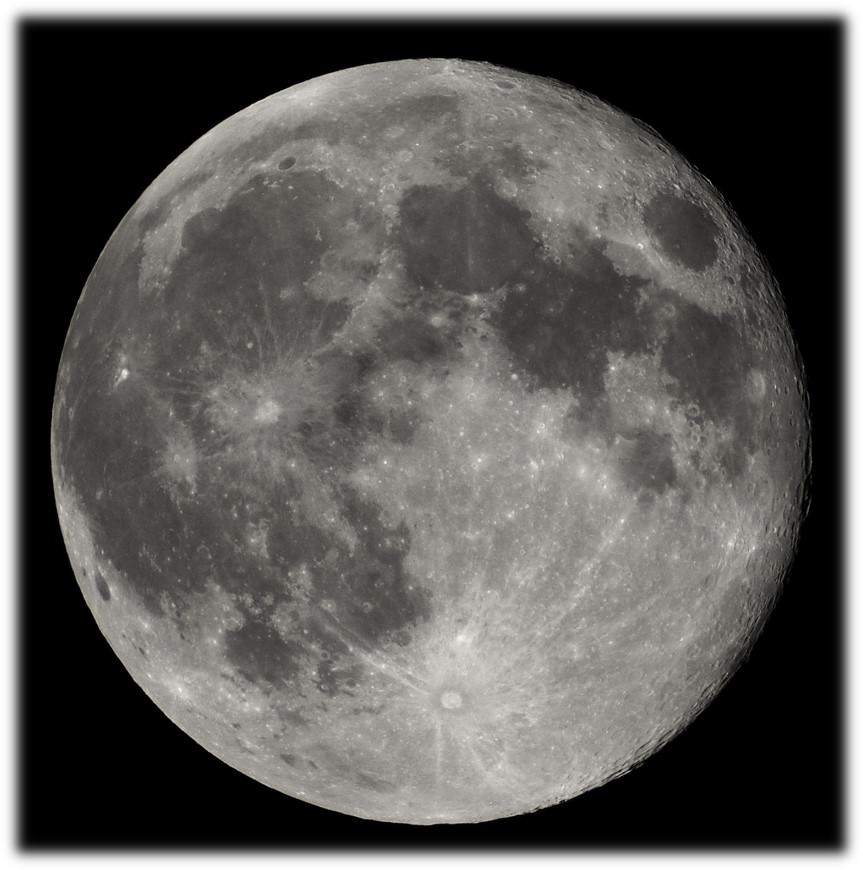
In studying Picture1and familiarizing myself with more “Goldilocks” factors, or factors necessary for life to exist on this planet, I am reminded of some basics, considerations I was amazed and entertained by in my youth, but have since forgotten or dismissed. I remember leafing through science books about oceans, and volcanoes, and animals, endlessly looking at pictures and enjoying all the wonders of nature. One of my favorite science books was the one on our solar system; our sun, our nine planets (Pluto wasn’t under the scrutiny it faces these days), and our amazing moon.
Genesis 1:14 Then God said, “Let there be lights in the firmament of the heavens to divide the day from the night; and let them be for signs and seasons, and for days and years; 15 and let them be for lights in the firmament of the heavens to give light on the earth”; and it was so. 16 Then God made two great lights: the greater light to rule the day, and the lesser light to rule the night. He made the stars also. 17 God set them in the firmament of the heavens to give light on the earth, 18 and to rule over the day and over the night, and to divide the light from the darkness. And God saw that it was good. 19 So the evening and the morning were the fourth day.

There are so many studies we could do on Genesis chapter 1, but one interesting thing to note is that many critics of the bible levy a charge against it that it simply borrowed creation accounts from other ancient cultures, such as Babylonian. I recommend studying that charge, as it is pretty easy to debunk. But note that those other stories from other peoples use terms for the sun and moon.

Babylon names them Shamash (sun) and Sin (moon). If we go farther back, to the Sumerians, their references to the moon-god are Sin, and Nanna. The sun was Utu, and Venus was Iananna, and since these were moon worshipping cultures, the writings say that these two objects were the children of our moon.

Clearly these ideas could not have given rise to our Genesis account, and any attempt to accuse such can be dismissed with a simple reading of the text. But note that at this point in history, these objects in our sky had already been named. It is intriguing to me that in our account, it simply states, “a greater light” (maor gadol) and “a lesser light” (maor qaton). It states they are there, made, and simply describes them. Genesis does not name either the sun, or the moon, because when that portion of Genesis was written, they had not yet been given names!

The names of these celestial bodies were given long after, by the Sumerians post-flood. The bible does not use names for them until Genesis 15 -Shemesh, the Babylonian name- and Genesis 37 – Yareah, a Canaanite name. This is great literary evidence that the first chapter of Genesis was written long before the myths of pagan cultures.

Our moon is a compass, a clock, a calendar, and a nightlight. Its distance and size is designed perfectly to provide a gravity that interacts with Earth’s, and regulates her tilt. It also keeps our oceans healthy, and regulates biorhythms. It is easy to understand how such a wonderful creation could be misunderstood and idolized by primitive peoples. But as Romans 1:25 tells us, mankind still falls into this trap today:

“Who changed the truth of God into a lie, and worshiped and served the created things more than the Creator, who is blessed for ever. Amen.”

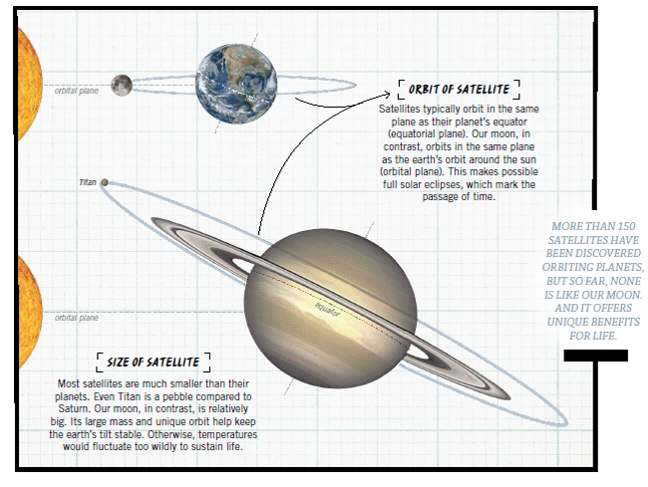
The moon is 238,900 miles from Earth, a particular distance that allows it, on its particular Picture2orbit to do something extraordinary, create eclipses. I say particular because typically satellites orbit around their planet’s equator. Since our earth is tilted at approximately 23.4 degrees, this would send the moon up and down rather than along the same plane as the sun. Instead, God had it orbit in perfect alignment with the earth’s orbit around the sun, regardless of the earth’s tilt.

It also has a particular size. The sun is 400 times larger than the moon, while the sun is exactly 400 times farther away! The result is that from Earth, they appear to be the same size. And when its orbit around Earth takes the Moon directly between Earth and the Sun, the Moon blocks our view of the Sun in what we call a solar eclipse. Considering the enormity of these bodies, and trying to fathom their perfect timing, size, and placement, that allows us on earth to appreciate their splendor that much more, I would be a fool as a cosmologist to not believe in an all-powerful creator God.

Psalms 19:1
The heavens are telling of the glory of God; And their expanse is declaring the work of His hands

Unfortunately though, that is precisely what many cosmologists are doing. The evolutionary mindset of many sciences has blinded them into thinking that despite all this perfect order, what they see is nothing more than blind chance, accidental, coincidental luck.

They cling to the dying theory of molecules-to-man evolution so faithfully that it forces the prevailing theories on the moon’s origin to be laughable. This is NASA’s theory as it stands today. This is literally what they believe, or try to believe, and condone teaching to students. This is what hoping there is no God looks like:

“The leading theory of the moon’s origin is that a Mars-sized body collided with Earth about 4.5 billion years ago. The resulting debris from both Earth and the impactor accumulated to form our natural satellite 239,000 miles (384,000 kilometers) away. The newly formed moon was in a molten state, but within about 100 million years, most of the global “magma ocean” had crystallized, with less-dense rocks floating upward and eventually forming the lunar crust. ” – NASA, (http://moon.nasa.gov/about.cfm)

Did you get that? A planet sized body collided with ours and formed a molten moon from the accumulating debris of an impact, in its perfect position, a perfect distance away, and didn’t destroy the earth in the process. And people laugh at my biblical beliefs!

Aside from the insurmountable ridiculousness of our leading cosmology theory, we run into another problem called lunar regression. It has been ascertained that the moon is slowly drifting away from the Earth at a rate of about 1.5 inches per year. Now, if we consider this drift from the presupposition that the bible’s chronology is accurate, after 6000 years or so this equates to moving the moon only 250 meters. Not a big deal.

However if, like NASA is declaring, the moon was blasted out of the Earth and somehow ended up in orbit 4 billion years ago, was it drifting the whole time? If we reverse the 1.5 inch drift over a period of  only 1.5 billion years (I say only, due to the vast ages applied to evolutionary theory) we reach what scientists refer to as “Roche’s Limit”. This puts the moon only 11,500 miles from the Earth, at which point, Roche calculated that the gravity of the two bodies would rip each other apart. This does not bode well for the theory that the moon could survive being blasted off the side of our planet. It also does not bode well for the moon’s age, which is purported to be 4 billion years old. This limiting factor of 1.5 billion years continues to baffle those who hope our beautifully arranged solar system has come about by mere chance.

In addition to this Roche Limit, it was also calculated (to further complicate the scenario) that the closer the moon was to the Earth, the faster the lunar regression would be, due to the Earth’s gravitational pull and spin ‘flinging’ the moon away faster. This means that we now have to account for even more regression in the past, and two bodies that cannot be too close.

And one final consideration. If Lunar regression puts the moon insanely close to the Earth a billion years ago -95% closer! –  and somehow scientists can bypass the reality of Roche’s Limit, what would gravity do to the tides of the oceans? Would the moon’s gravity flood the earth twice a day via global catastrophic flooding in a constant, destructive, never-ending, muddy, violent, perpetual water event? We already know evolutionists don’t believe in a global flood, right? (snicker snicker). But we would somehow have to explain how life not only came about and survived in this harsh environment, but also how it continued to thrive and evolve into more and more complexity.

I am glad it is not my challenge to solve, as I comfortably rest on the truth of God’s word. I can look up at the night sky, and feel blessed to look upon the heavens, and our amazing moon, and know that despite my sin, He loved me anyways.

Romans 8:37 Yet in all these things we are more than conquerors through Him who loved us. 38 For I am persuaded that neither death nor life, nor angels nor principalities nor powers, nor things present nor things to come, 39 nor height nor depth, nor any other created thing, shall be able to separate us from the love of God which is in Christ Jesus our Lord.

Goodnight Moon.